Is spray drying cost-effective?
Spray drying is a versatile and widely adopted technique for converting liquid materials into stable, dry powders. It is used extensively in the food, pharmaceutical, and chemical industries to produce products ranging from powdered dairy and nutraceuticals to active pharmaceutical ingredients and specialty chemicals. The process offers precise control over particle size, moisture content, and functional properties, making it suitable for both high-volume production and specialized formulations.
As industries continuously seek to optimize production efficiency, evaluating the economic viability of drying technologies has become a critical step in decision-making. This involves assessing capital investment, operational expenses, and product quality outcomes, as well as comparing spray drying with alternative methods such as freeze drying. Here we examine the main cost components of spray drying and provide a detailed comparison with freeze drying to help determine its economic viability.
What is the cost of a spray dryer?
The price of a commercial spray dryer can vary meaningfully depending on capacity, level of automation, and intended application. Large-scale industrial units designed for continuous, high-volume output can cost several million dollars, while smaller, specialized units for niche production may be available at a fraction of that price. This variation reflects differences in complexity, construction materials, and engineering standards required for each sector.
Pharmaceutical spray drying equipment must meet stringent regulatory requirements. Pharmaceutical-grade dryers require features like advanced sterility controls, closed-loop systems, and containment measures to comply with Good Manufacturing Practices (GMP). These features are crucial for protecting product integrity, preventing contamination, and ensuring patient safety, but they increase the capital expenditure and pharma spray drying cost significantly. Moreover, these systems often need clean-in-place (CIP) functionality for sanitation between production runs, further increasing costs.
Similarly, food spray drying cost is influenced by the need for food-grade materials, sanitary design, and systems that facilitate thorough cleaning to prevent cross-contamination. In food production, spray dryers are often optimized for specific products such as milk powders, flavorings, or nutritional supplements, requiring careful design to maintain product quality while enabling efficient cleaning between production runs.
What is the cost of a pilot scale spray dryer?
Pilot-scale spray dryers typically range from $50,000 to over $500,000, depending on their capacity, level of automation, and specialized features. These systems are used extensively for product testing, process optimization, and early-stage research and development (R&D). By working at a smaller scale, companies can fine-tune their formulations, adjust process parameters, and validate product quality before committing to full-scale commercial production.
When considering pharma spray drying cost at pilot scale, additional investment is often required for systems capable of producing clinical-grade materials under regulatory compliance. Validating cleaning procedures, functioning within controlled environments, and use of specialized filtration systems may be required to meet strict health and safety standards.
For the food industry, pilot scale drying plays an essential role in product prototyping. Manufacturers can test new recipes, assess flavor retention, and verify physical properties without incurring the full operational cost of a large-scale production run.
It is important to note that the purchase price is only part of the investment. Operational costs such as preventive maintenance, utilities, consumables, and labor can considerably influence the overall cost of ownership.
Is spray drying cheaper than freeze drying?
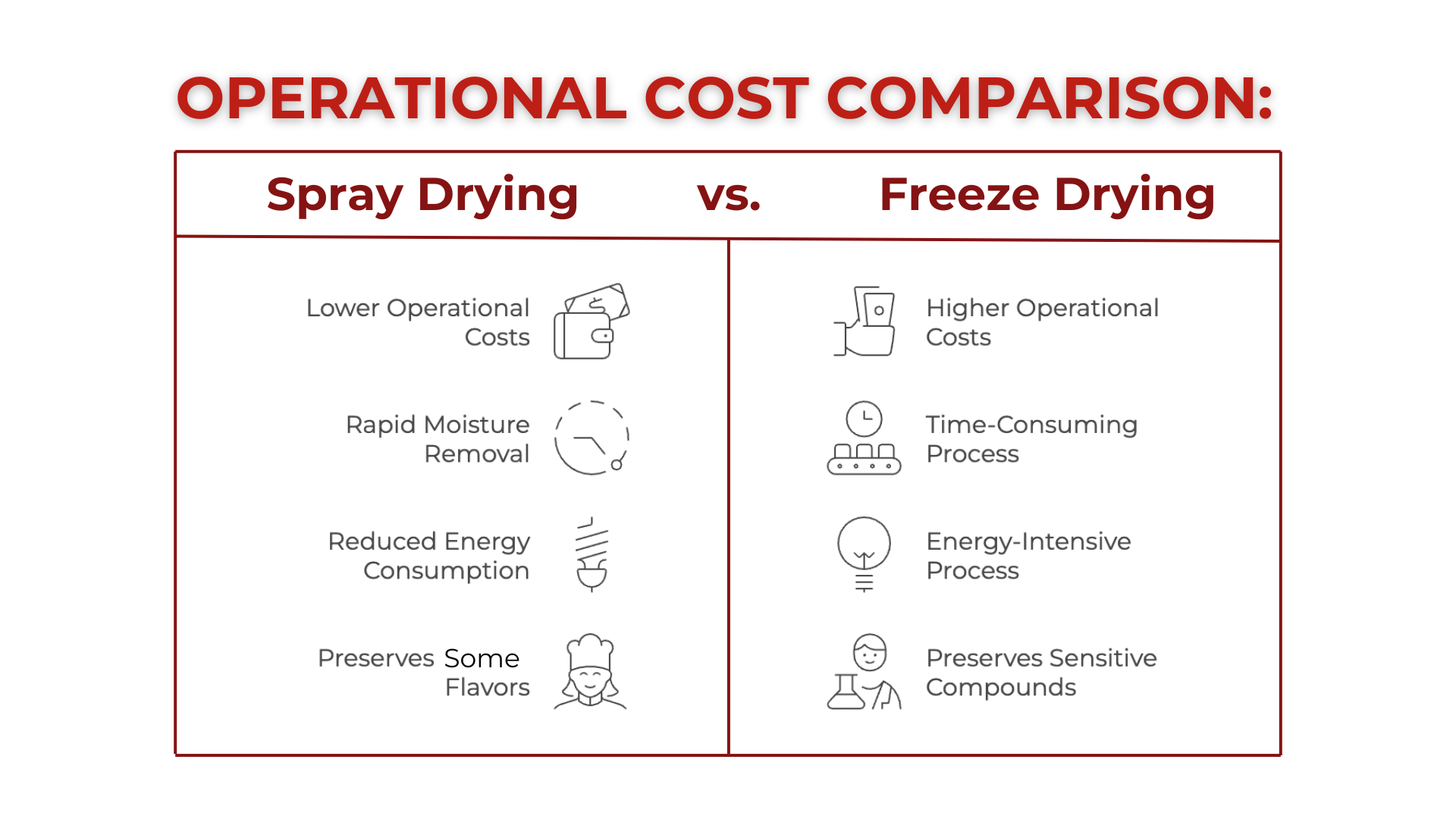
In many industrial applications, spray drying is more cost-efficient than freeze drying, particularly for large-scale operations. Freeze drying is known for preserving sensitive compounds and extending product shelf life. However, it is time-consuming, energy-intensive, and requires costly refrigeration and vacuum systems. For example, freezing the product and then using vacuum sublimation to remove water requires extensive refrigeration and vacuum equipment. Such operational inefficiencies make freeze drying less cost-effective for large-scale manufacturing compared to the rapid moisture removal used in spray drying, which significantly reduces energy consumption and processing time.
Spray drying offers further advantages in speed, scalability, and operational efficiency. It can remove over 90% of a product’s moisture content in a matter of seconds, making it ideal for high-throughput manufacturing. For example, pulse atomization spray drying has been documented to achieve fuel energy consumption of 1600 BTU/pound water evaporated for certain applications.
When addressing the question “Is spray drying expensive?”, the answer depends on the scope and scale of production. While initial equipment costs can be substantial, ongoing operational expenses are generally lower than those for freeze drying. This is due to higher throughput, reduced energy use per kilogram of product, and shorter processing times.
A useful consumer-level comparison involves how much does it cost to run a Harvest Right Freeze Dryer. Although these small-scale units vary in cost depending on size and usage, they illustrate freeze drying’s higher energy and time demands. In commercial settings, the need for powerful refrigeration and vacuum systems further increases operational costs, extending batch cycles and limiting throughput.
Spray drying, by contrast, can handle large volumes quickly while preserving volatile flavors and functional properties, making it well-suited to applications in both food and pharmaceuticals. Additionally, innovations such as pulse atomization spray drying have improved the process by increasing operational efficiency, reducing energy use, minimizing protein denaturation, and enhancing overall powder quality.
Conclusion
Spray drying remains one of the most efficient and commercially advantageous drying methods, particularly in food, pharmaceutical, and chemical industries. Its ability to combine high throughput, precise product quality control, and lower operational costs per unit makes it an ideal alternative to freeze drying, especially in high-volume production.
Technological advancements such as pulse drying have further strengthened its economic appeal, delivering improved energy efficiency and product performance while maximizing yield. For organizations seeking to optimize drying processes, reduce costs, and maintain high product standards, spray drying offers a compelling balance of performance and value.
To explore how advanced spray drying solutions can meet your production needs and deliver a competitive advantage, contact the PULSE DRYING SYSTEMS team for a customized cost and performance assessment.