Spray Drying vs Freeze Drying
Choosing the optimal drying method for food and pharmaceutical products is essential for manufacturers seeking to balance product quality, operational efficiency, and economic viability. Two prominent drying technologies often considered are spray drying vs freeze drying (lyophilization), each having distinct processes, advantages, disadvantages, applications, and cost implications. Understanding these differences is critical for selecting the best method tailored for specific needs.
What is the difference between spray drying and freeze drying?
The main distinction between spray drying vs freeze drying involves the processes and conditions used to achieve moisture removal. Spray drying is a high-temperature process that atomizes a liquid feed into fine droplets, rapidly evaporating water with hot air or – in the case of heat-sensitive proteins – a few seconds of superheated steam. Spray dryer principles of operation involve droplet formation, contact with hot gas, and quick particle solidification, making it ideal for large-scale powder production.
Freeze drying operates at very low temperatures and under a vacuum, removing water by sublimation directly from its solid state. While slower and more energy-intensive, it preserves structure, bioactivity, and delicate product qualities.
Spray drying is common in dairy powders, nutraceuticals, chemicals, minerals, and pharmaceuticals; freeze drying is preferred for high-value, heat-sensitive products such as vaccines, therapeutic proteins, and premium foods.
How does freeze drying work?
Freeze drying maintains structure and chemical stability through three stages:
- Freezing – Rapid cooling of the product solidifies water into crystals. Cooling rate influences crystal size and the product’s final structure.
- Primary drying (sublimation) – Under vacuum, gentle heat turns ice directly into vapor, which is collected on a condenser. Product temperature must stay below the collapse or melting points.
- Secondary drying (desorption) – Additional heat under vacuum removes bound water to levels below 1–3%, ensuring stability and extended shelf life.
Additionally, the question “What is the spray freeze drying method?” refers to a process that combines atomization with freezing and sublimation, resulting in powders with excellent morphology and high volatile retention. Its application is to high-value products like coffee powder, whey protein powder, fruit juices, whole milk powder, and egg albumin. Small spray freeze drying equipment can accelerate drying compared to conventional bulk methods.
Required equipment includes a temperature-controlled chamber, vacuum system, and condenser. A key challenge is batch heterogeneity, where variations in moisture and temperature require careful process control to maintain consistent quality.
How does spray drying work?
Spray drying is a continuous process that transforms liquid feeds, solutions, emulsions, or suspensions, into powders. The feed is atomized into fine droplets that enter a drying chamber, where hot air or superheated steam evaporates the moisture. Dried particles are collected via cyclones or bag filters.
The spray drying microencapsulation process protects sensitive components like flavors, vitamins, oils, and bioactives by embedding them in a protective matrix during drying, preventing oxidation, degradation, and flavor loss.
Advanced systems allow precise particle control, creating specialized structures such as hollow salt particles for enhanced taste or powders within situ crystallization for targeted functionality. Standard dryers produce droplets tens to hundreds of microns in size, while monodisperse droplet spray drying offers tighter control. Pulse atomization spray drying uses high-temperature pulsating jets to atomize and dry simultaneously, producing low-moisture powders with minimal heat damage to sensitive proteins.
Is a freeze dryer better than a spray dryer?
The choice between freeze and spray dryer technologies depends on product characteristics, quality requirements, and cost. Freeze drying excels in quality retention, shelf life, and functional properties for heat-sensitive, high-value materials. But how does freeze drying preserve nutrients, taste, and texture better than other methods? The key is by removing water from the frozen state, it avoids high temperatures and liquid-phase transitions that can degrade nutrients, alter texture, or cause shrinkage. This makes it ideal for delicate foods and pharmaceuticals, such as viral vaccines.
Spray drying offers scalability, speed, and cost efficiency, making it suitable for large-scale production of more thermally stable products. Advanced methods like Pulse Drying Systems, reduce protein denaturation by limiting high-heat exposure, enabling high-quality powders for sensitive proteins.
For premium products requiring maximum preservation, freeze drying is preferred. For high-volume, cost-sensitive production, spray drying is generally the better option.
Spray drying vs freeze drying cost
A cost comparison between spray drying vs freeze drying shows major differences in capital investment, operating expenses, and maintenance due to their distinct operational principles.
Freeze drying is expensive, involving high capital costs for low-temperature, high-vacuum equipment such as refrigeration systems and vacuum pumps. Operating costs are also substantial resulting from the energy required to maintain low temperatures and vacuum for long periods. A batch cycle for pharmaceuticals can be costly, but the premium quality achieved (e.g., preservation of delicate biologicals) often justifies it for high-value products.
Spray drying is generally more economical for large-scale production. Capital costs can be lower, and continuous operation allows higher throughput. Operating costs are lower because the process is faster, and energy use per unit of water evaporated can be more efficient, e.g.,pulse atomization spray drying reports up to 1500 BTU/pound water evaporated. Maintenance usually involves atomizer wear or powder collection, which is simpler than vacuum system upkeep.
Other factors influencing cost include scale, energy use, and processing time. Spray drying is more viable for large-scale production due to continuous operation and higher throughput.
What are the operating conditions for spray drying?
- Inlet/outlet temperatures – High inlets speed drying but must avoid product degradation.
- Feed rate – Controls drying load and energy use.
- Air flow rate – Affects heat and mass transfer.
- Particle size/concentration – Smaller droplets and higher solids improve efficiency.
- Drying medium – Hot air is common; superheated steam can enhance functionality but complicates separation.
- Configuration – Cocurrent protects heat-sensitive powders; countercurrent is more efficient but risks damage.
- Residence time – Must balance moisture removal with quality.
Optimizing these parameters can greatly improve profitability.
What are the disadvantages of Freeze Drying?
To understand what are the disadvantages of freeze drying (lyophilization), it is important to note several drawbacks that limit its applicability for large-scale manufacturing and use in certain products. These include:
- High Energy Consumption: Freeze drying is one of the most energy-intensive drying methods, involving the energy required to freeze the product, maintain low temperatures in the drying chamber, and operate the vacuum system and condenser for sublimation. This makes it meaningfully more expensive from an energy perspective compared to most other drying technologies.
- Long Processing Times: The sublimation process in primary drying and the desorption in secondary drying are inherently slow. Freeze-drying cycles can last for days, especially for large batches or products with high moisture content. This extended processing time increases operational costs and reduces throughput.
- Batch Heterogeneity: In processes like vial freeze-drying for pharmaceuticals, achieving uniform drying across an entire batch can be challenging due to variations in product temperature and residual water content in individual vials. This heterogeneity can lead to inconsistencies in final product quality, requiring more conservative control algorithms that further increase drying time.
- Fragility of Dried Product: While freeze-drying preserves structure, the resulting products, particularly gels, can be “fragile” with high porosity. This fragility makes them susceptible to damage from mechanical stress during handling, packaging, or subsequent processing.
- Risk of Product Damage: Despite being a low-temperature process, there is still a risk of product damage if the product temperature exceeds critical values during either primary or secondary drying – particularly the glass transition or collapse temperatures. This requires precise monitoring and control, as errors can lead to irreversible quality loss.
- Limitations for Large-Scale Manufacturing: The high costs, long durations, and batch-wise nature (for many applications) of freeze drying make it less suitable for high-volume, low-cost products. Moving from batch to continuous operation for biological and pharmaceutical products has been challenging despite its potential for process intensification.
When considering what are the drawbacks of freeze-drying in addition to the above, note that freeze drying does not inherently provide a “kill step” for microbiological contamination. Both vegetative and sporulate bacteria types may be preserved during the process. Therefore, an additional decontamination step is often required in industrial production lines to ensure product safety. In some cases, technologies like controlled sudden decompression (DIC) are proposed as alternatives. These can achieve product quality similar to freeze-dried products, at lower cost and with the desired decontamination effect.

Which is better, spray drying or freeze drying food?
The choice between spray drying vs freeze drying food depends heavily on the specific food product, the desired quality attributes, and economic considerations. Both methods are widely used in the food industry, each offering unique benefits.
When preserving nutrients, taste, and texture is paramount, freeze drying is often the superior method. This is particularly true for heat-sensitive food items like fruits (e.g., raspberry, kiwi) and vegetables, where high temperatures can cause significant degradation. Freeze-dried foods are known for their porous structure, which allows for rapid and complete rehydration. Freeze drying enhances their ability to retain delicate flavors and colors that might be lost during thermal drying, extending shelf life while maintaining superior quality.
Conversely, spray drying is an excellent choice for large-scale production of food powders where operational efficiency, high throughput, and convenience are key. It is extensively used for dairy products including milk powder, whey protein, and infant formulas, as well as for nutraceuticals. For convenience foods like instant drinks and potato flakes, spray drying offers rapid reconstitution characteristics and good sensorial qualities.
While traditional spray drying can impact the quality of heat-sensitive ingredients, advancements like pulse atomization spray drying and superheated steam spray drying are addressing these limitations. Utilization of these better preserves the functional properties of heat-sensitive proteins and improves particle characteristics.
Comparing specific food applications:
- Dairy: Spray drying is the dominant method for milk and whey protein powders due to its scalability and efficiency.
- Coffee: Both methods are used. Spray drying produces soluble coffee, while spray freeze drying (a hybrid method) is employed for soluble coffee processing to achieve better morphology and quality characteristics.
- Fruits and Vegetables: Freeze drying is often preferred for high-quality dried fruits and vegetables where nutrient and sensory preservation is critical. However, traditional hot air drying can cause serious degradation of food quality.
- Prepared Meals: freeze drying would be selected for premium, lightweight, and high-quality prepared meals (e.g., for camping or emergency rations), whereas spray drying might be used for powdered ingredients within these meals.
In addressing convenience, quality, and storage benefits for each:
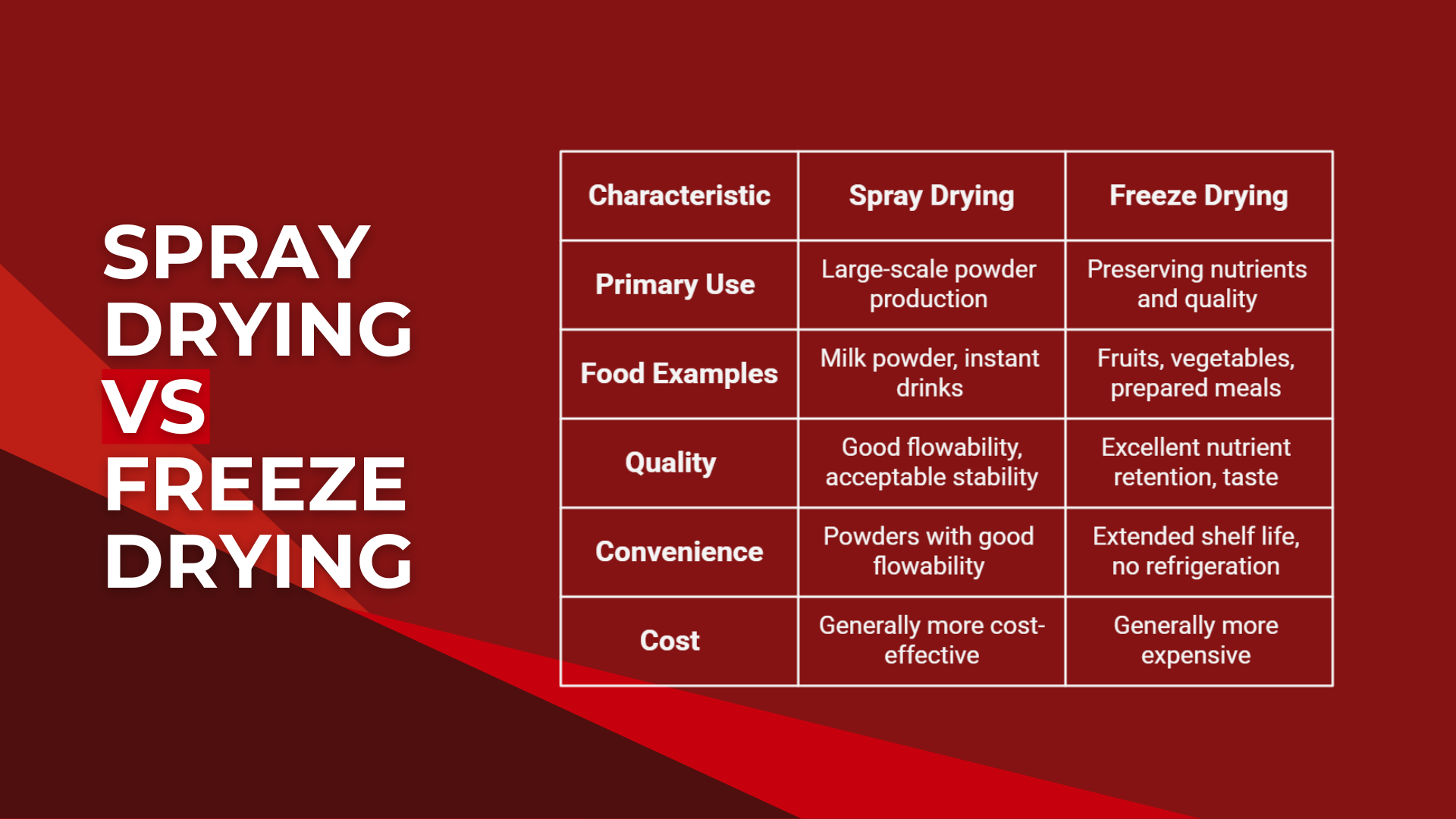
- Spray drying excels in producing powders with good flowability and acceptable storage stability, making them convenient for various applications. However, quality aspects like nutrient retention and texture can sometimes be compromised compared to freeze-drying.
- Freeze drying offers exceptional quality in terms of nutrient retention, taste, and texture, leading to products that closely resemble their fresh counterparts upon rehydration. The extended shelf life without refrigeration is also a significant benefit for storage.
Finally, the “better” method depends upon the context. For high-volume, cost-sensitive production of robust powders, spray drying is generally preferred. For delicate, heat-sensitive, or high-value foods where maximum quality preservation and rehydration properties are paramount, freeze drying is the method of choice. Both technologies are continuously evolving, with hybrid techniques offering improved performance for specific applications.
Conclusion
The selection between spray drying and freeze drying is fundamentally dictated by product characteristics, desired quality, and economic viability.
Spray drying presents a sustainable and scalable solution for high-volume production of thermally stable products, such as dairy powders and nutraceuticals, leveraging its high throughput and efficiency. In contrast, freeze drying, despite being more costly and time-consuming, remains unrivaled in preserving the delicate structure, bioactivity, and sensory qualities of heat-sensitive, high-value materials (including vaccines, therapeutic proteins, and premium foods), by eliminating the need for high temperatures.
Ultimately, securing the optimal drying method necessitates a thorough evaluation of these inherent trade-offs to ensure both product integrity and operational feasibility. As both technologies continue to advance, hybrid approaches like spray freeze drying offer enhanced capabilities for niche applications.
Pulse Drying Systems provides advanced spray drying solutions tailored to industry-specific needs. Contact Pulse Drying Systems for expert consultation on optimizing their drying process for quality, efficiency, and cost savings.