Types of Spray Dryers
Spray drying is a widely adopted industrial process for converting liquid feeds into dry powder, offering exceptional control over particle characteristics and product quality. This technology is essential across various sectors, enabling the efficient production of finely formulated solids from solutions, slurries, or emulsions.
Modern drying technologies are increasingly focused on process intensification, aiming for reductions in resources like energy and operating time, while also delivering greener, safer, and more controllable operations that meet evolving consumer needs. Understanding the diverse types of spray dryers, their atomization techniques and drying methods, is essential for engineers, product managers, and procurement specialists tasked with selecting optimal drying systems.
What are the different types of spray dryers?
The primary types of spray dryers are distinguished by their atomization method and drying chamber configuration, each suited to different materials and industrial applications. These include rotary atomizer spray dryers, nozzle atomizer spray dryers, and hybrid systems like fluidized spray dryers. Selecting the appropriate system depends on factors such as desired particle size, thermal sensitivity of the product, and production capacity.
Rotary atomizer spray dryers, also known as centrifugal atomizers, use a high-speed rotating disc to atomize the liquid feed into fine droplets. This method is highly versatile, capable of handling a wide range of viscosities and solid contents. It is often favored by industrial spray dryer manufacturers for its ability to produce a relatively uniform particle size output. Droplet size is influenced by liquid surface tension, viscosity, and density, with higher values generally leading to larger average droplet sizes.
Nozzle atomizer spray dryers, in contrast, utilize pressure nozzles or two-fluid nozzles to create droplets. Pressure nozzles force the liquid through a small orifice at high pressure, while two-fluid nozzles use compressed gas to shear the liquid into fine droplets. These systems are typically chosen for producing very fine powders and are widely used in industries requiring precise particle size control.
Fluidized spray dryers integrate a fluidized bed directly into or after the primary drying chamber. This design allows for longer residence times at lower temperatures, beneficial for heat-sensitive products and achieving very low residual moisture content. These systems often involve multi-stage drying to optimize both drying efficiency and particle properties, sometimes returning fines for agglomeration.
What are the methods of spray drying?
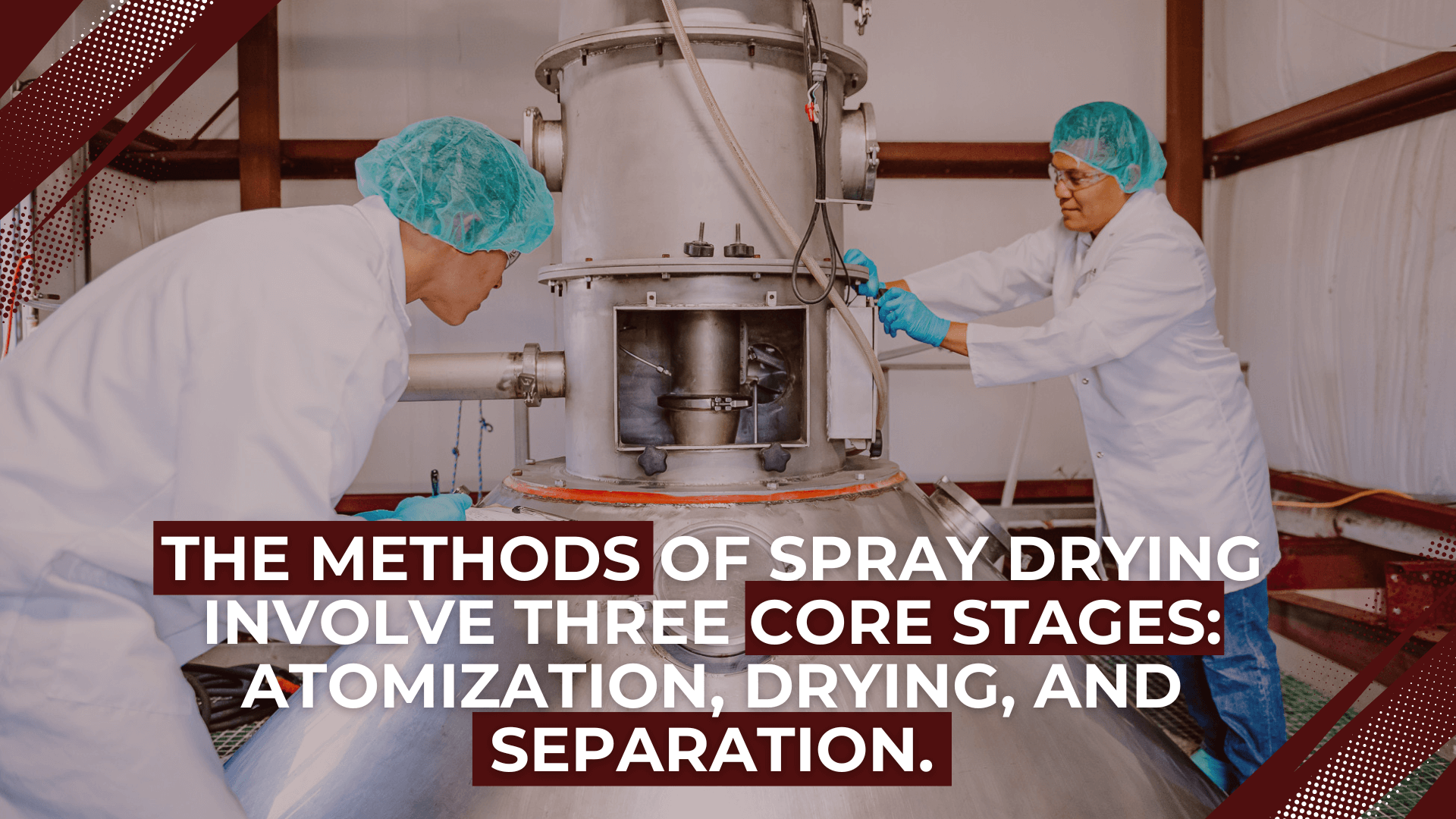
The methods of spray drying involve three core stages: atomization, drying, and separation. During atomization, the liquid feed is transformed into fine droplets, maximizing the surface area for rapid moisture evaporation. This is an important step that sets the stage for efficient drying.
The drying stage occurs when these droplets come into contact with a hot drying gas, typically air. Heat and mass transfer rapidly reduce the moisture content of the droplets, a process critical for defining the final product’s characteristics. This stage can involve either co-current or counter-current flow configurations.
In co-current drying, the hot drying gas flows in the same direction as the atomized droplets. This method exposes the droplets to high temperatures initially, but as moisture evaporates, the gas cools, keeping the product temperature relatively low. This is particularly advantageous for heat-sensitive products, protecting their thermal integrity and minimizing degradation.
Counter-current drying, where the drying gas flows opposite to the droplets, subjects the driest particles to the hottest gas. While this method can be more energy-efficient and achieve lower final moisture content, it is generally less suitable for highly thermal-sensitive products due to prolonged exposure of the dry product to high temperatures. Concerns also exist regarding browning from wall deposits in counter-current systems.
Effective separation of the dried powder from the drying gas is the final stage, typically achieved using cyclones, bag filters, or electrostatic precipitators. This ensures product recovery and environmental compliance. These methods are fundamental to spray drying in the food industry and certain types of drying common to the pharmaceutical industry for creating stable, high-quality powders.
The various types of spray drying in the food industry play a central role in producing milk powders, foods, nutraceuticals, and encapsulated flavors. One of their key strengths is flavor retention: while more than 90% of water can be removed, a significant portion of volatile compounds is preserved under optimal conditions, which is essential for maintaining sensory quality. Successful spray drying also depends on forming a stable, glassy particle surface that prevents agglomeration and reduces adhesion to the dryer walls, ensuring both efficiency and product integrity.
Similarly, types of drying in the pharmaceutical industry leverage spray drying for sensitive active pharmaceutical ingredients (APIs) and excipients. The rapid drying time minimizes degradation, allowing for the production of stable, precisely controlled drug particles suitable for various delivery systems. For heat-sensitive protein compositions, pulse atomization spray drying, for example, can achieve minimal denaturation even when the composition exceeds its denaturation temperature due to extremely short residence times.
What are the different types of atomizers in spray dryers?
An awareness of what are the different types of atomizers in spray dryers is important for their significant impact on droplet size, distribution, and overall drying performance. The main categories include rotary (centrifugal) atomizers, pressure nozzles, and two-fluid nozzles. Each of these represents a distinct approach to breaking down the liquid feed into fine droplets.
Rotary atomizers create droplets by feeding liquid onto a spinning disc, which then centrifugally throws off the liquid. This method is known for producing a relatively narrow particle size distribution and is adaptable to a wide range of feed viscosities and solids content. Adjusting disc speed and feed rate allows for control over droplet size.
Pressure nozzles atomize liquid by forcing it through a small orifice under high pressure, converting pressure energy into kinetic energy to form a spray. The resulting droplet size is determined by the feed pressure and nozzle design. These are commonly used for producing fine powders and are robust for the support of large-scale operations.
Two-fluid nozzles use the energy of a compressed gas (such as air or steam) to shear the liquid feed into a fine spray. This method is effective for highly viscous liquids or slurries and can produce very fine droplets, making it a common solution to what type of atomizer is a spray dryer when ultra-fine powders are desired. The selection of an atomizer is critical for optimizing the drying process, as droplet size directly affects drying kinetics and the final product’s characteristics.
Spray drying microencapsulation
Spray drying microencapsulation is a versatile technique used to encapsulate active ingredients within a protective matrix, offering benefits such as enhanced stability, controlled release, and masking of undesirable tastes or odors. This method is particularly vital for preserving sensitive compounds like flavors, vitamins, and probiotics.
The process involves dispersing the active material within a carrier solution, atomizing this mixture into fine droplets, and then rapidly drying them to form solid microcapsules. The carrier material forms a protective shell around the active ingredient, preventing its degradation from environmental factors like oxygen, light, or moisture. This protection is key for maintaining the quality and efficacy of the encapsulated substance.
Various types of spray drying microencapsulation exist, largely determined by the specific carrier materials used and the nature of the active ingredient (hydrophilic or hydrophobic). Common carrier materials include polysaccharides (starches, maltodextrins, gum arabic), lipids (stearic acid), and proteins (gelatin, casein), chosen for their film-forming properties. For example, studies on aromatic oil encapsulation utilize different maltodextrins and starches as matrix materials.
The efficiency of microencapsulation is influenced by factors such as feed solids content, inlet and outlet drying temperatures, and the properties of the encapsulating material. A high solids content in the feed, for instance, is generally expected to increase the retention of volatile compounds by promoting the rapid formation of a semipermeable membrane on the particle surface. Emulsion droplet size also plays a role, with finer emulsions generally leading to higher flavor retention, although very small droplets can sometimes lead to increased dissolution and loss of water-soluble flavors.
What is spray drying used for?
The question of what is spray drying used for is best explained as a process that spans a vast array of products across many industries, efficiently transforming liquid feeds into dry powders. In foods, the various types of spray drying in the food industry enable the production of milk powders, nutraceuticals, and encapsulated flavors. In pharmaceuticals, spray drying supports precisely engineered drug particles and excipients, making it one of the key types of drying in the pharmaceutical industry.
Beyond food and pharmaceuticals, spray drying is also applied in the manufacturing of detergents, ceramics, and viral vaccines. For example, viral suspensions can be dried into powders with carrier materials such as glucose, lactose, or trehalose, protecting viral particles during drying. This broad utility underscores its role in creating stable, high-quality, and easy-to-handle powdered products.
Is a spray dryer better than a dehydrator?
Comparing a spray dryer with a conventional dehydrator highlights clear differences in speed, control, and product quality. Dehydrators use hot air over long periods, often producing slower and less uniform results, while spray dryers convert liquid feeds into powders within seconds.
The main advantages of spray dryers include:
- Speed and Efficiency: Rapid heat and mass transfer reduces drying time and protects heat-sensitive materials.
- Uniformity and Particle Control: Precise control over particle size, shape, and density ensures consistent powders.
- Handling of Liquid Feeds: Unlike dehydrators, spray dryers are designed for solutions, slurries, or emulsions.
- Thermal Sensitivity: Short residence times prevent degradation and preserve product integrity.
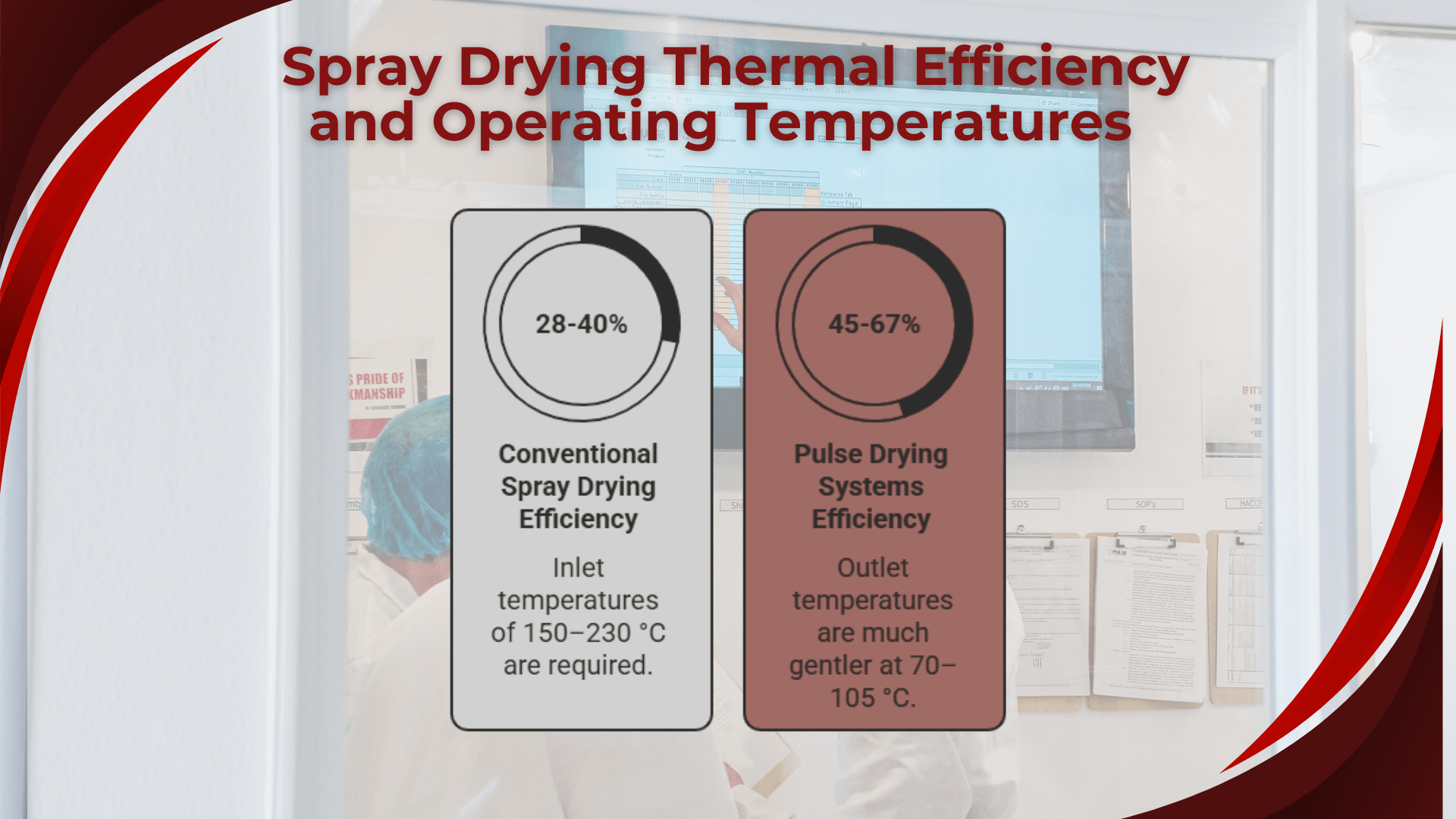
Safety and energy remain important considerations. Many users ask, is spray drying safe? While spray drying generally meets high safety standards, any powder with the potential of a dust explosion or a fire requires that the dryer be fitted with an explosive safety system to protect personnel and equipment. Advanced methods, such as pulse atomization spray drying, enhance safety by limiting oxidation and denaturation, while also boosting thermal efficiency (45–67% vs. 28–40% in conventional systems).
Other technologies, such as electrohydrodynamic (EHD) drying, instant controlled pressure drop (DIC), and microwave-assisted drying, offer specialized benefits, but the choice ultimately depends on product requirements, quality goals, and process efficiency.
What type of dryer is a spray dryer?
A spray dryer is fundamentally a type of convective dryer, where heat is transferred to the material primarily through direct contact with a hot gas. This classification highlights its reliance on the movement of a heated medium to facilitate moisture removal, distinguishing it from conductive or radiant drying methods. The key advantages of spray dryers include rapid drying kinetics, which minimizes exposure to high temperatures and helps preserve the integrity of heat-sensitive products. Their scalability allows for production volumes from laboratory to industrial levels, handling capacities from several to tens of tons of powder product per hour. Additionally, spray dryers offer precise control over particle characteristics such as size, shape, and density, making them invaluable for producing custom-engineered powders.
While traditional spray drying operations commonly achieve thermal efficiencies between 28% and 40%, more advanced systems such as Pulse Drying Systems, utilizing pulse atomization spray drying, can exceed that with efficiencies between 45% and 67%, significantly reducing energy consumption. Pulse Drying Systems operate with outlet temperatures ranging from 70 to 105°C, which is lower than many conventional systems (150-230°C inlet temperatures), further safeguarding product quality. These lower outlet temperatures are possible due to intense mixing of drying gas with the atomized feed, ensuring rapid and uniform drying in a consistent drying environment.
This ability to rapidly process liquid feeds while maintaining product quality and offering high throughput makes the various types of spray dryer technologies available indispensable in modern manufacturing. The technology’s continuous advancements aim to further enhance efficiency and broaden its application, particularly for complex and sensitive formulations such as heat-sensitive protein compositions that require minimal denaturation.
Conclusion
Spray dryers are an essential technology across many industries, offering flexible and precise solutions for converting liquid feeds into high-quality powders. From rotary and nozzle atomizers to specialized fluidized systems, the variety of types of spray dryer allows for tailored approaches to meet diverse product and process requirements. Understanding the interplay of atomization, drying methods, and their impact on thermal sensitivity is key to leveraging this technology effectively. Innovations in spray drying, such as those offered by Pulse Drying Systems, continue to push the boundaries of efficiency and product integrity.
Ready to explore the best spray drying system for your product or facility? Contact Pulse Drying Systems to discuss your application and discover how our custom solutions outperform traditional drying methods using pulse atomization spray drying.
Frequently Asked Questions
When selecting a spray dryer, consider the following factors:
- Production capacity – How much material do you need to process? Dryers are typically sized on evaporation capacity – pounds of water removed per hour.
- Feedstock characteristics – What are the properties of the material being dried?
- Powder characteristics – What are desired characteristics of the powder produced?
- Energy efficiency – What are the operational costs associated with spray drying your product? This is normally expressed in cost per pound of powder produced, and is a straightforward calculation.
- Space requirements – How much room do you have for installation?
The design and operation of a spray dryer can significantly affect product quality in several ways:
- Particle size – Uniformity in particle size contributes to better solubility and consistency.
- Moisture content – Properly controlled drying minimizes residual moisture and enhances shelf life.
- Nutritional value – Gentle drying processes can preserve sensitive nutrients in food products.
Regular maintenance is crucial for optimal performance of spray dryers:
- Cleaning – Routine cleaning prevents residue buildup and ensures efficiency.
- Inspection – Check components like nozzles and fans for wear and tear.
- Calibration – Periodically calibrate temperature and pressure settings for consistent results.
Yes, spray dryers are versatile and can handle a variety of materials, including:
- Liquids – Solutions, slurries, or emulsions can be dried into powders.
- Suspensions – Particulates suspended in liquid can also be processed.
- Pastes – Some paste materials can be converted into dry powders, although all spray dryers have viscosity limits. Pulse Atomizing dryers have the highest viscosity limits, about 3-5000 CentiPoise (cP).
Improving energy efficiency in spray drying can be achieved through:
- Heat recovery systems – An air-to-air heat exchanger on the dryer’s hot exhaust air can reduce air heating costs..
- Advanced control systems – Automated controls can optimize operational parameters.
- Alternative energy sources such as solar and wind are mostly impractical for spray dryers running continuously. Pulse Atomizing Dryers have the best thermal efficiency in the industry, and run off of electricity, propane, or methane.
Spray dryers are widely used across various industries, including:
- Food and beverage – For drying milk, flavors, soy, corn (maltodextrin) and fruit juices.
- Nutraceuticals – Extracts and filter pressed health foods
- Pharmaceuticals – medications and supplements.
- Chemicals – specialty chemicals, fertilizers.
- Minerals – wet-milled slurries.
To optimize your spray drying process, consider the following strategies:
- Conduct trials – Test different parameters like temperature and atomizer type to find the best conditions. Test rotary, pressure nozzle and pulse atomization technologies.
- Use appropriate additives – Some additives can enhance drying efficiency and product quality.
- Monitor and adjust – Continuously monitor output quality and adjust settings as needed for optimal results.