What are the operating conditions for spray drying?
Spray drying is one of the most widely used methods for converting liquid feeds such as solutions, slurries, or emulsions into dry powders. It plays a vital role in the manufacture of food ingredients, pharmaceutical compounds, and chemical products that require stability, long shelf life, and ease of handling.
Achieving the best results depends heavily on the precision with which the system is operated. Precise control of parameters such as inlet/outlet temperature, airflow rate, feed concentration, and atomization settings determines not only product quality but also whether the outcome is spray drying safe.
Typical spray dryer systems include atomizers, a drying chamber, and separation equipment such as cyclones or baghouses. Each of these components is managed via controlled operating specifications that must be finely tuned for the material being processed. Even slight variations in feed properties or temperature can alter drying kinetics and final particle characteristics. By mastering these operating conditions, manufacturers can achieve consistent results, minimize risks, and ensure their powders meet the highest performance and safety standards.
What are the objectives of spray drying?
The primary objectives of spray drying are efficient moisture removal, precise particle size control, and maintaining product stability. Each of these goals directly shapes the operating parameters as they are applied in practice. Successful moisture removal ensures low residual water content—often less than 10% by weight, and in some cases as low as 2%— essential for extending shelf life and preventing microbial growth. Particle size control is equally important for the determination of how powders behave in downstream processes, whether improving solubility, flowability, or blending performance.
Stability and product quality are also central objectives. Properly tuned conditions help preserve nutrients, flavors, and bioactive compounds while minimizing undesirable effects like shrinkage or protein denaturation. Parameters such as inlet and outlet temperature ranges, airflow, and atomization must be carefully managed for each material. This ensures reliable performance across diverse spray dryer applications from sensitive food ingredients and nutraceuticals to complex pharmaceutical formulations.
What are the stages of spray drying?
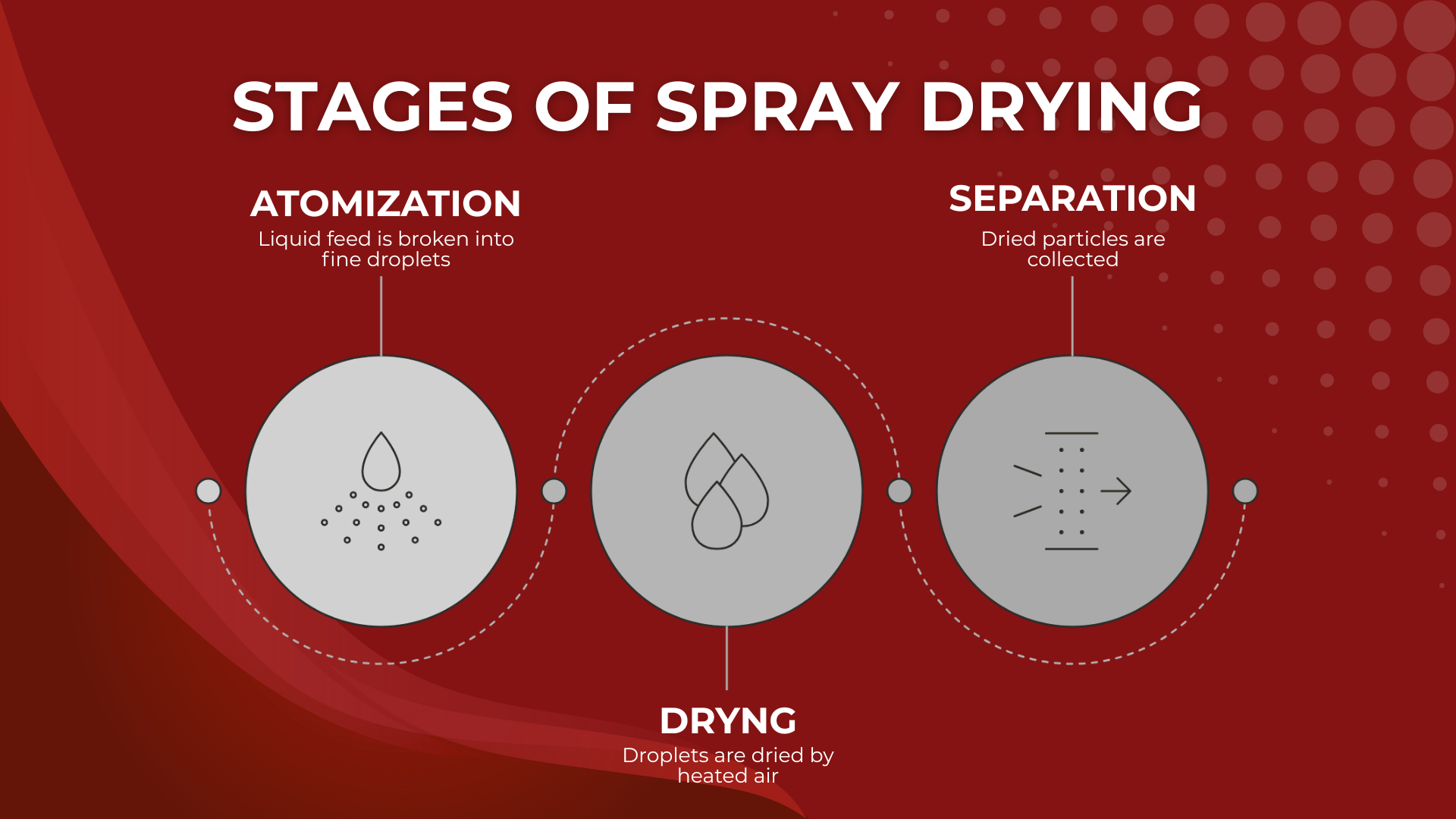
Spray drying occurs in three essential stages: atomization, drying, and separation. Each stage is governed by carefully monitored parameters to achieve consistent powder quality. The first stage, atomization, breaks the liquid feed into fine droplets using rotary atomizers, high pressure nozzles, or gas-dynamic nozzles. Droplet size plays a critical role, directly influencing drying kinetics and final particle characteristics.
During the drying stage, droplets contact a stream of heated air. Moisture evaporates rapidly as the droplet passes through a constant-rate period, followed by a falling-rate period as a surface crust forms. Controlling the dryer temperature range is vital here. Inlet gas temperatures can reach 150–230°C (302–446°F), while outlet temperatures may fall between 88–121°C (190–250°F) depending on the product.
In the final separation stage, dried particles are collected using cyclones, baghouses, or multistage systems designed to further reduce residual moisture. These steps ensure uniform powders that are stable, transportable, and ready for downstream use.

What are the limitations of spray drying?
While spray drying is a highly versatile and widely used technology, it has inherent challenges. One of the main disadvantages of spray drying is its high energy demand. Operating at elevated temperatures and airflow rates requires significant power, increasing production costs. In addition, the equipment itself represents a large capital investment, particularly when designed for industrial-scale capacity.
Product-specific limitations can also arise. Highly viscous, sticky, or thermoplastic materials may adhere to chamber walls, leading to reduced efficiency, yield losses, and the need for frequent cleaning. Heat-sensitive products, though often manageable through precision control, can still be at risk of denaturation or degradation if parameters are not carefully tuned. Powder losses during recovery are another limitation manufacturers must address, especially when fine particle sizes are involved.
More advanced systems help minimize these issues. Techniques like pulse atomization spray drying or multi-stage drying chambers improve efficiency, reduce energy consumption, and enhance product quality. Still, balancing costs, technical requirements, and product performance remains a key consideration in spray drying operations.
Safety considerations in spray drying operations
The process of spray drying involves high temperatures, fine powders, and large volumes of airflow – therefore requiring careful attention to safety. Dust explosion risk is a common concern, since airborne powders can become combustible under the right conditions. Compliance with NFPA 61/652 standards for combustible dust, use of inert gas blanketing (e.g., nitrogen) for oxygen-sensitive materials, and installation of explosion suppression or venting systems are required for combustible products processed in industrial-scale dryers.
Contamination prevention is another critical aspect. Routine cleaning and inspection of atomizers, chambers, and collection systems reduces the risk of microbial growth or cross-contamination between product batches. Ensuring the process is spray drying safe requires maintaining low residual moisture, which supports product stability and minimizes microbial activity.
Best practices include regular maintenance, strict monitoring of airflow and temperature, and adherence to industry safety standards. By implementing these measures, manufacturers can ensure efficient, consistent drying while protecting both operators and the integrity of the final product.
Mastering the right operating conditions is key to unlocking the full potential of spray drying. At Pulse Drying Systems, we provide the expertise and equipment to optimize every step of your process—from feed preparation and atomization to temperature, airflow control, and powder recovery. Our team offers tailored consultation, technical datasheets, and turnkey installation services designed to improve efficiency, safety, and product quality. Whether you’re scaling up production or refining existing operations, we can guide you towards the best solutions. Contact Pulse Drying Systems today to discuss your requirements and enhance your spray drying performance.