What is the process of spray drying?
It is a highly efficient method for transforming liquid feeds into dry powder, utilized across various industries. This process is essential for preserving sensitive materials, extending shelf life, and creating powders of specific particle sizes and morphology. It typically involves three main stages: atomization, drying, and powder recovery.
Understanding the Spray Drying Process
Spray drying is fundamentally a continuous process that converts a liquid or slurry into a dried powder through rapid heat transfer. It is widely applied for materials that are heat-sensitive, as it allows for swift moisture removal, minimizing degradation. This technique is applied when the final product requires a specific particle size, low moisture content, or enhanced stability.
Step-by-Step: How Spray Drying Works
The spray drying process step-by-step involves several distinct stages that ensure the efficient conversion of a liquid feed into a desired powder.
- Feed Preparation: The liquid feed, which can be a solution, suspension, or emulsion, is prepared to a specific concentration and viscosity suitable for atomization. Heat-sensitive protein compositions, e.g., the liquid egg white used in one study, contained approximately 87% water.
- Atomization: The prepared liquid feed is dispersed into fine droplets within a drying chamber. This is achieved using an atomizer, such as a rotary atomizer or pressure nozzle, which dictates the droplet size and distribution. Pulse atomization spray drying, for instance, uses pulsating jets to atomize and dry the feed simultaneously, allowing for the processing of feeds with higher solids content.
- Contact with Hot Gas: The atomized droplets immediately encounter a drying gas, typically air, within the drying chamber. This rapid contact facilitates swift heat transfer to the droplets. In pulse atomization spray drying, the inlet temperatures can reach around 200–425 °C, while the outlet temperatures are typically around 70–105 °C. By comparison, conventional spray drying systems generally operate with inlet temperatures around 150–230 °C.
- Moisture Evaporation: As the hot gas transfers heat to the droplets, moisture rapidly evaporates from the surface, forming a solid shell around the particle. This quick evaporation ensures that the internal temperature of the particle remains relatively low, even with high inlet gas temperatures. This is critical for heat-sensitive materials like proteins. For example, egg white proteins are heat-sensitive and can denature at high temperatures, reducing their foaming and gelling properties.
- Powder Collection: The dried particles, now in powder form, are separated from the moist air. This typically involves cyclone separators and bag filters, which capture the fine powder while the exhausted air is expelled. The total yield of powder from pulse atomization spray drying can be meaningfully higher than conventional methods, with final moisture content typically around 8%.
Variables like drying gas temperature, atomizer type, and feed flow rate critically affect the final particle size, moisture content, and overall product quality.
Spray Drying Process Flow Diagram
These systems include a feed pump, an atomizer, a drying chamber, and powder collection units.
The feed pump precisely controls the flow of the liquid into the atomizer. The atomizer then disperses the liquid into fine droplets within the drying chamber. Within the drying chamber, hot drying gas contacts the droplets, causing rapid moisture evaporation. Finally, components like cyclone separators and bag filters recover the dried powder or granules.

Spray Drying Process
Spray drying is highly adaptable for various applications, especially when handling hazardous or sensitive materials such as pharmaceuticals, vaccines, and biomaterials. For example, when used for drying viral vaccines, an attenuated live virus or inactivated virus components are suspended in a buffered aqueous solution with a carrier material. The liquid vaccine is then introduced into a pulse atomization spray drying system, where it is dried and recovered as a stable powder.
Special considerations are essential in these applications. Temperatures must be carefully controlled to avoid degradation of active components, with inlet ranges typically maintained between 200–425 °C and outlet ranges of 70–105 °C. These conditions, enabled by rapid evaporation and uniform gas mixing, ensure efficient moisture removal while protecting heat-sensitive compounds.
Safety and environmental factors are equally important in chemical spray drying. Hazardous feedstocks must be processed within closed systems equipped with appropriate filtration to prevent exposure and emissions. Operators also implement rigorous cleaning and containment protocols to maintain workplace safety and prevent cross-contamination. From an environmental perspective, energy-efficient designs and effective dust collection help minimize waste and reduce operational impact.
Consistency is another priority, particularly when spray drying high-value or regulated products. Careful monitoring of droplet size, residence time, and final moisture content (often less than 8%) ensures uniform powders that meet strict quality standards. The use of carrier materials provides additional protection for sensitive actives, preserving stability during both drying and storage.
Applications: What is Spray Drying Used for in Food Processing?
An understanding of what is spray drying used for in food processing encompasses knowledge of a wide range of applications that play a pivotal role in creating stable, high-quality food powders. This process is preferred for its ability to preserve nutritional content, flavors, and functional properties of food products.
Notable applications include:
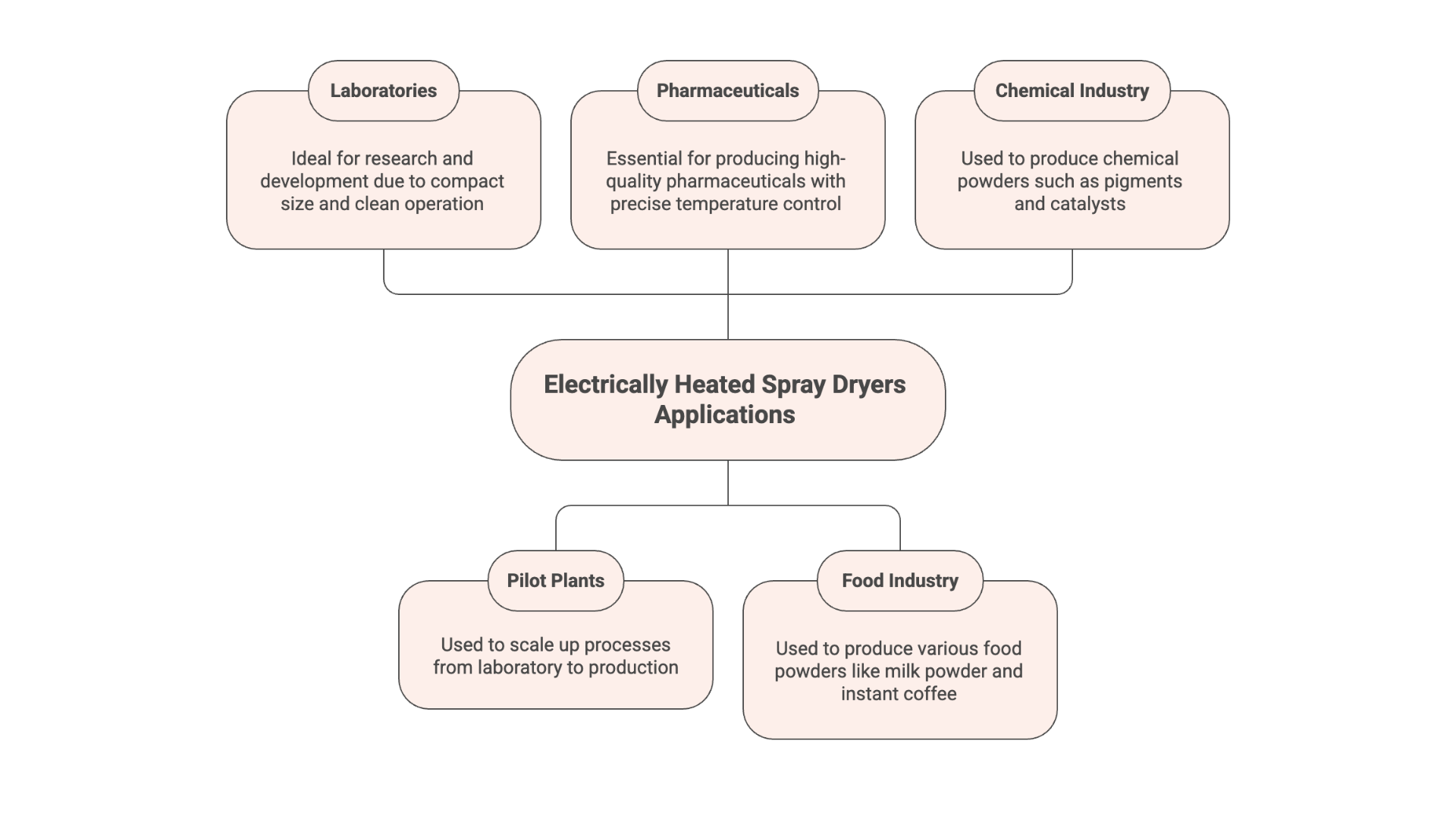
- Milk Powder and Coffee: Spray drying is a conventional method for producing milk powders and instant coffee, facilitating ease of use and long shelf life.
- Flavors and Aromatics: Also used for microencapsulation of flavors like citral and linalyl acetate, protecting them from oxidation and improving storage stability. Encapsulation can extend the shelf life of aromatic oils such as orange, mint, and bergamot oil, preventing their degradation.
- Nutrients and Bioactive Compounds: The process is essential for drying sensitive ingredients like probiotics, enzymes, and other nutraceuticals, ensuring their viability and stability. The ability to achieve low moisture content (e.g., less than 1.0–3.0%) is critical for maintaining product viability and stability over time for many products.
- Egg White: Pulse atomization spray drying is applied to egg whites, a heat-sensitive protein, to produce dried powders with superior physical characteristics and functional properties. These include improved foaming and gelling abilities when compared to traditional spray drying methods. In one study, pulse atomization spray drying methods were found to be up to 50% more efficient than conventional spray drying.
Conclusion
The process of spray drying is a versatile and efficient solution for transforming liquid materials into high-quality powders across diverse industries. Its precise control over particle characteristics and ability to handle heat-sensitive compounds make it essential in the food, pharmaceutical, and chemical sectors. For customized solutions, contact Pulse Drying Systems to discover how we can reinvent spray drying for your applications.
Frequently Asked Questions
Spray drying is widely used in various industries, including:
- Food and beverage (for powdered products)
- Pharmaceuticals (for drying active ingredients)
- Chemicals (for producing fine powders.
- Ceramics (for drying wet-milled products)
Spray drying offers several benefits:
- Fast drying time, preserving product quality
- Uniform particle size and distribution
- Ability to handle heat-sensitive materials
- Reduction in storage and transportation costs due to reduced moisture content
A variety of materials can be processed through spray drying, such as:
- Liquids (e.g., solutions, emulsions)
- Slurries and pastes
- Certain solids (e.g., wet-milled ceramics)
- Heat-sensitive substances (e.g., vitamins, probiotics)
The process impacts several aspects of the final product:
- Moisture content is fine-tuned for stability and functionality
- Particle morphology can affect solubility and dispersibility
- Flavor and aroma retention is often enhanced
- Nutritional value may be preserved, depending on conditions
Several factors can affect efficiency, including:
- Spray nozzle type and design
- Inlet and outlet air temperatures
- Feed rate and concentration of the solution
- Type of drying chamber used
Selecting the right parameters is crucial for optimal results:
- Conduct pilot tests to evaluate different conditions
- Monitor particle size and moisture content
- Adjust temperatures based on the material’s heat sensitivity
- Use feedback from product performance for adjustments
Users may encounter several challenges, such as:
- Caking or clumping of powders
- Inconsistent particle size
- Overheating sensitive materials
- High energy consumption, which can impact costs
To address common issues, consider these actions:
- Adjust feed concentration or flow rate
- Check and optimize nozzle types
- Monitor air temperature and humidity levels
- Regularly clean equipment to prevent blockages and contamination