
Keep the drying chamber.
Change the atomizer.
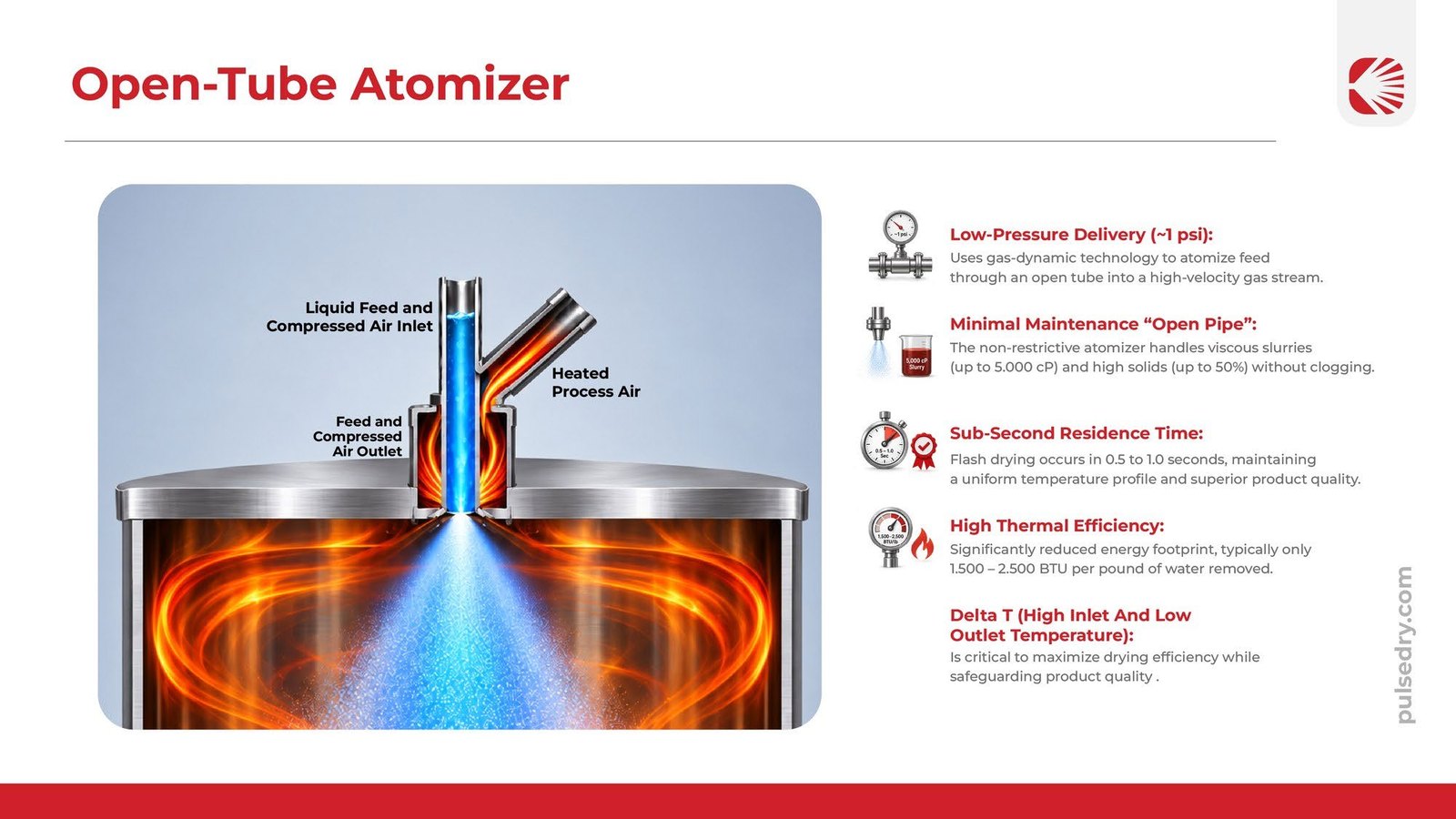
If your spray dryer is a tall-form unit with a pressure nozzle, the chamber, cyclone and baghouse can stay where they are. A Pulse retrofit replaces the nozzle and the high-pressure pump, and costs 20 to 30% of what the dryer cost to build.
Same spot at the top center of the chamber.
A peristaltic pump takes the place of the high-pressure pump.
Four things improve when you change
the atomizer on a dryer you already own.
Converting a tall-form dryer is easy and inexpensive. What comes back depends on your product, and these are the four places it shows up.
A better powder from a dryer that already makes a good one
In some cases the result is a freeze-dry quality powder from a spray-drying process.
Abrasive and corrosive feeds stop wearing out the atomizer
The pump runs at low pressure and the atomizer has no restrictions in it, so there is nothing to abrade or corrode. Maintenance cost on these materials heads toward zero.
More powder for the same energy
A Pulse dryer is more thermally efficient than the dryer it replaces, so throughput goes up on its own. You make more pounds of powder for the same energy input.
Higher solids, if your feed can take them
At 25% solids you evaporate 3 lb of water for every pound of powder. At 50% it is 1 lb. Throughput triples and the cost per pound falls to a third.
The best candidate
is a tall-form dryer
with a pressure nozzle.
Walk up to one and it already looks like a Pulse Dryer. A pressure nozzle sits at the top center of the chamber, where our atomizer goes. From there down it is chamber, cyclone, baghouse and exhaust fan. A fan or two is the difference.
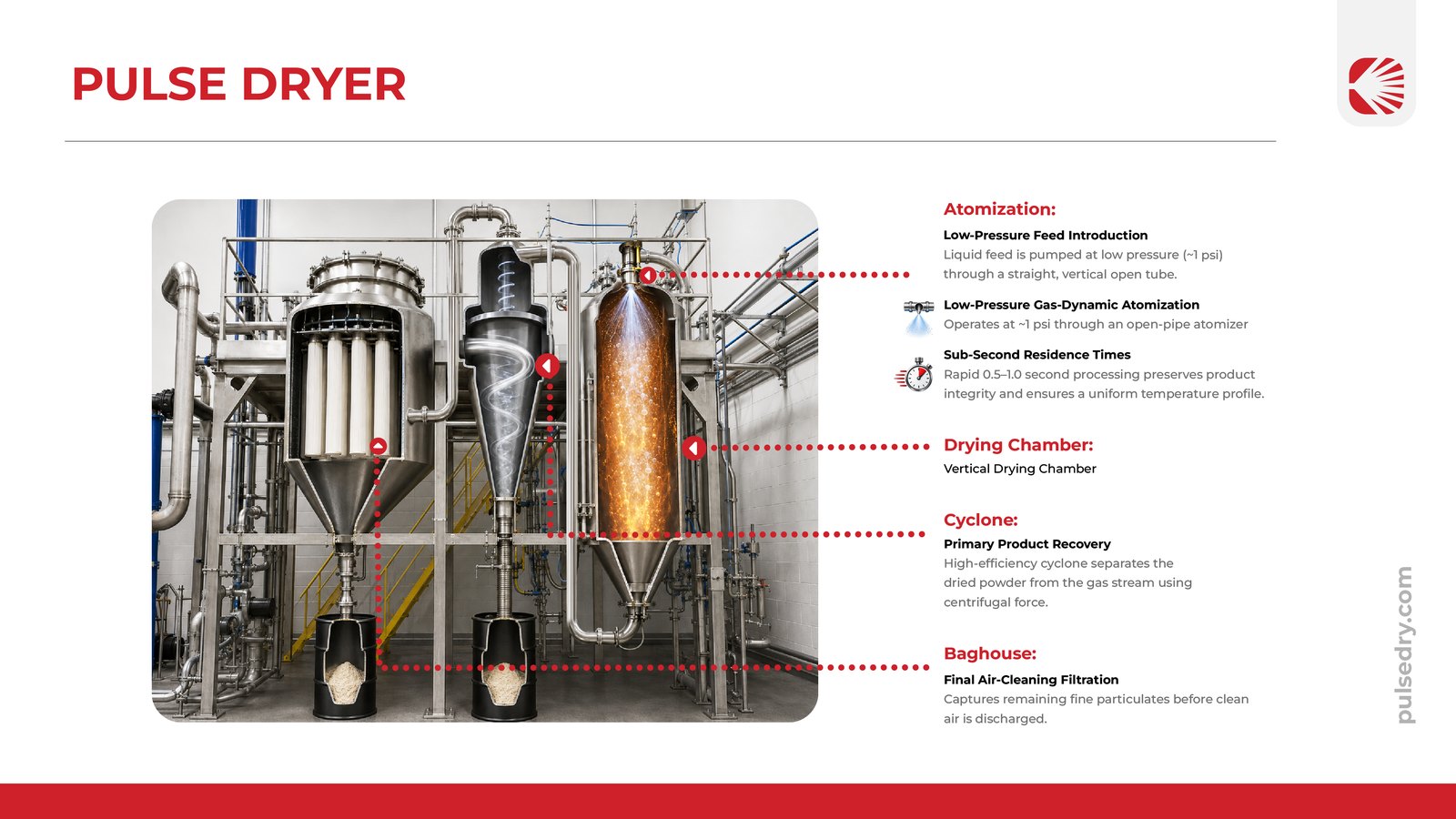
Tall-form, pressure-nozzle spray dryers
- Pressure nozzle at the top center of the drying chamber.
- Drying chamber, cyclone, baghouse and exhaust fan below and beside it.
- The Pulse atomizer takes the nozzle’s place. The tower stays.
Some rotary-disk atomizer dryers
- Some can be converted. It depends on the dryer, so we look at yours with you.
- Tell us the dryer type, its size and what you run, and we will tell you where it stands.
Two parts come
out. A blower, some
ducting and a control
change go in.
The nozzle and the pressure pump are the parts that are heavy on maintenance and subject to corrosion and erosion. They are the parts that change. All the big, expensive parts stay.
| Component | Today | After the retrofit |
|---|---|---|
| AtomizerReplaced | Pressure nozzle | Pulse atomizer in the same spot, on the same bolt pattern |
| Feed pumpReplaced | High-pressure pump, in some cases up to 5,000 psi | Peristaltic (tube) pump at 2–3 psi. Handles higher-viscosity materials |
| Process airAdded | - | Process blower pushing ambient air into the heater. The hot air from the top of the heater is the atomizing and drying air |
| Transport airAdded if needed | Some dryers already have a fan that can do this job | Where there is none, a simple small fan |
| HeaterChecked with you | Electric or gas-fired | Electric: reused as it is. Gas-fired: reused if it can handle a few psi. Otherwise we work it out together |
| Exhaust fanChecked with you | Existing exhaust fan | Normally fine. If throughput goes up it may need to be a little bigger, which is not an expensive item |
| Chamber, cyclone, baghouseStays | Existing | Unchanged, along with the ducting to the cyclone and to the baghouse |
| ControlsAdapted | Existing control system | Adapted to Pulse control: regular VFDs run the motors, and a loop on the dryer outlet temperature controls the feed pump |
About six months from order to done, for a
fraction of a new dryer.
Most of the schedule is fabrication and procurement. The work on your site is short.
From order to done
Example: a production spray dryer evaporating about 500 lb of water per hour.
- 3–4 months
We build and procure
We fabricate the Pulse atomizer and source the process blower, a transport air blower if needed, and a heater if needed. When everything is built and in hand, it ships to your plant.
- Under a week
You install on site
Pull the pressure nozzle and bolt the atomizer onto the same pattern. A crescent wrench does most of it. Set the high-pressure pump aside and put in the peristaltic pump. Mount the process blower, duct it to the heater and on to the atomizer, power it, and adapt the controls.
- Within 6 months
Done
Better powder, at a higher rate, with lower maintenance costs.
What the retrofit costs
Measured against what the dryer cost to build.
The range depends on dryer size
The fans, blowers, heater and atomizer we procure and build cost less on a small dryer than on one five times the size.
Payback comes from three places
Better powder, potentially a higher rate, and lower maintenance costs.
A dairy manufacturer, a nutraceutical by-product,
and a feed that kept choking the dryer.
Great product, great engineers, and a spray dryer that could not run above 25% solids. We proposed a Pulse retrofit because nothing else was going to solve it.
The limit
Above 25% solids the feed clogged the dryer. The team could not get past it.
The proposal
We proposed a Pulse atomization retrofit and gave them a price. They said go ahead.
The proof
In our lab we had shown that the feed could go from 25% to 50% solids and make an equivalent powder.
The installation
We built the components and shipped them. The customer installed the kit and changed their control system for the Pulse way of running.
The result
On their pilot dryer, which evaporates 100 lb of water per hour, a feed formulated at 50% solids made a beautiful powder. One third of the cost, three times the output.
3 lb of water per pound of powder. About 33 lb/h of powder at 100 lb/h of water evaporated.
1 lb of water per pound of powder. About 100 lb/h of powder at the same 100 lb/h.
James explains
the retrofit, one
question at a time.
James Rehkopf, founder and CEO of Pulse Drying Systems, walks through the retrofit in a short video playlist: why do it, which dryers qualify, what is involved, how long it takes, what it costs and a real example.
Watch the full playlist on YouTubeThe best way to know if Pulse Drying is right
for your product is to see it in action.
Tell us what you dry today and what it costs you at the atomizer. An engineer will review your feed and, if it fits, run it at our HQ and lab in Mesa, Arizona.