No nozzles. No rotary disks.
    No high-pressure pumps.

    Conventional spray drying is the industrial standard, and it is held back by two things: mechanical wear at the atomizer and 15 to 30 seconds of “warm and wet” exposure that degrades heat-sensitive materials. Pulse atomization replaces the high-pressure nozzle with a low-pressure open tube and finishes drying in under a second.

    0.5 – 1.0s
    Drying
    time
    *vs 15–30s conventional
    ~1 psi
    Feed
    pressure
    *vs up to 5,000 psi
    25 – 50%
    More energy-efficient than
    conventional spray dryers
    98.4%
    Protein activity
    preserved
    *egg white test

    Four stages.
    The difference is in the first one.

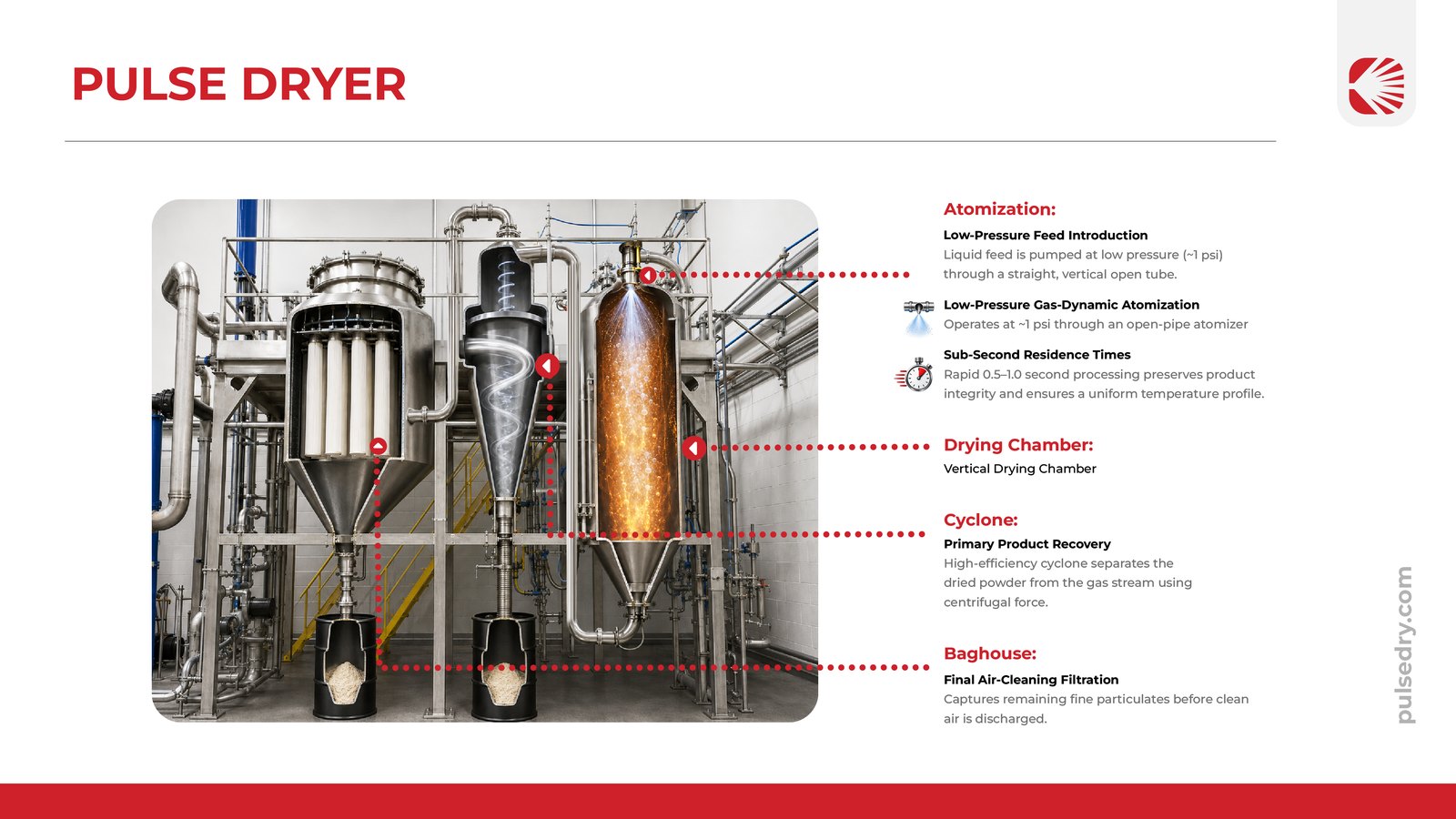
    Chamber, cyclone and baghouse look like any spray dryer. What changes is how the liquid becomes droplets: no high-pressure nozzle, no rotary disk, just a straight open tube feeding into the gas stream of the combustor.

    Figure 1: Pulse Dryer process: atomization, drying chamber, cyclone, baghouse

    Stage 1

    Atomization

    Liquid feed pumped at ~1 psi through a straight, vertical open tube into gas jets. Gas-dynamic atomization and drying start at the same instant.

    Stage 2

    Drying chamber

    All process air passes through a narrow aperture at roughly 250 mph, creating extreme turbulence and a very high heat-transfer coefficient.

    Stage 3

    Cyclone

    High-efficiency cyclone separates the dried powder from the gas stream by centrifugal force. Primary product recovery.

    Stage 4

    Baghouse

    Captures remaining fine particulates before clean air is discharged.


    5,000 psi through a pinhole, or 1 psi
    through an open tube.

    Conventional spray dryer

    Mechanical atomization

    up to 5,000psi
    High-pressure nozzles or centrifugal rotary disks spinning at high velocity.Small orifices and high-speed moving parts are highly susceptible to clogging, abrasion and corrosion.Particulate-laden or abrasive feeds (minerals, corrosive chemicals) accelerate wear.Thick slurries can catastrophically disable a pressure nozzle, so feeds are often diluted first.
    Pulse dryer

    Pulse atomization

    ~1psi
    Liquid feed enters through an “open tube” at very low pressure. A peristaltic pump is enough.Atomization is driven by the intense shear of the gas stream, not by pressure or rotation.No small orifices and no high-speed moving parts in the atomization zone, so nothing to clog or rebuild.Processes thick slurries that would stop a conventional nozzle.

    Hotter air,
    shorter exposure.

    In a traditional spray dryer a particle spends 15 to 30 seconds going from wet to dry, and that whole time it sits “warm and wet”: the state most conducive to degrading proteins, vaccines and other sensitive biologicals. Pulse Drying finishes the job before that window opens.

    Time a particle spends drying, drawn to scale

    Conventional15–30 seconds
    15 – 30 s
    0 s51015202530 s
    Pulse Dryer0.5–1.0 second
     0.5 – 1 s
    0 s51015202530 s
    ~250mph

    All process air is forced through a narrow aperture, creating extreme turbulence and an exceptionally high heat-transfer coefficient.

    15–30x

    Faster wet-to-dry transition than a conventional tower (0.5–1.0 s against 15–30 s).

    <1s exposure

    Near-instant evaporative cooling and ultra-short exposure keep the material below its denaturation point.

    Inlet temperature range

    Conventional systems for heat-sensitive foods are usually limited to 300-450 °F. Pulse systems run contact temperatures of 400-900 °F.

    Conventional300-450 °F
     
    0 °F100200300400500600700800900°F
    Pulse Dryer400-900 °F
     
    0 °F100200300400500600700800900°F

    Why the product survives a 1,300 °F inlet: evaporation is near-instantaneous and exposure lasts well under a second, so the droplet cools itself faster than heat can reach its core. The high inlet and low outlet temperature (a large ΔT) is what makes the process both efficient and gentle.


    Thicker feed, less
    water to evaporate.

    Conventional dryers often struggle with high-viscosity or high-solids feeds and require dilution to avoid nozzle clogging. Because the Pulse Dryer has no restrictive orifice, it processes feedstocks that are commercially non-viable in a traditional spray dryer.

    3 lb water to
    evaporate
    1 lb solids

    Conventional · 25% solidsDilution keeps the nozzle from plugging. Three pounds of water removed for every pound of product.

    1 lb water to
    evaporate
    1 lb solids

    Pulse Dryer · 50% solidsSame dryer, same hour. One pound of water removed per pound of product, so throughput triples.

    Water you must evaporate
    per pound of dry powder

    A nutraceutical feed limited to 25% solids in a traditional dryer proven to run at 50% powder in a Pulse system. Going from 25% to 50% means one pound of water per pound of powder instead of three.

    Slurries up to 5,000 cP25% → 50–67% solids3× throughput⅓ the energy per lb of powder

    Energy per pound of water, and what there is to maintain.

    Pulse Drying is reported to be 25% to 50% more efficient than conventional spray drying. The savings come from the thermodynamics of the process and from removing the hardware that wears out.

    Energy per pound of water evaporated

    Pilot-scale evaluation.

    Pulse Drying1,500–2,500 BTU/lb
     
    05001,0001,5002,0002,5003,0003,5004,000
    Conventional2,500–4,000 BTU/lb
     
    05001,0001,5002,0002,5003,0003,5004,000

    Maintenance: about 25% of a conventional dryer

    Low-pressure peristaltic feed pumps

    A tube, not a piston. Inexpensive, quick to swap, and chosen for the chemistry of the feed.

    No high-pressure pistons or seals

    The parts that fail at 5,000 psi are not in the machine.

    No rotary drive units

    Nothing spinning at high velocity in the atomization zone, so no frequent and expensive rebuilds.

    Lower energy and capital cost

    Higher solids loading cuts energy per pound of powder by up to three times, with a continuous, high-throughput process.


    Conventional vs. Pulse Dryer, side by side.

    Criterion Conventional spray dryer Pulse dryer
    Atomization Mechanical: high-pressure nozzles or rotary disks Gas-dynamic: open tube
    Feed pressure Up to 5,000 psi ~1 psi
    Wear points Small orifices and high-speed parts;
    clogging, abrasion, corrosion
    No small orifices, no moving parts in the atomization zone
    Drying time 15–30 s, “warm and wet” throughout 0.5–1.0 s
    Gas velocity Moderate ~250 mph through a narrow aperture
    Inlet temperature
    (heat-sensitive foods)
    300–450 °F (148–232 °C) 400–900 °F (204–482 °C), product protected
    by evaporative cooling
    Viscosity Dilution often required to protect the atomizer Slurries up to 5,000 cP
    Solids loading
    (nutraceutical example)
    ~25% 50–67% · up to 3× throughput
    Energy per lb of water 2,500-4,000 BTU/lb 1,500-2,500 BTU/lb pilot result · 25–50% more efficient
    Maintenance Pistons, seals, rotary drives rebuilt often;
    clogging, and nozzle wear
    ~25% of conventional; peristaltic pumps
    Versatility at very
    large scale
    Established standard across food, chemical
    and pharma; largest installed capacities
    Process intensification focused on quality,
    high-solids and heat-sensitive feeds

    Change the atomizer,
    and four things
    change with it.

    Conventional spray drying remains a versatile technology. Its limits come from mechanical wear and from the thermal stress of long residence times. Substituting mechanical fragmentation with gas-dynamic atomization addresses both, and the rest follows from there.

    Fewer wear points

    An open tube at ~1 psi has no orifice to clog and no disk to erode.

    Shorter thermal exposure

    0.5–1.0 s instead of 15–30 s, so sensitive materials spend less time warm and wet.

    Higher solids, less water to evaporate

    Up to 5,000 cP and 50–67% solids; at 50% solids, throughput triples and energy per pound of powder drops to a third.

    Lower operating cost

    Reported 25–50% higher energy efficiency and maintenance around a quarter of a conventional dryer.


    The best way to know if Pulse Drying is right
    for your product is to see it in action.

    Tell us what you dry today and what it costs you at the atomizer. An engineer will review your feed and, if it fits, run it at our HQ and lab in Mesa, Arizona.

    400+ Products Tested

    15 Recent Installations

    Mesa, AZ HQ & R&D Lab