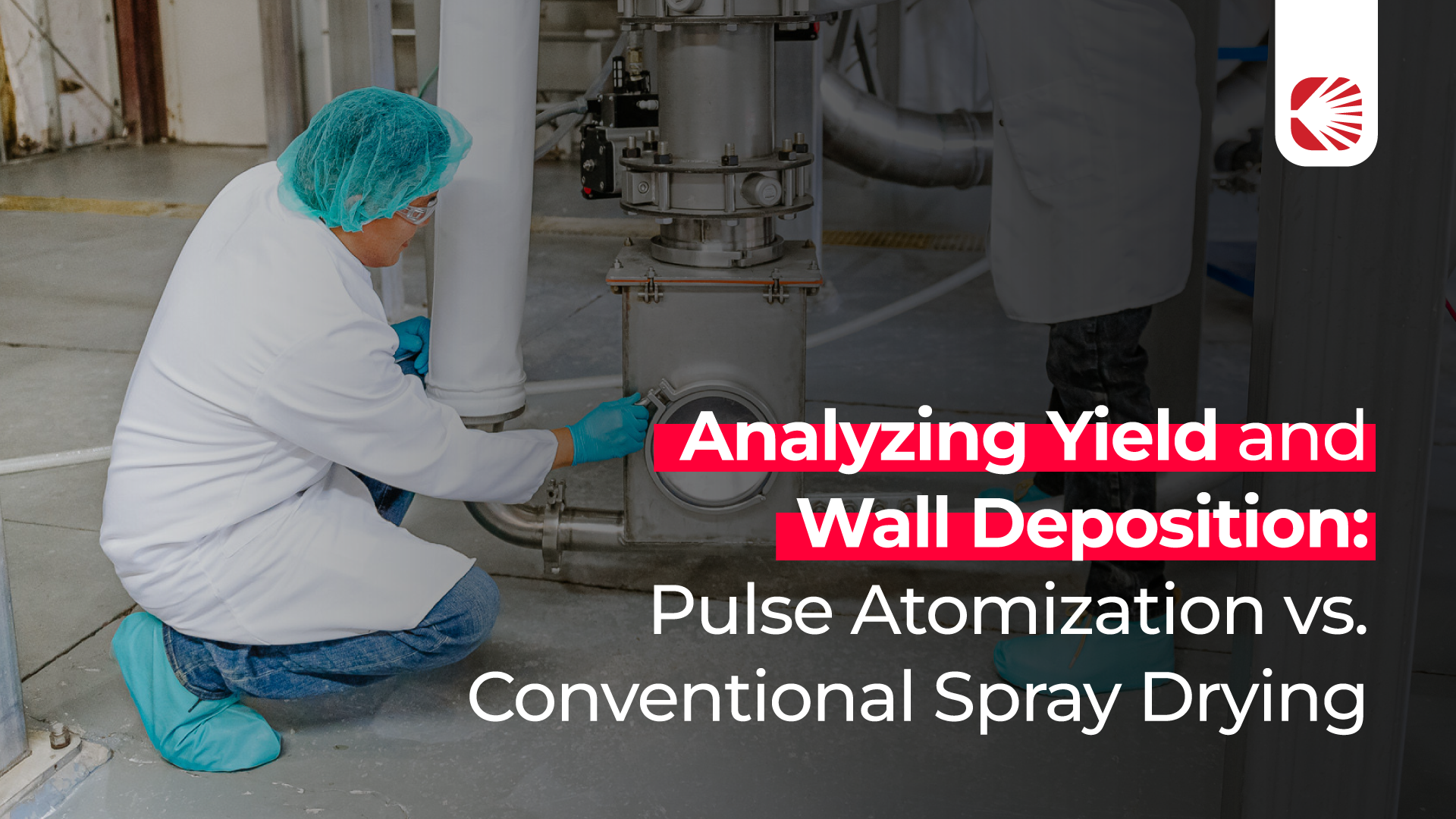
In industrial drying operations, yield is defined as the ratio of the dry matter introduced to the system versus the amount successfully collected at the cyclone. While mechanical settings such as inlet and outlet temperatures influence this metric, formulation is the primary determinant of whether a material will dry into a consistent powder or adhere to the chamber walls. From an engineering standpoint, any material that can be spray-dried with high yield can achieve equivalent or superior recovery rates using Pulse Atomization Spray Drying (PASD).
The Mechanism of Wall Deposition
Conventional tall-form spray dryers often suffer from inconsistent atomization that results in wall buildup from wet material that contacts the wall before drying and therefore sticks on the wall and is lost. PASD utilizes high-velocity pulsating gas streams (~200–300 mph) to create a highly turbulent mixing zone that tends to reduce atomization variation. Also, this turbulence ensures a uniform temperature profile across the chamber, effectively running the entire system at the exit temperature and significantly reducing the risk of heat-induced wall sticking.
In pilot-scale tests of egg white, PASD achieved a total yield of 73.5%, with 60.3% collected at the cyclone and 13.2% recovered from the walls via compressed air blowdown. Notably, the wall deposits were minor and non-scorched, indicating that the material did not permanently vitrify or “bake” onto the stainless steel.
Recovery Rates and Material Dependency
Empirical data demonstrates that recovery rates are highly material-dependent and influenced by the efficiency of the collection hardware. Low recovery rates in certain applications, such as when processing TiO2, are often the result of inefficient collection of ultrafine particles by multipurpose cyclones rather than a failure of the atomization process itself. PASD produces a tighter Relative Span Factor (RSF) compared to conventional methods, leading to more homogeneous particles that are easier to manage in downstream collection.
Process Intensification and Throughput
The most significant operational distinction in terms of yield is PASD’s ability to handle higher-solids feeds. Conventional pressure nozzles are limited by viscosity and often require feed dilution to prevent clogging, which increases the energy required per pound of dry matter. Because PASD uses a gas-dynamic “open pipe” feed system, it can process viscous slurries up to 5,000 cP. Increasing solids concentration—for example, from 25% to 50%—can triple throughput and reduce the drying cost per finished pound by nearly 67% without sacrificing powder quality.
Is your production yield limited by wall sticking or feed dilution requirements? Determining the exact recovery rate for your formulation requires empirical data under real-world conditions. Contact our technical team today to discuss a feasibility trial for your material and evaluate your process efficiency.