In industrial spray drying, the processing of abrasive or corrosive feed materials presents a fundamental challenge to the longevity and performance of traditional rotary and nozzle atomization hardware. Every conventional system, whether utilizing a high-speed rotary disc or a pressure nozzle, begins its operational cycle with new components, including the atomizer head and the feed pump. However, the physics of high-pressure delivery ensures that these components begin to degrade immediately upon contact with aggressive feedstocks.
The Inevitability of Mechanical Wear
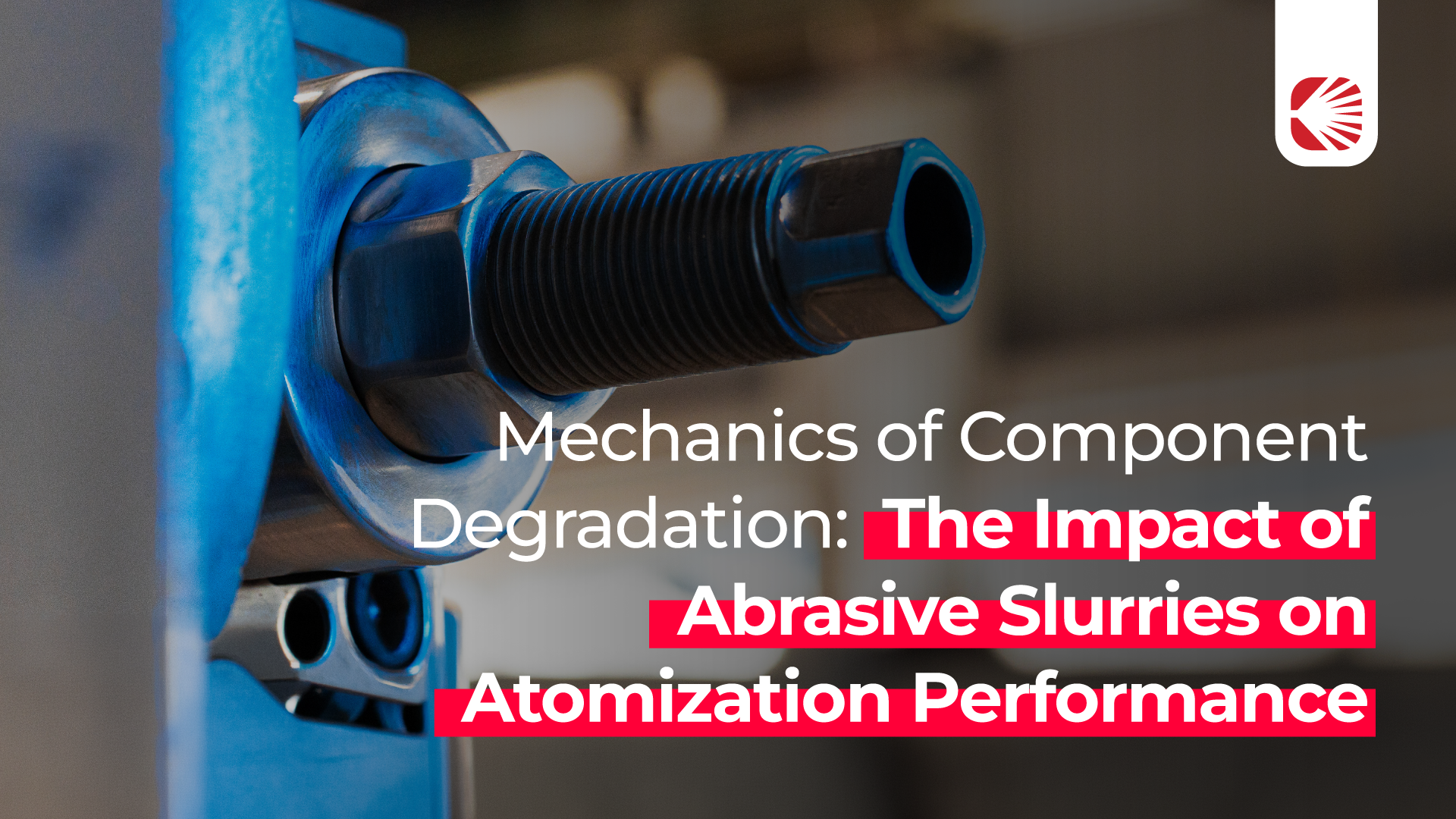
For process engineers, component wear is not a variable of “if” but “when”. In traditional systems, atomization is achieved by forcing liquid through restricted orifices or across disc surfaces at high velocities and pressures (up to 5,000 psi). When suspended solids are present, they act as grinding media, leading to continuous erosion of the hardware. This degradation is a direct consequence of the mechanical friction inherent in traditional atomization physics.
As these components wear, the system’s ability to maintain a consistent spray pattern is compromised. Over time, the enlargement of nozzle orifices or the erosion of rotary disc channels alters the atomization kinetics, inevitably leading to out-of-spec powders,, increased maintenance expenses, and significant production downtime.
Technical Alternatives and Retrofitting
Addressing the maintenance cycles associated with abrasive wear often requires a shift in atomization technology. Pulse Atomization Spray Drying (PASD) utilizes a low-pressure (~1 psi) gas-dynamic delivery system. Because the feed is introduced through an “open pipe” into a high-velocity gas stream rather than being forced through a restricted mechanical orifice, the primary mechanism of erosion is bypassed.
For facilities currently operating conventional tall-form dryers, transitioning to this technology does not necessarily require a complete system replacement. Existing dryers can be retrofitted to pulse atomization for approximately one-quarter of the cost of a new installation. In a retrofit scenario, the original drying chamber, cyclone, baghouse, and fans are retained; only the atomizer and the feed delivery system are replaced.
Operational Efficiency in Retrofit Transitions
The engineering timeline for such a conversion is relatively brief, with typical changeovers from pressure nozzle systems to pulse drying estimated to take approximately one week. This allows manufacturers to resolve chronic maintenance issues and downtime while leveraging their existing capital equipment. By removing high-pressure failure points and restricted orifices, the system can handle higher-solids processing (up to 50 – 75%) and viscous slurries (up to 5,000 cP) with greater mechanical stability.
Are you ready to evaluate the ROI of transitioning your abrasive process to a low-pressure atomization environment? The most effective way to validate the performance of gas-dynamic atomization for your specific formulation is through a technical feasibility assessment. Contact our engineering team today to review your current maintenance cycles and discuss a retrofit evaluation.