What a dryer really costs to run. These articles look at thermal efficiency, energy use, maintenance and total cost of ownership, and explain the gap between a dryer’s rated performance and its results on the production floor.
In the world of industrial processing, few numbers are as closely scrutinized during a capital purchase as “thermal efficiency.” Manufacturers often present data showing their systems operating at peak performance under ideal lab conditions. Yet once the equipment is installed on a factory floor, it may be found that real-world thermal efficiency falls significantly short of expectations.
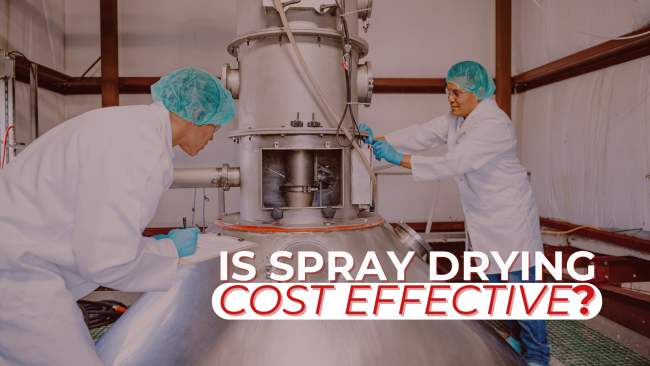
In industrial spray drying, the Total Cost of Ownership (TCO) is dictated more by recurring operational expenses than by initial capital outlay. When comparing Pulse Atomization Spray Drying (PASD) to conventional mechanical atomization over a five-year horizon, three primary variables drive the annual savings estimate: thermal efficiency, maintenance requirements, and the impact of feed concentration on throughput.
In industrial drying, evaluating energy consumption requires a comprehensive audit of both thermal requirements and the electrical load of the pressure blower, transportation air blower, and exhaust fan. Conventional spray dryers utilize high-pressure pumps to achieve atomization, whereas Pulse systems rely on a gas-dynamic atomizer that operates at significantly lower feed pressures. The primary engineering advantage of Pulse Atomization Spray Drying (PASD) is the superior efficiency of heat utilization during the evaporation cycle.
In industrial spray drying, thermal efficiency is fundamentally driven by the “Delta T”—the temperature differential between the inlet drying air and the outlet exhaust. Pulse Atomization Spray Drying (PASD) achieves superior efficiency by using a gas-dynamic atomization zone in which hot air and atomized liquid meet at the same point in space and time. This allows PASD systems to operate with inlet temperatures as high as 1,000°F against a 200°F outlet, resulting in an 800°F Delta T, whereas traditional dryers are often limited to a 300°F or 400°F Delta T to avoid product degradation. This increased driving force can reduce theoretical air consumption by 300% to 400% depending on the material.
Evaluating spray drying efficiency is a top priority for manufacturers looking to optimize their production lines and improve their bottom line. Choosing the right spray dryers is not just about producing a powder; it is about doing so in a way that maximizes energy utilization and minimizes waste. While traditional drying methods have long been the industry standard, modern advancements are significantly raising the bar for what defines an efficient process.
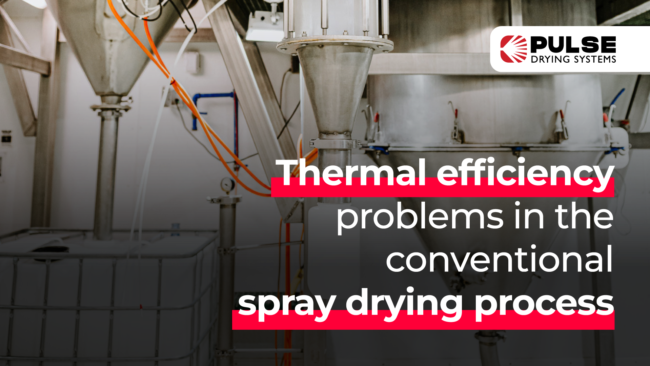
Spray drying is recognized as one of the most energy-intensive unit operations in pharmaceutical, nutraceutical, and food processing facilities. While the technology has proven essential for producing stable, bioavailable powders, thermal efficiency in spray drying continues to challenge even the most optimized facilities.
Understanding where and why energy is lost in conventional systems is the first step toward addressing what has become an issue as energy prices rise.
Spray drying is a versatile and widely adopted technique for converting liquid materials into stable, dry powders. It is used extensively in the food, pharmaceutical, and chemical industries to produce products ranging from powdered dairy and nutraceuticals to active pharmaceutical ingredients and specialty chemicals. The process offers precise control over particle size, moisture content, and functional properties, making it suitable for both high-volume production and specialized formulations.