Side-by-side evaluations of drying technologies. These articles compare pulse atomization with conventional spray drying, freeze drying, flash drying and fluid bed drying, so engineers can judge which method fits their material, quality targets and scale.
Conventional spray drying of abrasive or corrosive materials typically relies on high-pressure pumps—often reaching 5,000 psi—and restricted spray nozzles. These mechanical components are prone to rapid erosion and chemical degradation, leading to frequent maintenance cycles and inconsistent spray patterns. For process engineers, Pulse Atomization Spray Drying (PASD) provides an alternative mechanism that eliminates the fundamental dependence on high fluid pressure and restricted orifices.
In industrial spray drying, abrasive slurries present a significant mechanical challenge to conventional hardware due to the fundamental dependence on high-pressure atomization. Traditional systems achieve atomization by forcing feed through a restricted nozzle orifice, typically at pressures reaching 5,000 psi. This mechanical process results in continuous erosion of the nozzle, which increases the orifice diameter and alters the spray pattern over time.
In the food and nutraceutical industries, selecting a drying technology is a critical engineering decision that hinges on a fundamental trade-off: maintaining the highest possible powder quality while managing operational costs and throughput. For products like dairy, coffee, and flavorings, where volatile retention and bioactivity are paramount, manufacturers generally choose among three primary methods: traditional spray drying, freeze-drying, and Pulse Atomization Spray Drying (PASD).
The transition from pilot to production requires a standardized framework for comparing competing drying technologies. Selecting the appropriate system is a high-stakes decision that dictates both product viability and long-term operational costs. To facilitate an objective assessment, it’s recommended to evaluate technologies across critical categories: powder quality, demonstration capabilities, operational scale, cost, and vendor support.
In process engineering, every technology choice involves a series of trade-offs between performance, scalability, and operational requirements. While Pulse Atomization Spray Drying (PASD) offers significant advantages in thermal efficiency and powder quality, it is not a universal solution for every industrial application. To provide a transparent technical evaluation, we must address the specific areas where PASD faces limitations compared to conventional spray drying.
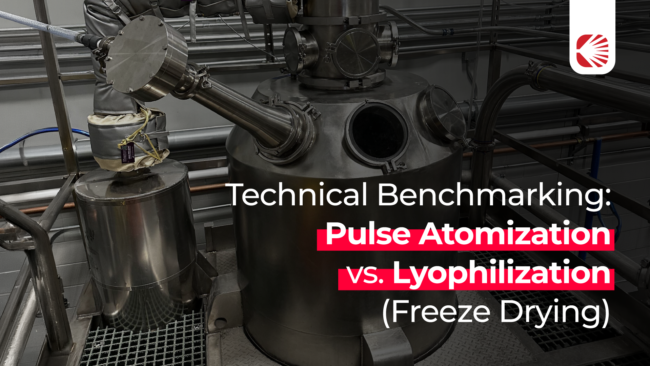
For heat-sensitive biologicals and high-value food ingredients, lyophilization (freeze drying) has long been the industry benchmark for preserving molecular integrity and volatile profiles. However, the process is inherently constrained by its thermodynamic requirements, leading to high capital expenditure and low production rates. Pulse Atomization Spray Drying (PASD) offers a continuous alternative that, for specific applications, can match the quality output of a freeze dryer while significantly improving operational economics.
In the pharmaceutical industry, product quality, defined as the delivery of uncontaminated, non-degraded, and biologically active medicines, is the primary engineering objective. For heat-sensitive materials such as proteins, vaccines, and therapeutic enzymes, the selection of a drying technology involves a critical trade-off between preserving molecular integrity and operational throughput.
Scaling a spray drying operation from R&D to production is often a non-linear and high-risk endeavor. The primary hurdle in conventional systems is the fundamental shift in atomization mechanics required as throughput increases.
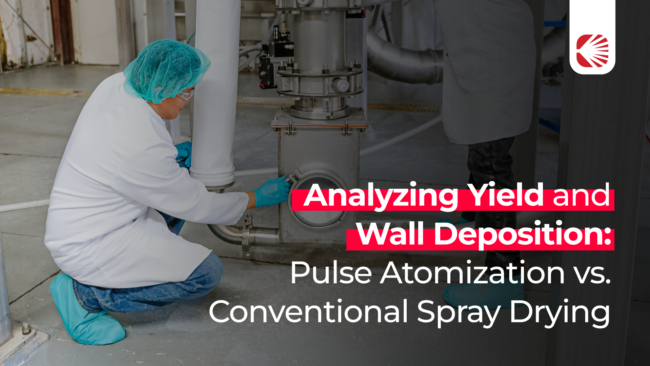
In industrial drying operations, yield is defined as the ratio of the dry matter introduced to the system versus the amount successfully collected at the cyclone. While mechanical settings such as inlet and outlet temperatures influence this metric, formulation is the primary determinant of whether a material will dry into a consistent powder or adhere to the chamber walls. From an engineering standpoint, any material that can be spray-dried with high yield can achieve equivalent or superior recovery rates using Pulse Atomization Spray Drying (PASD).
In the production of industrial powders, particle morphology and flowability are critical metrics that dictate a product’s commercial viability and ease of handling. However, because every material behaves differently depending on its unique chemical composition, concentration, and temperature requirements, these characteristics cannot be determined solely by theoretical models. To accurately assess the quality gap between Pulse Atomization Spray Drying (PASD) and conventional spray drying, a direct empirical comparison is necessary.