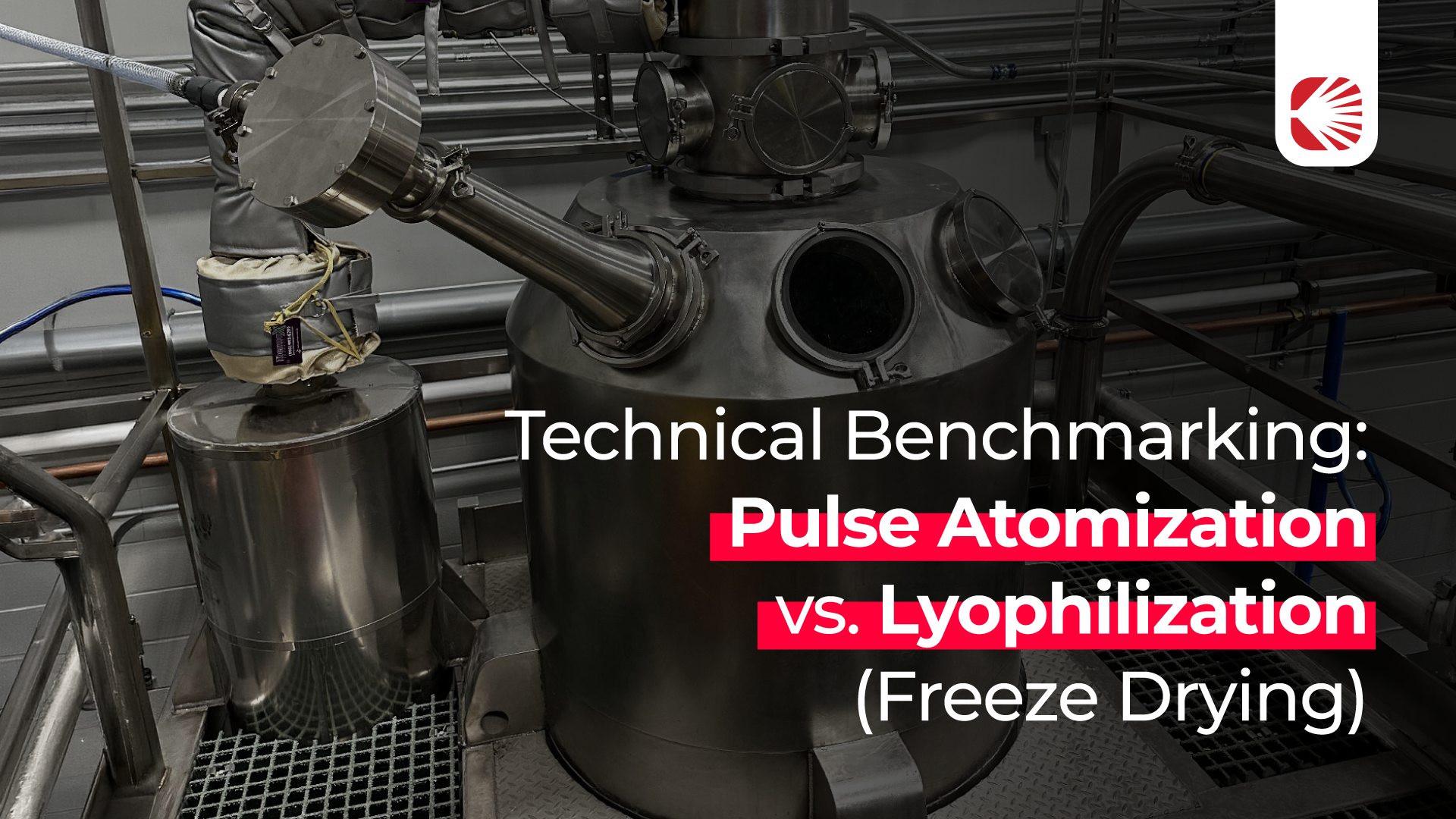
For heat-sensitive biologicals and high-value food ingredients, lyophilization (freeze drying) has long been the industry benchmark for preserving molecular integrity and volatile profiles. However, the process is inherently constrained by its thermodynamic requirements, leading to high capital expenditure and low production rates. Pulse Atomization Spray Drying (PASD) offers a continuous alternative that, for specific applications, can match the quality output of a freeze dryer while significantly improving operational economics.
The Quality Baseline: Passing the “Freeze-Dry Assay”
The primary technical hurdle for replacing a freeze dryer is verifying that an alternative method can produce a powder of identical or superior quality. In engineering evaluations, this is typically measured through an assay to ensure that bioactivity, taste, and morphology remain within specification.
Economic Divergence: Capital and Operating Costs
The economic gap between the two technologies is driven by the energy required to remove water under a vacuum versus atmospheric conditions. Lyophilization requires extensive cycle times, typically ranging from 24 to 48 hours, to manage ice sublimation. Conversely, Pulse systems utilize sub-second residence times (0.5 to 1.0 s) to achieve evaporation, allowing for a continuous process that can be five times more productive.
From a capital and operational standpoint:
- Operating Costs: Documentation suggests that producing powder via Pulse atomization can be approximately 20% of the cost associated with freeze drying, largely due to the superior thermal utilization of the high “Delta T” environment.
- Capital Investment: Because pulse technology does not require the massive vacuum chambers and refrigeration plants inherent in lyophilization, the capital cost for a pulse dryer is often estimated as a fraction of that of a freeze-drying system of equivalent capacity.
Throughput and Scaling Trade-offs
The transition from batch-based freeze drying to continuous PASD addresses a major bottleneck in manufacturing throughput. While a freeze dryer is limited by the volume of its trays and its multi-day cycle time, an industrial-scale Pulse dryer can evaporate up to 1,500 pounds of water per hour.
Are your production costs and cycle times limiting your ability to scale? Determining if your formulation can achieve freeze-dry quality in a continuous spray process requires precise empirical data. Contact our technical team today to discuss a feasibility study for your material.