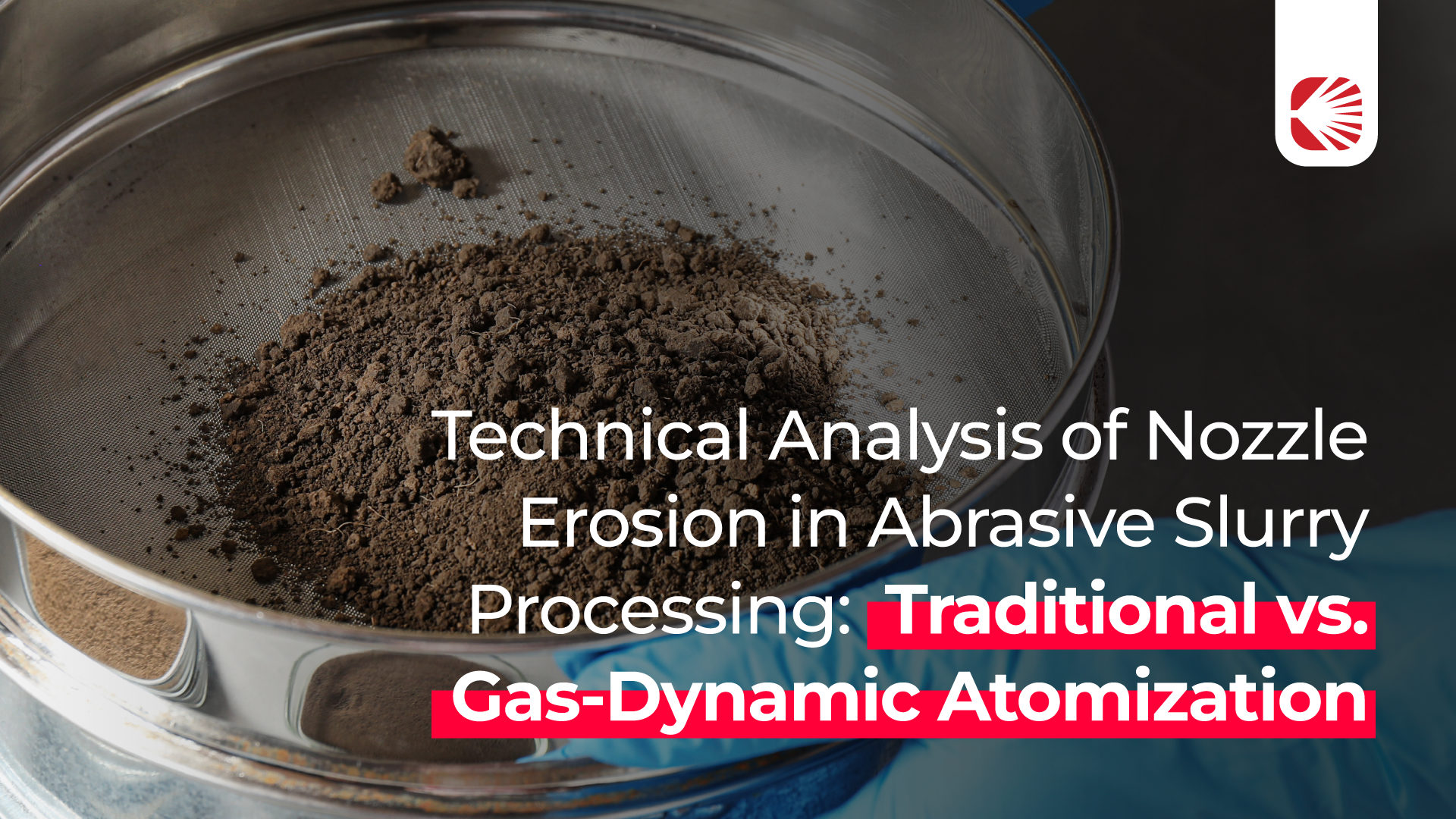
In industrial spray drying, abrasive slurries present a significant mechanical challenge to conventional hardware due to the fundamental dependence on high-pressure atomization. Traditional systems achieve atomization by forcing feed through a restricted nozzle orifice, typically at pressures reaching 5,000 psi. This mechanical process results in continuous erosion of the nozzle, which increases the orifice diameter and alters the spray pattern over time.
Operational Impact of Nozzle Wear
As the nozzle orifice enlarges due to abrasion, the system can no longer atomize the feed as it did when the component was new. This leads to a measurable drift in particle size distribution and inconsistent final moisture profiles. To mitigate these effects, process engineers often utilize ceramic or titanium nozzles. While these materials reduce the rate of wear, they do not eliminate it, forcing a trade-off between component cost and replacement frequency.
Gas-Dynamic Atomization and Maintenance Reduction
Pulse Atomization Spray Drying (PASD) offers an alternative by utilizing a low-pressure (~1 psi) delivery through an open-tube system. Because atomization is driven by the energy of a high-velocity gas stream rather than fluid pressure, the feed is introduced through a straight open tube with no internal restrictions. This configuration removes the high-pressure contact between abrasive particles and the nozzle orifice, effectively eliminating the primary mechanism of erosion and the subsequent need for specialized maintenance technicians.
System-Wide Reliability and Viscosity Handling
High-pressure pumps in conventional systems are also highly susceptible to failure when processing abrasive materials, often requiring bi-weekly overhauls in rigorous applications. PASD systems utilize low-pressure pumps, such as peristaltic units, where maintenance is simplified to the periodic replacement of an inexpensive nylon or rubber tube. Furthermore, PASD handles viscous slurries up to 5,000 cP and enables higher-solids processing up to 50%, while maintaining a sub-second residence time of 0.5 to 1.0 seconds.
The transition to gas-dynamic atomization can also be achieved through retrofitting existing tall-form dryers with an open-pipe atomizer and a low-pressure feed pump, removing high-pressure failure points from the production line.
Are you ready to audit your current maintenance costs and eliminate nozzle erosion? The most effective way to validate these performance metrics for your abrasive formulation is through a technical feasibility assessment. Contact our engineering team today to evaluate your material’s processing kinetics.