Side-by-side evaluations of drying technologies. These articles compare pulse atomization with conventional spray drying, freeze drying, flash drying and fluid bed drying, so engineers can judge which method fits their material, quality targets and scale.
In industrial spray drying, the thermodynamic history of a particle—specifically the relationship between heat intensity and exposure duration—is a primary determinant of final product quality and bioactivity. While both Pulse Atomization Spray Drying (PASD) and most conventional spray dryers operate using co-current flow, their mechanical designs result in divergent residence times and thermal protection capabilities.
In industrial spray drying, achieving a tight and consistent particle size distribution (PSD) is often considered more of an art than a science. Traditional atomization methods, such as pressure nozzles and rotary disks, frequently struggle with “distribution drift” because their mechanical components are subject to constant wear and tear. As an orifice enlarges or a disk erodes, the energy delivered to the liquid feed fluctuates, leading to a wider range of particle sizes and, in some cases, undesirable bimodal distributions. Pulse Atomization Spray Drying (PASD) addresses this fundamental mechanical limitation by utilizing gas-dynamic force rather than restrictive mechanical orifices.
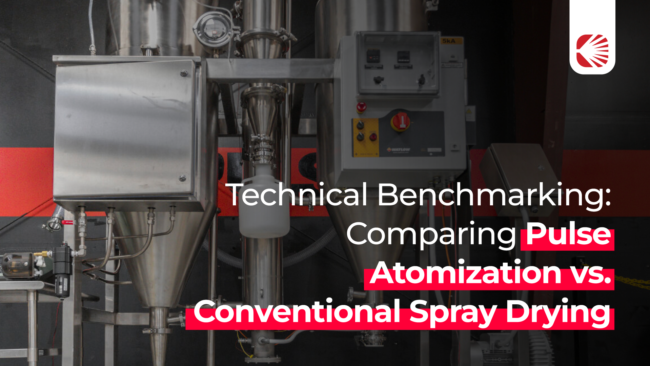
The selection of a drying technology requires a rigorous evaluation of how different atomization and heat transfer mechanisms affect the final powder and operational ROI. While conventional spray drying remains a standard for many commodity applications, Pulse Atomization Spray Drying (PASD) offers a distinct thermodynamic and mechanical profile.
When evaluating industrial drying options for high-value or heat-sensitive materials, three primary conventional technologies serve as the benchmarks for comparison against Pulse Atomization Spray Drying (PASD): pressure nozzle spray dryers, rotary atomizer spray dryers, and freeze dryers. Selecting the appropriate technology requires a technical assessment of atomization mechanics, residence time, and thermal efficiency.
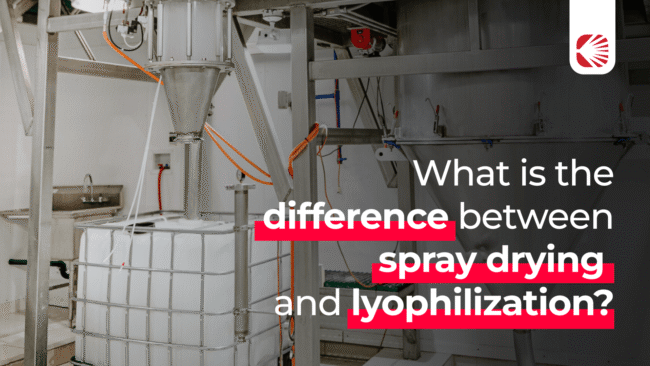
When manufacturers need to stabilize sensitive biologicals or food products, they often choose between two primary methods of dehydration. Understanding the nuances of spray drying vs lyophilization is essential for optimizing product quality and controlling production costs.
Spray dryers are commonly used to convert liquid feeds into solid particles through rapid moisture removal. However, not all particle-forming techniques rely on evaporation. One such alternative is Spray congealing, a specialized process used for materials that require a phase change from liquid to solid through cooling rather than solvent removal.
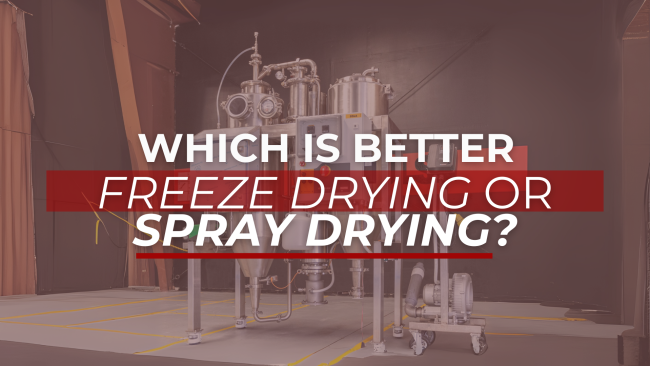
Drying technologies play an essential role in preserving foods, pharmaceuticals, and other sensitive materials. Two widely utilized methods – freeze drying and spray drying -each offer distinct advantages and limitations. This article provides a focused comparison between these processes, examining their efficiency, equipment needs, and financial viability. It identifies which method is most suitable for different applications, highlighting the value of advanced spray drying technology for achieving superior results.
Choosing the right drying technology is critical for industries where product quality, efficiency, and cost all hinge on reliable moisture removal. Flash dryers and spray dryers both serve this purpose, yet they differ fundamentally in how they operate and the types of materials they handle.
Understanding the distinctions between various drying technologies is essential for optimizing industrial processes. Here we will clarify the differences between spray dryers and fluidized bed dryers – along with related technologies like flash dryers and ring dryers – to help engineering and operations professionals select the most suitable solution for their specific needs.
Freeze-drying is a widely used method for preserving materials such as pharmaceuticals and foods due to its ability to retain the quality of the product during the process. However, the process comes with distinct disadvantages and limitations that can impact its practicality and overall value.