Spray dryers are commonly used to convert liquid feeds into solid particles through rapid moisture removal. However, not all particle-forming techniques rely on evaporation. One such alternative is Spray congealing, a specialized process used for materials that require a phase change from liquid to solid through cooling rather than solvent removal.
What is spray congealing?
Spray congealing is a process in which a molten material is atomized and solidified into particulate form through cooling. Unlike traditional spray drying, which removes moisture or solvent to form a solid crust, spray congealing involves the phase change of a melt into a solid state without evaporation.
This process is particularly practical for formulations where the active ingredient is dissolved or suspended in a molten carrier, such as a lipid or wax. By avoiding the need for solvents, the process eliminates the energy required for the latent heat of vaporization, focusing instead on the removal of the latent heat of fusion.
What is the spray congealing method?
The spray congealing method follows a specific sequence: melting the feed material, atomizing it into fine droplets, and subjecting those droplets to a cooling medium to trigger solidification. This process, often referred to as Spray Chilling, relies on the temperature of the incoming air being lower than the melting point of the carrier material.
Key equipment requirements include a heatable feed system to maintain the liquid state of the melt, and a high-efficiency atomizer. In pulse atomization systems, intense mixing and uniform conditions help ensure that each droplet experiences a consistent processing environment, which is critical for uniform particle formation.
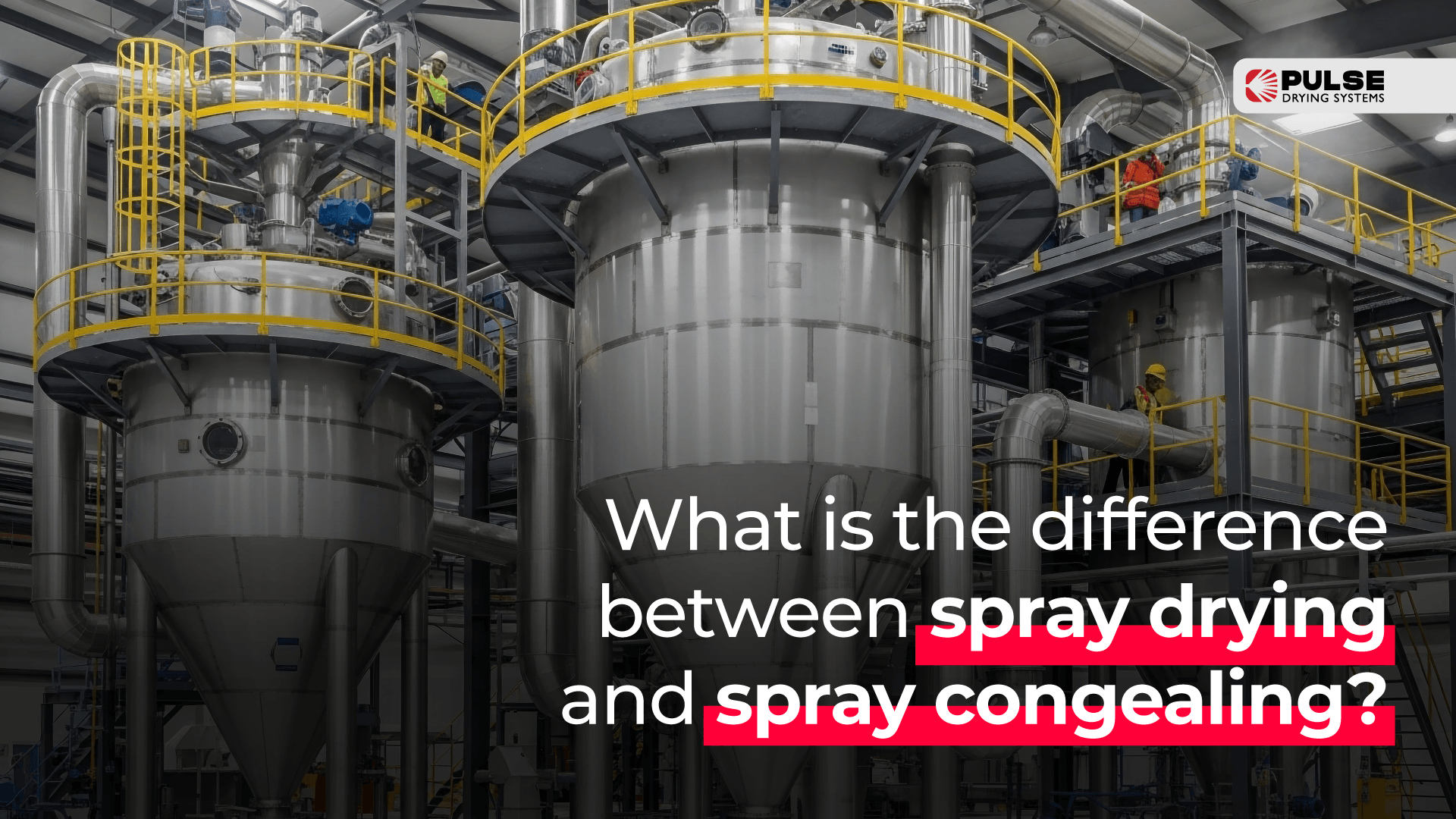
What is the difference between spray drying and spray congealing?
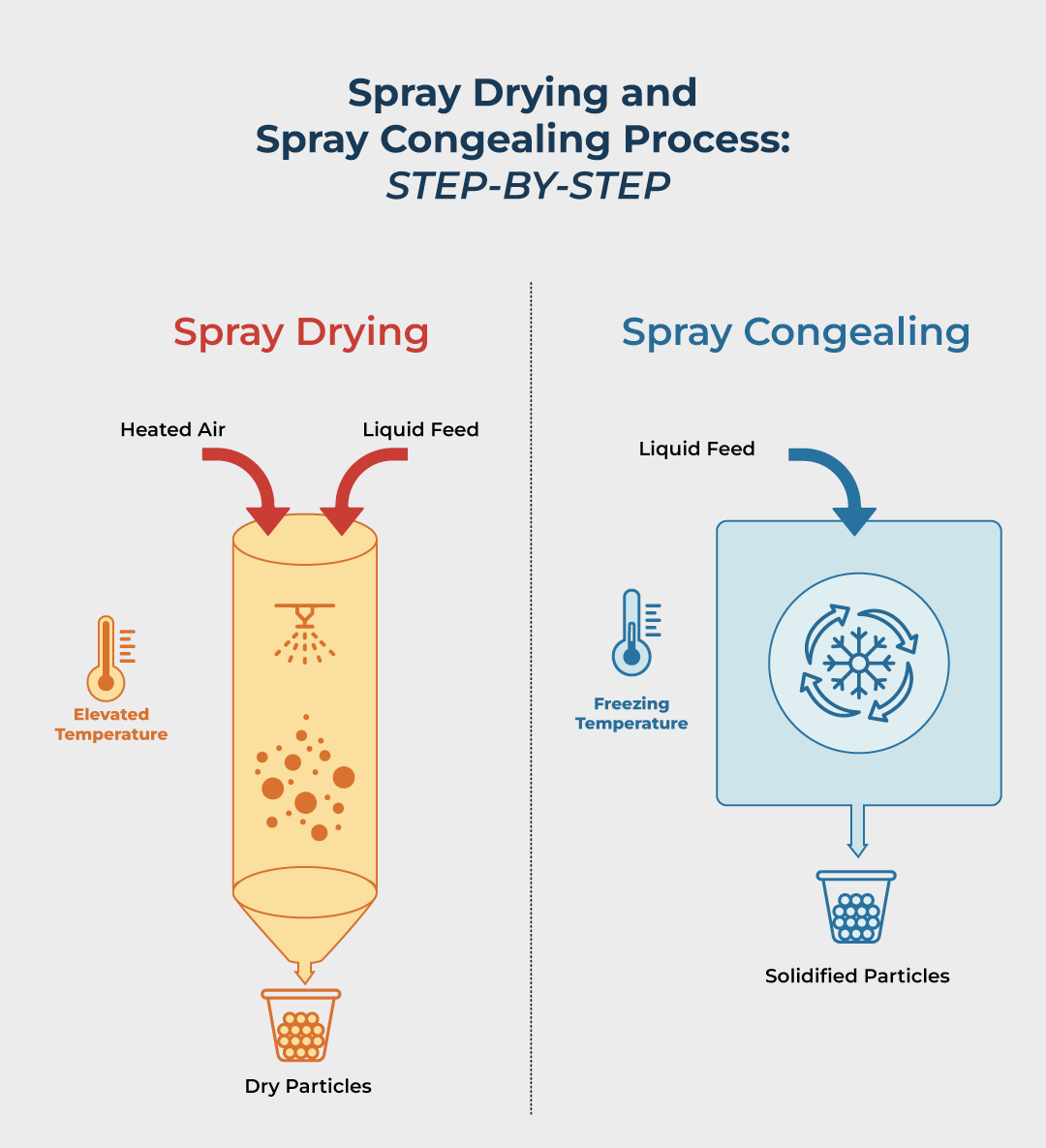
The fundamental difference between spray drying and spray congealing is the physical mechanism of particle formation: spray drying uses evaporation, while spray congealing uses solidification. Spray drying requires hot gas to drive off moisture, and creates a massive evaporation surface area for heat and mass transfer from the atomization of a liquid feed into fine droplets. While conventional spray dryers often struggle with efficiency, advanced pulse drying systems can achieve significantly higher thermal efficiency ranges than those typically observed in conventional spray dryers.
Conversely, spray congealing requires a cooling environment to solidify a molten feed. Again, pulse congealing units are highly effective due the fine atomization and rapid mixing of the atomized droplets and the cooling air.
| Feature | Spray Drying | Spray Congealing |
| Phase Change | Liquid to solid via evaporation | Molten to solid via cooling |
| Energy Requirement | Latent heat of vaporization | Latent heat of fusion |
| Gas Temperature | Higher than the boiling point of the solvent | Lower than the melting point of the carrier |
| Material Compatibility | Aqueous or solvent-based solutions | Waxes, lipids, and plastics |
Temperature requirements differ meaningfully between the two processes. Spray drying utilizes inlet temperatures of 200–425 °C, while Spray Chilling operates at temperatures lower than the melting point of the carrier material. Material compatibility also varies: spray drying is preferred for heat-sensitive aqueous solutions, while spray congealing is chosen for lipid-based formulations.
Typical applications and industries also differ by method. Spray drying is widely used across pharmaceutical manufacturing (APIs and excipients), food processing (dairy powders and instant products), and chemical industries (detergents and catalysts). Spray congealing, by contrast, is primarily employed in pharmaceutical applications (controlled-release formulations and taste-masking), nutraceutical production (lipid-based supplements), specialty food applications (where fat-soluble ingredients require encapsulation in wax or lipid carriers), and specialty products such as micronized paint substrates
What is spray drying and spray congealing of pharmaceuticals?
Spray drying and spray congealing of pharmaceuticals are essential for developing advanced drug delivery systems, such as controlled-release matrices and taste-masked powders. Pharmaceutical spray drying is the industry benchmark for creating stable APIs and excipients, with the process currently utilized in over 80% of food flavor and related bio-active manufacturing.
Pharmaceutical spray drying applications include API processing, excipient production, and microencapsulation for improved bioavailability. Spray congealing is primarily used for lipid-based formulations, controlled-release systems, and taste masking applications where the drug is entrapped within a fatty matrix for better absorption.
When choosing between these methods, manufacturers consider both the formulation’s thermal sensitivity and delivery requirements. Both processes are subject to rigorous regulatory standards to ensure particle consistency. Pulse technology can enhance Relative Span Factor (RSF) performance compared to traditional spray drying methods, supporting more uniform particle size distributions for pharmaceutical applications.
Looking for the right drying technology for your pharmaceutical or food application? Pulse Drying Systems offers advanced spray drying solutions with Pulse Atomization technology that delivers superior particle quality and cost efficiency. Our expert team can help you determine the best process for your specific needs. Contact us today to discuss your project and discover how Pulse technology can transform your production process.
The information in this article is provided for general educational purposes and to promote overall awareness. It is not intended as engineering, legal, or other professional advice, and should not be used in place of consultation with qualified professionals familiar with your specific application and conditions. This content should not be considered exhaustive.