Spray dryers serve as the primary technology for transforming liquid formulations into stable, high-quality powders in the industrial processing sector. One of the most sophisticated applications of this technology is spray drying microencapsulation, a technique that allows manufacturers to protect active ingredients from the environment.
By utilizing this method, producers can ensure the stability, controlled release, and extended shelf life of various compounds. This article explores the mechanics of how spray drying microencapsulation is achieved and why it remains the industry standard for food, pharmaceutical, and nutraceutical applications.
What is spray drying in microencapsulation?
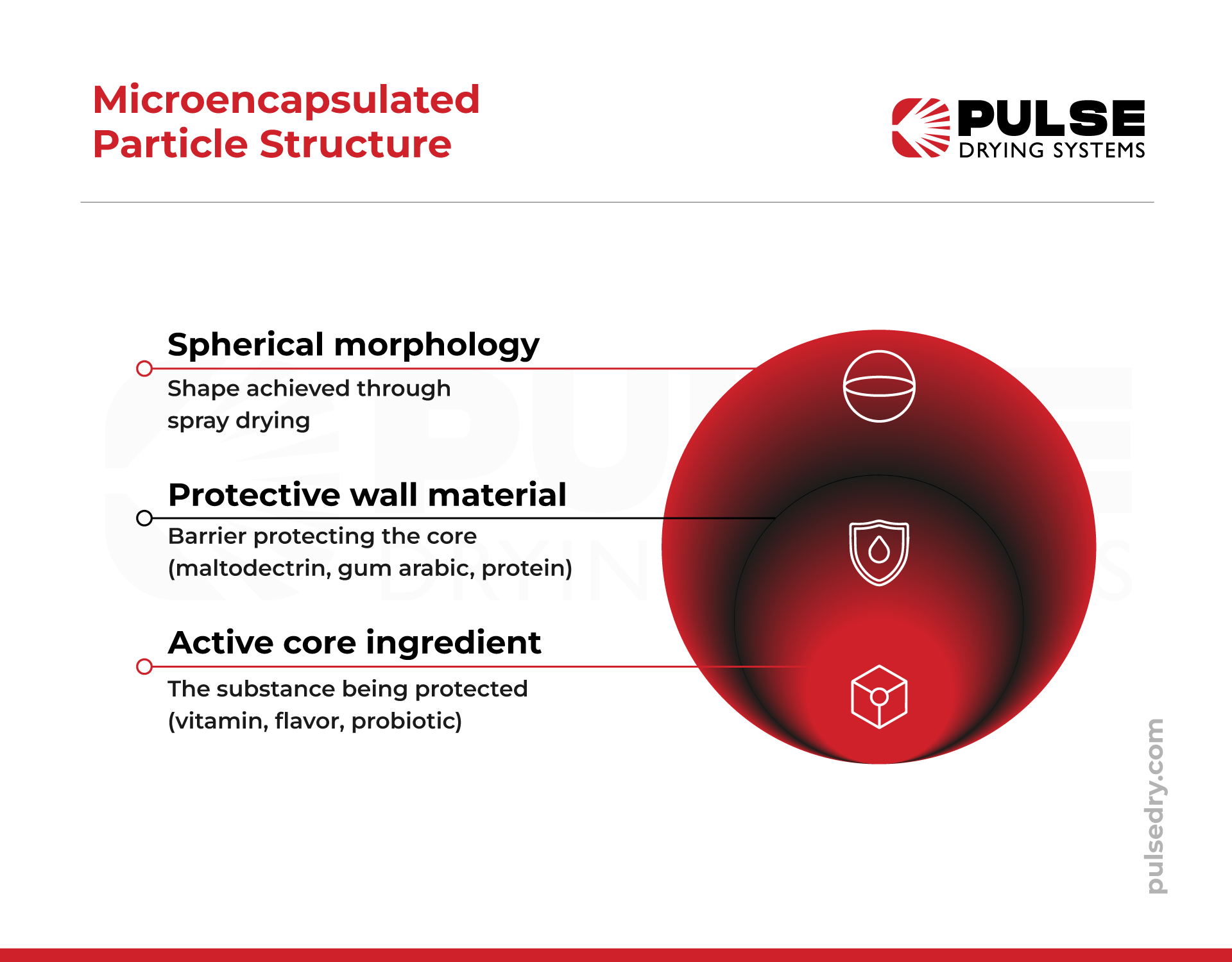
Spray drying in microencapsulation is the process of trapping an active “core” ingredient within a protective “wall” or matrix material during the drying stage. The goal is to isolate the core substance – such as a vitamin, flavor, or probiotic – from light, oxygen, or moisture.
Spray drying microencapsulation creates a physical barrier that prevents the active ingredient from degrading or reacting prematurely. It is widely used in the food industry to stabilize volatile oils, and in pharmaceuticals to ensure drugs are delivered efficiently within the human body.
The selection of wall materials comprising the physical barrier is critical to the success of the encapsulation. Common matrix materials include:
- Carbohydrates like maltodextrin or corn syrup solids.
- Natural gums such as gum arabic (gum acacia).
- Proteins, including whey protein isolate or soy protein.
What is the spray drying microencapsulation process?
The spray drying microencapsulation process consists of several fundamental stages: emulsion preparation, atomization, droplet drying, and particle collection. It begins by creating a stable blend of the active core and the wall material, often requiring an emulsification step to ensure uniform distribution.
Following preparation, the feed is introduced into a spray dryer where an atomizer breaks the liquid into millions of tiny droplets. These droplets enter a drying chamber where they are exposed to hot air for evaporation of the water. Advanced systems utilize inlet temperatures ranging from 200 to 425 °C to drive rapid evaporation.
As moisture evaporates, the wall material solidifies around the core, forming a protective shell. Precise control over temperature is essential, as the latent heat of vaporization helps maintain the internal temperature of the particle at a low level. This “consistent drying environment” ensures that the finished powder experiences an outlet temperature range of 70–105 °C.
What is the spray drying method for microspheres?
The spray drying method for microspheres is a rapid dehydration technique used to create fine, spherical particles with specific release characteristics. These microspheres can be engineered as single-core structures, where one droplet is centered in the matrix, or multi-core structures containing many smaller internal droplets.
Morphology and particle size are controlled by adjusting the feed rate, atomization pressure, and viscosity of the liquid. High-intensity mixing ensures the wall material encapsulates the core evenly. For heat-sensitive protein compositions, the residence time of a particle within the drying chamber is typically less than five seconds.
This rapid processing is essential because it prevents thermal damage to the active ingredients. Even when utilizing high inlet temperatures for better thermal efficiency, the “strong evaporative cooling” effect protects the core material from reaching peak temperatures. This results in microspheres with high retention of biological activity and nutritional value.
What are the advantages of spray drying in microencapsulation?
The advantages of utilizing a spray drying microencapsulation machine include its scalability, continuous production capabilities, and cost-efficiency compared to methods like freeze drying. It allows for the high-volume production of protected ingredients with uniform particle size distribution.
Thermal efficiency is a standout benefit of modern Pulse Atomizing Spray Dryers. These machines reach operational efficiencies between 45% and 67% (approximately 2250 to 1500 Btu/lb), which is significantly higher than the 28.5% to 40% efficiency seen in conventional spray dryers. This efficiency reduces energy costs while maintaining high production throughput.
In addition, the process provides:
- Enhanced protection for sensitive probiotics and enzymes.
- Controlled release profiles for pharmaceutical APIs (Active Pharmaceutical Ingredients).
- Improved shelf stability for volatile flavoring agents.
- Better flowability and handling characteristics for the final powder.
Conclusion
Efficient microencapsulation depends on a consistent drying environment that balances high throughput with the delicate protection of active cores. While traditional methods often struggle with thermal damage, pulse atomization spray drying provides a unique “strong evaporative cooling” effect that preserves sensitive ingredients, even at high inlet temperatures. This ensures that proteins, enzymes, and probiotics retain their biological activity and functional properties.
Manufacturers can achieve superior results with thermal efficiencies reaching 45% to 67%, a significant improvement over conventional spray dryer performance. By maintaining dryer outlet temperatures of 70–105 °C, Pulse Drying Systems ensures uniform conditions that produce high-quality, stable microspheres with tight size distributions. This technology is a transformative asset for those in the food, pharmaceutical, and nutraceutical sectors.
Ready to implement microencapsulation in your production process? Pulse Drying Systems offers advanced technology that delivers superior encapsulation efficiency and particle quality. Our systems are engineered to protect your most sensitive formulations while maximizing operational efficiency. Contact our technical team today to discuss your microencapsulation requirements and discover how Pulse technology can enhance your product performance.
The information in this article is provided for general educational purposes and to promote overall awareness. It is not intended as engineering, legal, or other professional advice, and should not be used in place of consultation with qualified professionals familiar with your specific application and conditions. This content should not be considered exhaustive.