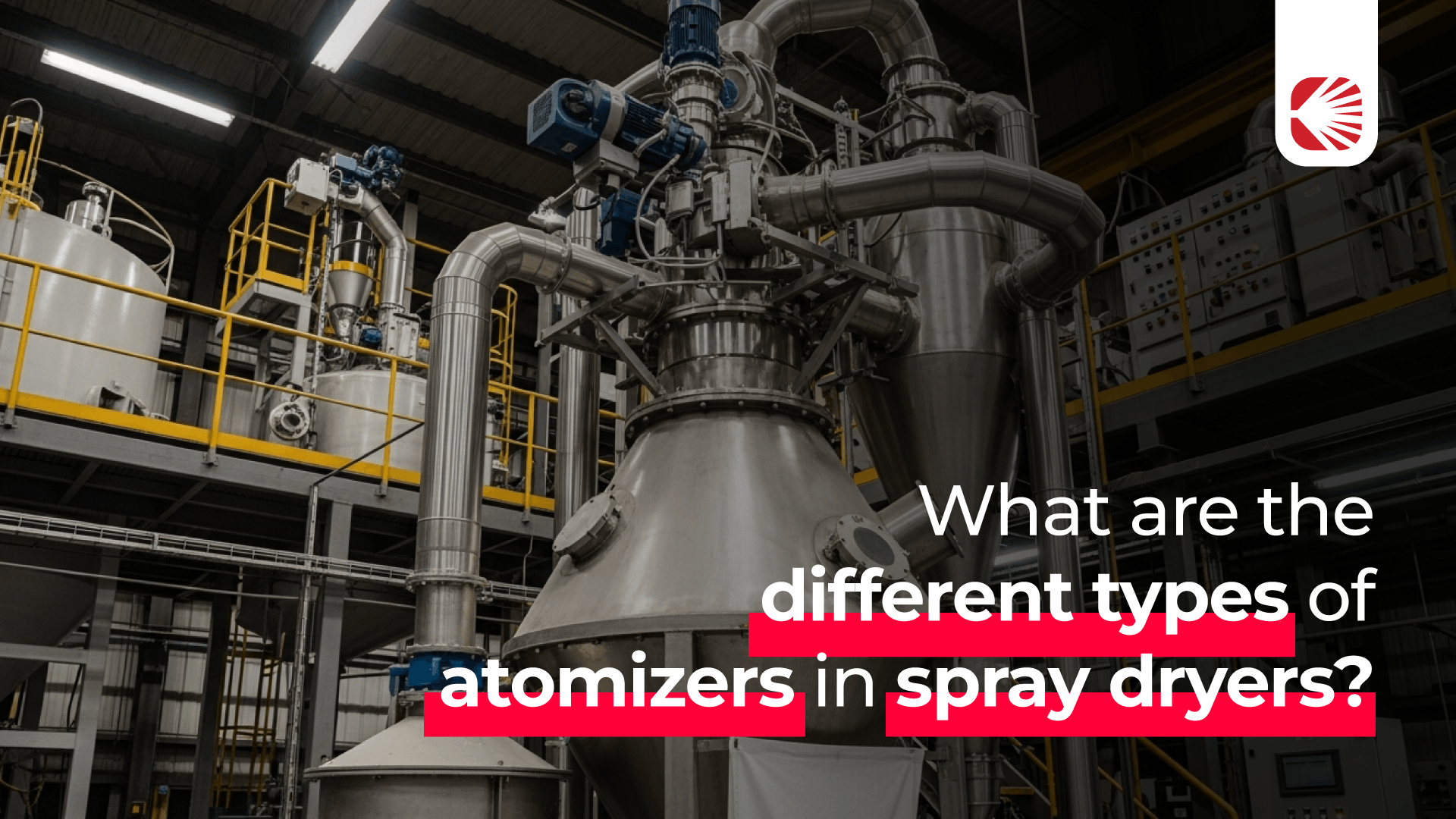
Atomization is the critical mechanical process that converts bulk liquid into a controlled “cloud” of fine droplets to provide the necessary surface area for rapid drying. Selecting the correct types of atomizers in spray dryers is the most significant technical decision in system design, as it dictates the efficiency of the entire operation.
Effective spray dryer atomizers create the foundation for high-quality powder production by determining the initial droplet size distribution. To put the physics of this process into perspective, when a single 1 ml liquid drop is atomized into fine 1 µm droplets, the available surface area increases by a factor of 1,000.
This massive increase in surface area allows for nearly instantaneous heat transfer, which is the defining characteristic of Spray Dryers. Since the atomizer must handle feedstocks ranging from low-viscosity solutions to heavy slurries, different mechanical designs have been developed.
What are the types of atomization in spray drying?
The primary spray dryer atomization methods are rotary disk, pressure nozzle, and two-fluid nozzle, with modern pulse atomization representing the technological frontier. Understanding the specific types of atomizers in spray dryers is essential because this stage is considered the most vital part of the process, determining the effectiveness of the drying step and particle morphology
Traditional atomization in spray drying relies on different forms of energy to overcome the surface tension and viscosity of the feed liquid. Due to the water’s surface tension, the atomizer must provide enough energy to tear the bulk liquid into thin ligaments that eventually snap into spherical droplets.
In addition to traditional mechanical methods, Pulse Drying Systems has introduced an innovation called “pulse atomization spray drying”. Unlike conventional tools that rely on high-speed rotary disks or pressure nozzles, this method uses gas-dynamic forces to create a consistent drying environment that handles heat-sensitive materials with far less degradation.
Rotary atomizer vs nozzle atomizer: Which is better?
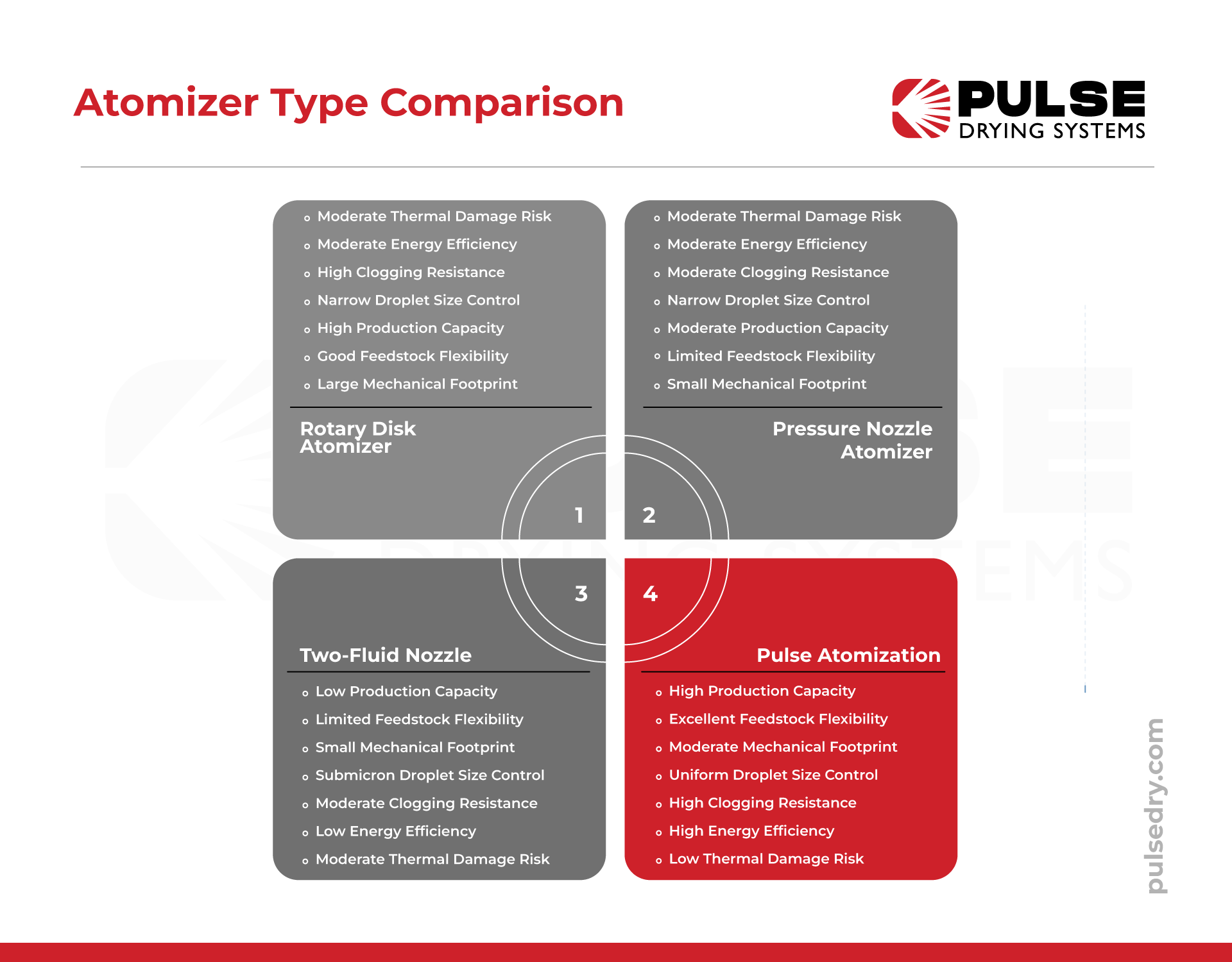
The rotary atomizer vs nozzle atomizer debate centers on production capacity, feedstock flexibility, and mechanical footprint. Rotary systems provide high capacity and handle viscous or abrasive feeds well, but require wider drying chambers due to horizontal spray trajectories.
Centrifugal disk atomizers spin at speeds up to 30,000 rpm to shear liquid into droplets. They are favored for large-scale dairy production because they are less prone to clogging, while maintaining a narrow particle size distribution even if the feed rate fluctuates. Conversely, pressure nozzles operate via hydraulic pressure and require “tall-form” dryer designs due to their narrow, downward spray pattern.
Two-fluid nozzles represent a third traditional option within spray dryer atomization methods, using high-velocity compressed gas to atomize low-viscosity feeds. While ideal for creating submicron particles for pharmaceutical applications, the high cost of compressed air often makes them less attractive for heavy industrial processing. Also, these atomizers do not scale up well, and are often confined to laboratory dryers used for product development.
What is the best atomizer for spray drying?
The best atomizer is the one that balances your specific feedstock characteristics, such as viscosity and solids content, with your desired final powder qualities and thermal efficiency goals. For large-tonnage operations such as dairy or egg processing, pressure nozzles are common.
When comparing spray dryer atomization methods, one must account for the relationship between viscosity and droplet size. In traditional systems, as you increase the concentration of the feed to save energy, the average droplet size increases, often resulting in poor drying performance or product degradation.
Process engineers are discovering pulse atomization from Pulse Drying Systems as the superior alternative. This technology allows for higher-than-usual inlet temperatures, ranging from 200–425 °C. Its rapid atomization provides such intense evaporative cooling that the product remains protected from thermal damage.
This method provides a consistent drying environment that traditional rotary or nozzle systems struggle to maintain at high throughput. By using gas-dynamic atomization rather than mechanical shearing, these systems eliminate the wear-and-tear issues of pressure nozzles, especially on corrosive or abrasive feeds
How does atomization affect spray drying performance?
Atomization performance directly dictates drying kinetics, which determines the thermal efficiency of the system and the functional integrity of the final powder. High-performance atomization in spray drying ensures every droplet is dried uniformly, preventing the moisture-related degradation that occurs in less controlled environments.
The speed of the process is one of its most remarkable attributes; Pulse Drying systems are capable of drying food products in as little as 1 second. This rapid transit through the “high heat zone” is essential for preserving the bio-activity of constituent enzymes and ensuring the product retains its “natural” looking color and its aroma.
Furthermore, the choice of atomizer impacts the bottom line through energy consumption and yield. Conventional spray dryers typically operate at thermal efficiencies between 28.5% and 40%, but pulse dryers from Pulse Drying Systems reach efficiencies between 45% and 67%.
This efficiency is achieved through a high “Delta-T” in the dryer, and very high heat transfer, protected by evaporative cooling. By ensuring consistent droplet sizes and high-intensity atomization, these systems reduce the amount of energy required to remove each pound of water, making the process both more sustainable and more profitable for the modern manufacturer.
Conclusion:
The atomizer is the heart of any spray dryer, and choosing the right type is critical for your operational success. Pulse Drying Systems has revolutionized the industry with its proprietary and patented pulse atomization spray drying technology, delivering superior droplet uniformity and particle quality compared to conventional rotary and nozzle atomizers.
Our innovative approach ensures uniform conditions that protect your most sensitive formulations while significantly reducing energy consumption. Contact the Pulse Drying Systems team today to learn how our Pulse Atomization technology can transform your spray drying results and maximize your production efficiency.
The information in this article is provided for general educational purposes and to promote overall awareness. It is not intended as engineering, legal, or other professional advice, and should not be used in place of consultation with qualified professionals familiar with your specific application and conditions. This content should not be considered exhaustive.