
A flash dryer is a pneumatic system that evaporates surface moisture almost instantly by suspending solids in a high-velocity hot air stream. With a residence time typically measured in just seconds, the flash drying process supports rapid drying. This may help reduce the risk of thermal degradation under appropriate operating conditions. While often grouped with Spray Dryers, flash dryers are specifically optimized for particulates like filter cakes and minerals rather than liquid feeds.
What is a flash dryer and how does it work?
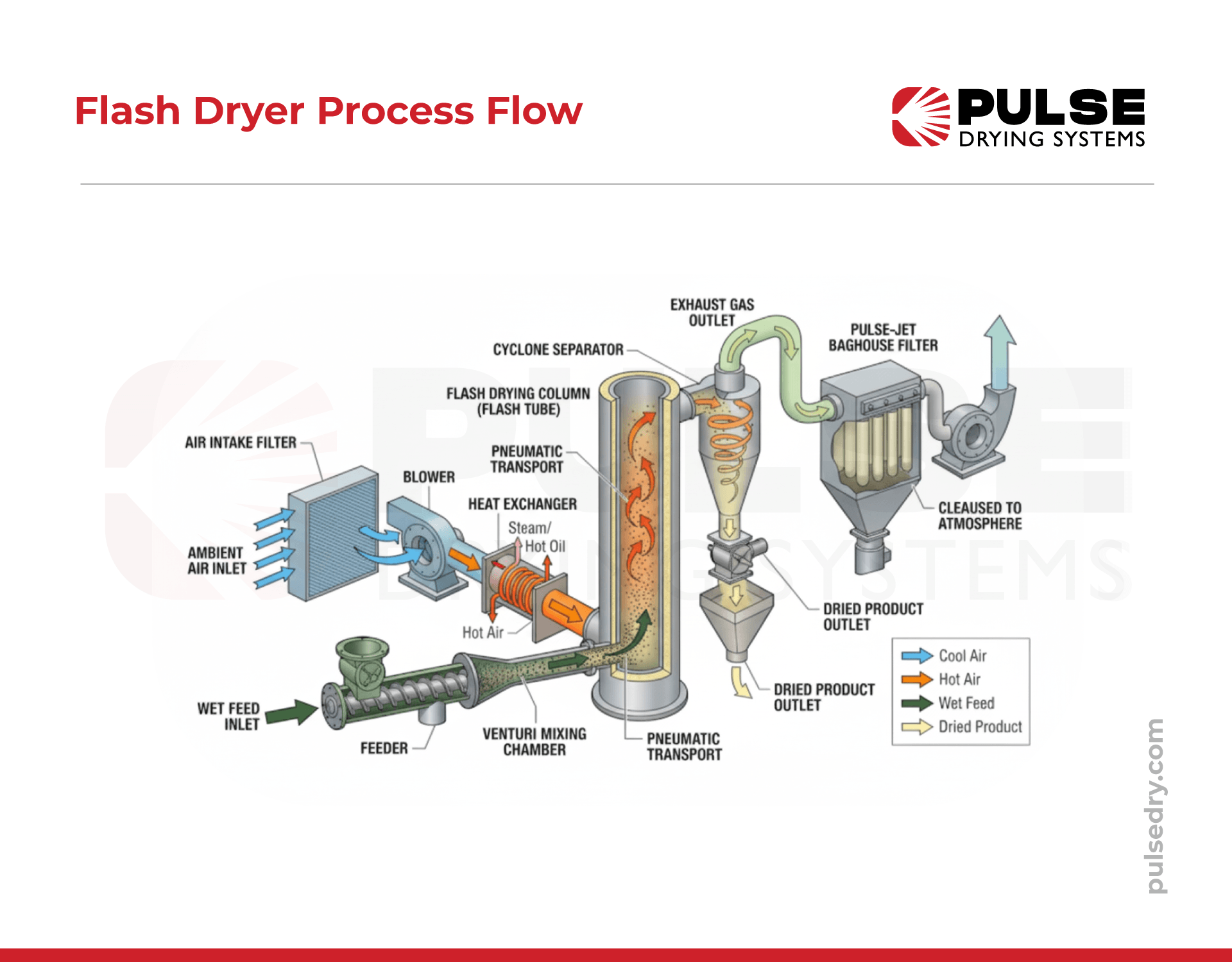
A flash dryer works by suspending wet material in a high-velocity stream of hot air, during which the moisture is “flashed” off during transport through a drying column. It is designed for the rapid removal of surface moisture from powders, granules, and small particles that can be easily dispersed in a gas stream.
The system relies on a set of integrated components to ensure efficient heat transfer. A standard setup includes an air heater for heating to the required processing temperatures and a venturi mixer where the wet feed is introduced into the air stream. The material then travels through a vertical drying tube before entering a cyclone separator and product collector for final recovery.
What is the flash drying process?
The flash drying process is a multi-step pneumatic operation that involves material feeding, air heating, dispersion, transport, and separation. The material is typically fed into the stream at a constant rate, where it is immediately caught in a turbulent environment that ensures a consistent drying environment.
One of the most defining characteristics of this technology is the speed of evaporation. The residence time for material in a flash dryer is typically of a duration measured in seconds, making it one of the fastest thermal drying methods available. During this brief window, moisture is removed while the material is carried to the separation stage.
To maintain high throughput, these systems utilize specific air velocities and temperature ranges. Conventional spray dryers operate within defined inlet/outlet temperature ranges depending on material and configuration; flash systems often utilize higher ranges to accommodate the extremely short contact time. This requires a feedstock having a uniform particle size and manageable initial moisture content to prevent clogging.
What is the purpose of a flash dryer?
The primary purpose of flash dryer technology is the rapid removal of surface moisture from solids that do not require internal diffusion drying. It is frequently used as a pre-drying stage to reduce the load on secondary equipment or as a final drying stage for filter cakes and centrifuge products.
This system offers several industrial advantages for high-volume production:
- Minimal Thermal Degradation: The short residence time ensures that heat-sensitive materials are not exposed to high temperatures long enough to damage their core properties.
- Compact Footprint: Because the drying happens within the conveying line, these systems often require less floor space than spray dryers.
However, there are limitations to this technology. It is generally unsuitable for solutions or slurries and offers limited control over final particle morphology or size distribution.
What are the common flash dryer uses and applications?
Industrial flash dryer uses span a wide variety of sectors, including chemical processing, minerals, pigments, and food ingredient manufacturing. It is commonly used for drying particulate materials such as crystalline products, pharmaceutical intermediates, and chemical powders.
Specific use cases often include:
- Filter Cake Drying: Removing moisture from dense cakes produced by industrial filter presses.
- Pre-Drying: Reducing moisture levels before the material undergoes more complex processing.
- Mineral Processing: Drying finely ground ores or minerals.
While flash dryers are excellent for surface moisture and particulate feeds, they differ significantly from spray dryers, which are better suited for liquid feeds such as solutions or slurries, while providing superior control over particle formation and structure. Understanding these differences helps manufacturers select the optimal solution for their specific application.
Conclusion
Choosing the right drying technology is essential for your production needs. While flash dryers excel at rapid removal of surface moisture, they are limited in their applicability. If a spray dryer is the right choice, Pulse Drying Systems specializes in advanced spray drying solutions that offer superior control over particle characteristics while handling liquid feeds efficiently. Our team can help you evaluate whether flash drying, spray drying, or a combination approach is best for your specific application. Contact us to discuss your drying requirements and find the optimal solution for your process.
The information in this article is provided for general educational purposes and to promote overall awareness. It is not intended as engineering, legal, or other professional advice, and should not be used in place of consultation with qualified professionals familiar with your specific application and conditions. This content should not be considered exhaustive.