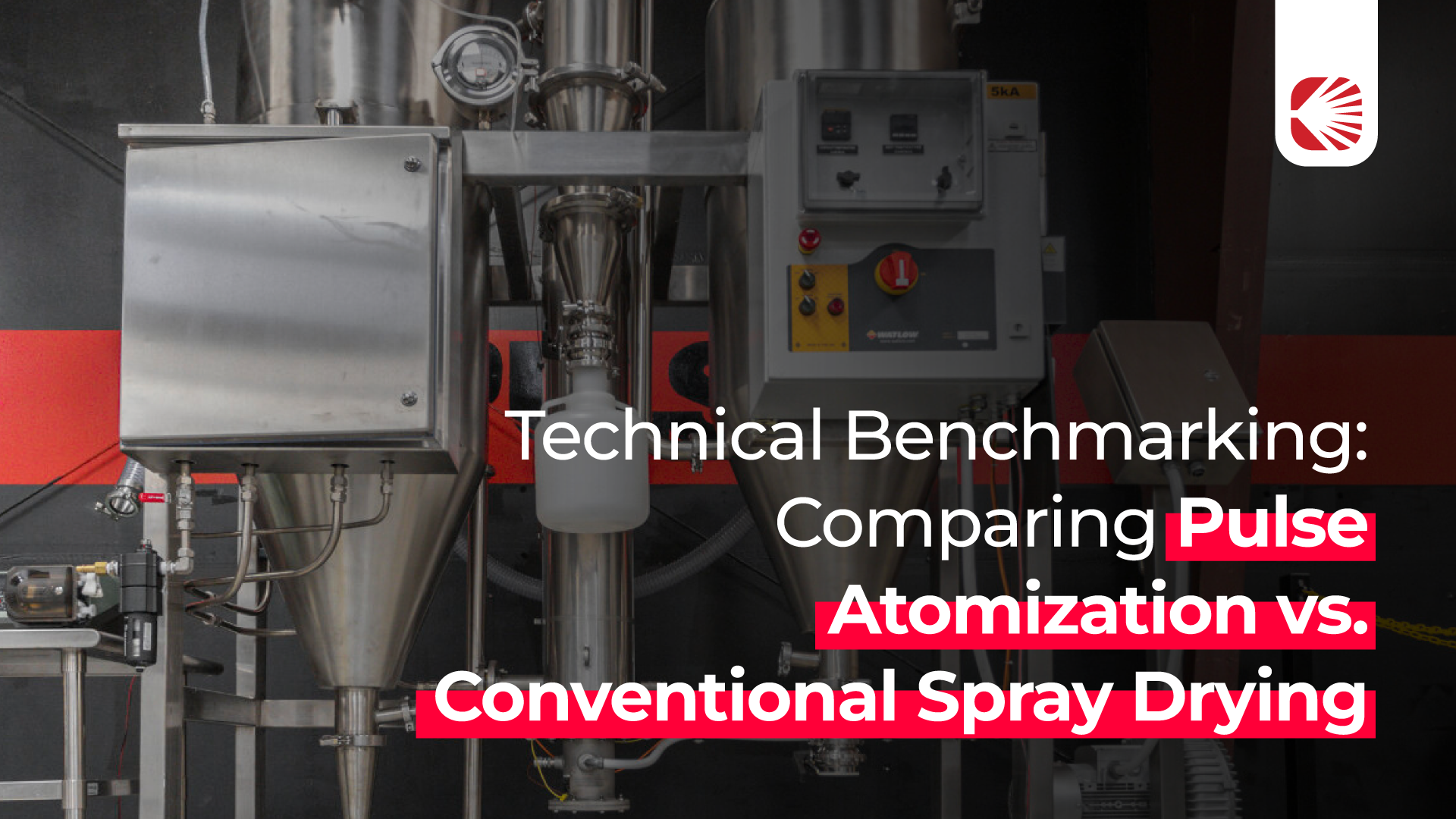
The selection of a drying technology requires a rigorous evaluation of how different atomization and heat transfer mechanisms affect the final powder and operational ROI. While conventional spray drying remains a standard for many commodity applications, Pulse Atomization Spray Drying (PASD) offers a distinct thermodynamic and mechanical profile.
To facilitate a technical comparison, we have outlined the six key attributes where these technologies diverge most significantly.
Comparative Attribute Matrix
| Attribute | Conventional Spray Drying | Pulse Atomization (PASD) |
| Atomization Mechanism | Mechanical: High-pressure nozzles (up to 5,000 psi) or high-speed rotary disks. | Gas-dynamic: Low-pressure (~1 psi) delivery through an open tube into a high-velocity gas stream. |
| Particle Size Uniformity | Higher Relative Span Factor (RSF ~3.42); prone to distribution drift as nozzles wear. | Lower RSF (~2.71); more homogeneous distribution because every droplet experiences the same atomization energy. |
| Residence Time | Typically 15 to 30 seconds. | Sub-second (0.5 to 1.0 second). |
| Thermal Efficiency | 2,500 – 3,500 BTU per pound of water removed. | 1,500 – 2,500 BTU per pound of water removed. |
| Viscosity & Solids Ceiling | Limited by nozzle diameter; typically requires dilution for feeds above 500 cP. | Handles viscous slurries up to 5,000 cP; enables higher-solids processing (e.g., 50% vs 25%). |
| Maintenance Profile | High: Abrasive and corrosive feeds require frequent overhauls of high-pressure pumps and nozzle replacement. | Low: Open-pipe system (often ceramic) has no moving parts or restricted orifices to wear. |
Engineering Analysis of Key Attributes
1. Atomization and Mechanical Wear
The most immediate mechanical difference is the elimination of high-pressure requirements. Conventional dryers act like a garden hose nozzle, pushing liquid through a tiny orifice to create a mist. In abrasive or corrosive applications, this leads to a continuous cycle of overhauling high-pressure pumps and replacing worn nozzles. PASD solves this by using an “open pipe” feed system. Because the atomization is driven by the energy of the gas stream rather than the pressure of the fluid, the feed system can utilize corrosion-resistant materials like ceramic tubes that can operate indefinitely without erosion.
2. Thermal Integrity and Bioactivity
Product degradation is a function of “time-temperature” history. In conventional towers, the longer residence time (up to 30 seconds) limits the allowable inlet temperature. PASD’s sub-second drying allows for much higher inlet temperatures (up to 1,000°F) because the material is never exposed to heat long enough for its internal temperature to reach the gas temperature. This protection is evidenced by the ability to dry egg whites while retaining 98.4% protein activity and essentially zero degradation. Pulse Drying Systems has earned a patent on this capability.
3. Operational Efficiency and Throughput
The ability to process higher-solids feeds directly impacts the cost per finished pound. Conventional systems often require feed dilution to reach a pumpable viscosity for small nozzle orifices. By moving from 25% solids to 50% solids, a facility can cut the amount of water removed by two-thirds and triple the powder throughput on the same footprint. This, combined with a higher “Delta T” (the difference between inlet and outlet temperatures), drives the thermal efficiency closer to (1,500) the theoretical limit of 1,000 BTU per pound of water.
4. Powder Morphology and Quality
While conventional methods often produce solid, dense particles, the rapid evaporation in a pulse system typically yields hollow, smooth, spherical particles. Additionally, because there are no mechanical heads to wear out, the particle size distribution remains consistent throughout the production run, eliminating the “distribution junk” often found in conventional batches.
Are you looking to optimize your production efficiency or improve powder consistency? The most effective way to validate these performance metrics for your material is through empirical testing. Contact our technical team today to discuss a feasibility trial for your product.