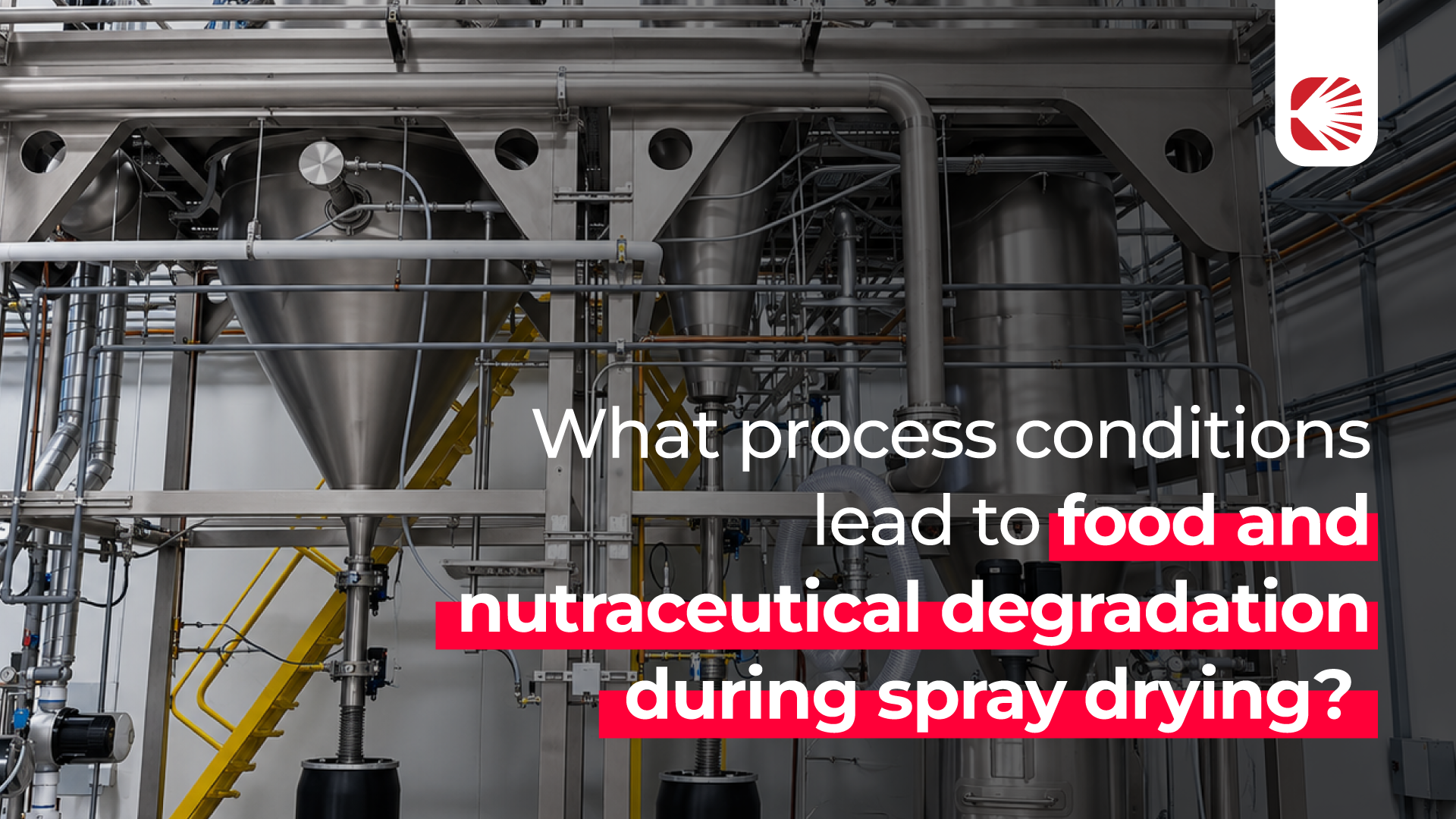
For manufacturers of high-value foods and nutraceuticals, the spray dryer is often the most critical piece of equipment in the facility. While the goal is to create a stable, free-flowing powder, the wrong process conditions can quickly transform premium ingredients into scorched, inactive, or unsellable “junk”. Understanding the root causes of this degradation is the first step toward achieving consistency in the output.
1. The “Time-Temperature” Trap
The most common misconception in process engineering is that heat alone causes damage. In reality, degradation is a function of both temperature and residence time.
In conventional spray dryers, atomized droplets typically spend 15 to 30 seconds in the drying chamber. While this seems brief, it is long enough for heat-sensitive proteins and enzymes to reach their “denaturation temperature”, often between 75°C and 90°C, at which point they lose their native molecular structure. Once denatured, a nutraceutical may lose its therapeutic efficacy, and a food protein may lose its ability to foam or gel.
2. The Oven Effect: Wall Deposition
A dryer may appear to be running within specification yet still produce degraded product if material sticks to the drying chamber walls. When powder adheres to the stainless steel, it is no longer being “dried” in a fraction of a minute; instead, it is effectively being baked in an oven for the entire duration of the production run.
This prolonged thermal stress leads to scorching and discoloration, which you will see immediately as “black specks” or a pale yellow tint in the powder. More importantly, anything that stays on the wall is usually a total loss, significantly reducing the total yield.
3. The Hidden Enemy: High Oxygen Exposure
Not all degradation is visible. For many foods and nutraceuticals, the primary cause of flavor loss or rancidity is oxidation. Conventional spray dryers use massive volumes of hot, ambient air for drying. This oxygen-rich environment, combined with high temperatures, accelerates chemical reactions that destroy delicate aromas and volatile compounds.
4. Hot Spots and Uneven Heating
Traditional dryers often introduce hot air at the top of the chamber, creating “hot spots” where the air temperature is significantly higher than the average outlet temperature. If powder recirculates into these zones, it experiences “thermal shock”. Advanced technologies, such as Pulse atomization, mitigate this by creating an extremely turbulent mixing zone, in which the entire chamber operates at a uniform, lower exit temperature, thereby protecting the material via evaporative cooling.
Is Spray Drying Always the Right Choice?
While advanced drying methods can achieve 98.4% retention of protein activity, they are not magic bullets.
- Freeze-drying remains the gold standard for materials that cannot tolerate thermal exposure, though it is a slow batch process that costs roughly five times as much to operate.
- Traditional Spray Drying is best for massive, commodity-scale operations (like 30,000 lbs/hr dairy plants) where slight quality variability is acceptable for the sake of volume.
- Pulse Atomization is the ideal “third path” for high-value nutraceuticals requiring freeze-dry quality in a continuous process.
Are process problems destroying your product’s value? Don’t guess at your drying parameters. The only way to truly understand how your material responds to heat is through a controlled trial. Contact our engineering team today to schedule a pilot test and get the data you need to scale with confidence.