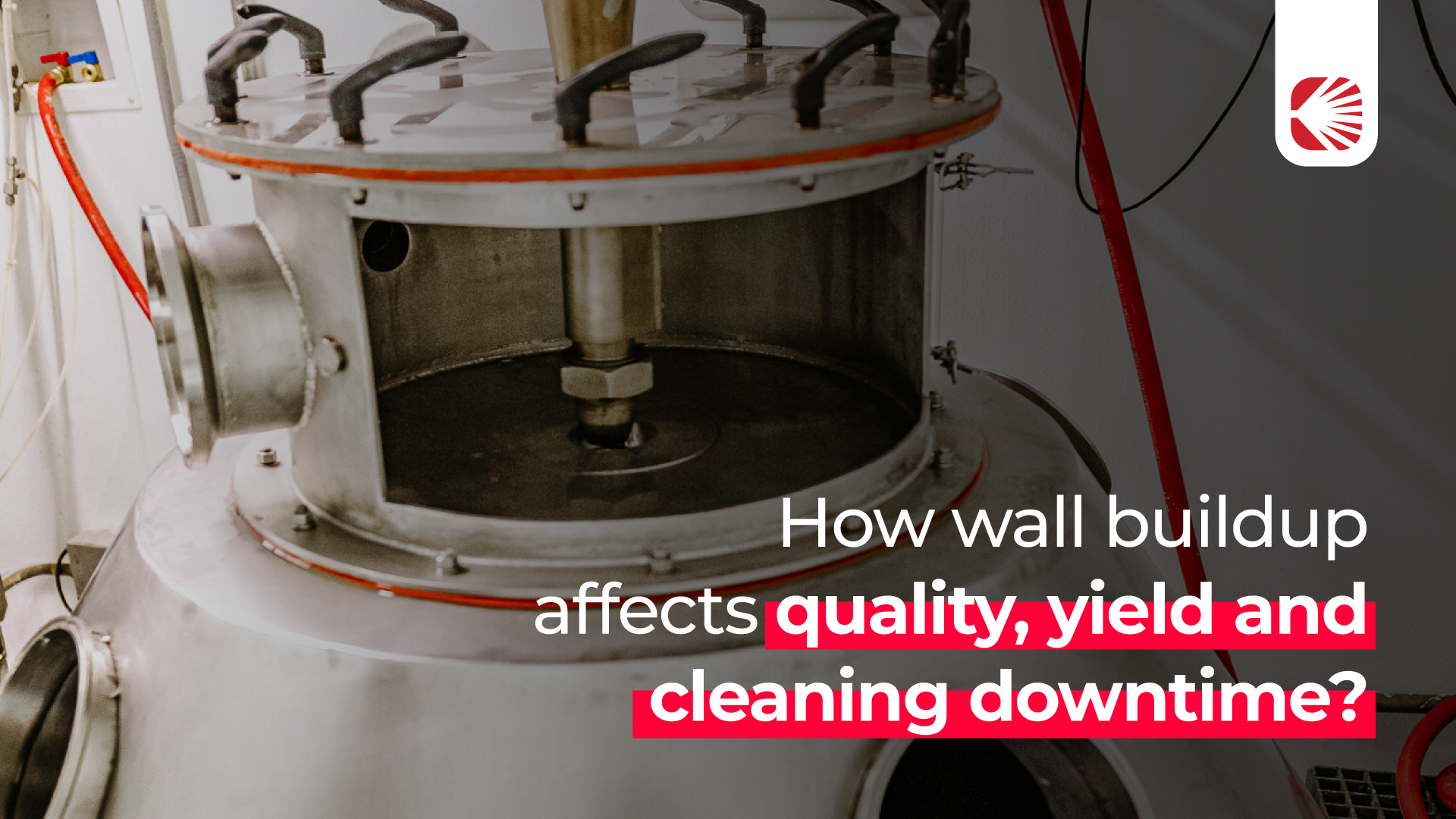
If you have ever opened your spray drying chamber at the end of a production run only to find a thick, scorched layer of material clinging to the stainless steel, you have witnessed one of the more expensive failures in process engineering.
While many manufacturers treat wall buildup (or “fouling”) as an unavoidable nuisance, it is actually a critical mechanical and thermodynamic problem. Understanding the root causes of buildup is the only way to move from “firefighting” your production schedule to achieving consistent, high-quality results.
Here is a look at how wall buildup affects the three pillars of the operation.
1. The “Industrial Oven” Effect on Product Quality
In a perfect run, particles spend only seconds in the drying chamber. However, the moment a particle adheres to the wall, its residence time jumps from 15–30 seconds to the entire duration of the production run.
Effectively, that material is being baked in an industrial oven. This leads to several quality failures:
- Scorching and Discoloration: High-heat zones, particularly at the top of conventional dryers, cause “hot spots” where powder will burn, turn yellow, or brown.
- The “Black Speck” Problem: In the dairy and food industries, scorched material eventually flakes off the wall, contaminating the fresh powder. This leads to “black specks” in the final product, which often results in the entire batch being downgraded to animal feed or discarded as “junk”.
- Loss of Bioactivity: For heat-sensitive proteins, probiotics, or vaccines, prolonged exposure to heat on the wall destroys the very functional properties you are trying to preserve.
2. The Direct Hit to Yield and Revenue
Yield is the ultimate metric of efficiency, and wall buildup is a direct subtraction from your sellable inventory.
- Unrecoverable Product: Material stuck to the wall is generally considered a total loss because it cannot be sold due to its degraded state.
- The Nozzle Chain Reaction: In many cases, buildup results from a clogged or worn nozzle. When a nozzle fails, it stops producing a fine mist and instead sprays a thick stream that hits the wall and sticks immediately, causing a rapid collapse in yield.
3. The “Cleaning Tax” and Downtime
The most overlooked cost of wall buildup is the impact on your labor and equipment availability.
- The 24-Hour Cycle: In regulated industries like dairy, systems are often required to be cleaned every 24 hours. If the buildup is significant, a manual cleaning process can take six hours or more, leaving you with only 18 hours of actual production time.
- The Cost of CIP: To combat this, many plants invest in “Clean-in-Place” (CIP) systems,expensive, automated arrays of tanks and pumps, to reduce cleaning time to roughly two hours. However, if the material is exceptionally sticky, even a CIP system may require a manual “scrub-down” by an operator, leading to further delays.
Why Does Buildup Happen?
Some products are a “bad fit” for certain equipment. Wall buildup is usually a conflict between your feed formulation and the dryer’s thermodynamics.
- Glass Transition Temperature (Tg): If the product’s surface does not form a hard, “glassy” shell quickly enough, it remains in a “rubbery” state and sticks to the wall like glue.
- Conventional vs. Pulse Atomization: Traditional spray dryers rely on hot air introduced at the top of the chamber, which creates “hot spots” that accelerate scorching. Pulse Atomization mitigates this by using an extremely turbulent mixing zone, in which the entire chamber operates at a uniform (lower) exit temperature, preventing the thermal shock that leads to buildup.
However, technology has limits: Even advanced pulse dryers will struggle with unformulated fruit juices (high sugar) or unencapsulated fats, which will stick to stainless steel regardless of the atomization method.
Conclusion
If you are constantly battling scorched specks or losing hours every day to cleaning, stop looking at your temperature sensors and start evaluating your atomization dynamics and residence time. The path to high yield isn’t found in a faster cleaning crew; it’s found in a dryer designed to keep your product off the walls and in the bag.
Tired of losing your product to the chamber walls? The only way to determine your true yield and see if our “open pipe” system can eliminate your buildup problems is through empirical data. Contact our engineering team today to schedule a pilot test and get an honest assessment of your production potential.