Beyond the Inlet and Outlet Temps –  Why Your Spray Drying Problems Might Need an Atomization Fix

In industrial spray drying, the thermodynamic history of a particle—specifically the relationship between heat intensity and exposure duration—is a primary determinant of final product quality and bioactivity. While both Pulse Atomization Spray Drying (PASD) and most conventional spray dryers operate using co-current flow, their mechanical designs result in divergent residence times and thermal protection capabilities.


Engineering Analysis: Residence Time and Thermal Protection in Spray Drying Systems

In industrial spray drying, the thermodynamic history of a particle—specifically the relationship between heat intensity and exposure duration—is a primary determinant of final product quality and bioactivity. While both Pulse Atomization Spray Drying (PASD) and most conventional spray dryers operate using co-current flow, their mechanical designs result in divergent residence times and thermal protection capabilities.
Evaluating Particle Size Uniformity: Pulse Atomization vs. Conventional Methods

In industrial spray drying, achieving a tight and consistent particle size distribution (PSD) is often considered more of an art than a science. Traditional atomization methods, such as pressure nozzles and rotary disks, frequently struggle with “distribution drift” because their mechanical components are subject to constant wear and tear. As an orifice enlarges or a disk erodes, the energy delivered to the liquid feed fluctuates, leading to a wider range of particle sizes and, in some cases, undesirable bimodal distributions. Pulse Atomization Spray Drying (PASD) addresses this fundamental mechanical limitation by utilizing gas-dynamic force rather than restrictive mechanical orifices.

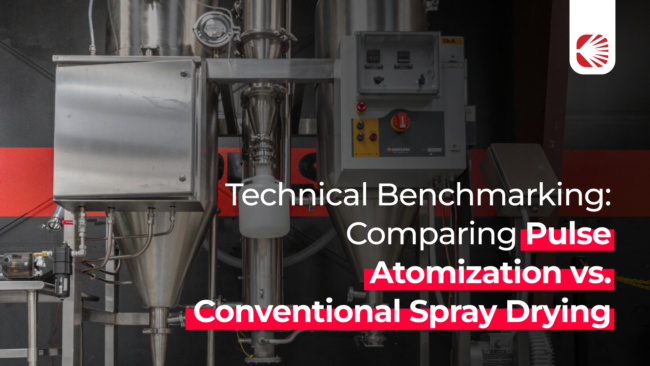
Comparative Analysis: Pulse Atomization vs. Conventional Industrial Drying Technologies

When evaluating industrial drying options for high-value or heat-sensitive materials, three primary conventional technologies serve as the benchmarks for comparison against Pulse Atomization Spray Drying (PASD): pressure nozzle spray dryers, rotary atomizer spray dryers, and freeze dryers. Selecting the appropriate technology requires a technical assessment of atomization mechanics, residence time, and thermal efficiency.

The Scale-Up Wall: Why Your Pilot Success Might Be a Production Failure

It is a story told in laboratories and R&D centers across the globe: a team spends months perfecting a formulation on a benchtop spray dryer. The powder is perfect, the yield is acceptable, and the stakeholders are ready to greenlight full production. But the moment that same material is fed into a commercial-scale tower, the process collapses. The powder comes out too wet, the particles are the wrong size, or the material simply sticks to the walls and scorches.