In conventional spray dryers, nozzle clogging can lead to production interruptions, unplanned cleaning, and lost time and product. Nozzle clogging is a persistent operational challenge in spray drying, affecting production efficiency and final product quality.
But what actually causes nozzle clogging in spray dryers? How can you prevent it? And are there better alternatives? In this article, we’ll explore the root causes of nozzle clogging, its operational impact, proven prevention strategies, and how alternative atomization technologies can eliminate this problem.
Understanding Spray Dryer Nozzles and Atomization
To understand why nozzles clog, you first need to understand how they work. Conventional spray dryers rely on pressure nozzles to atomize the feed material, breaking it down into tiny, uniform droplets that dry quickly and efficiently.
How Pressure Nozzles Work in Spray Drying
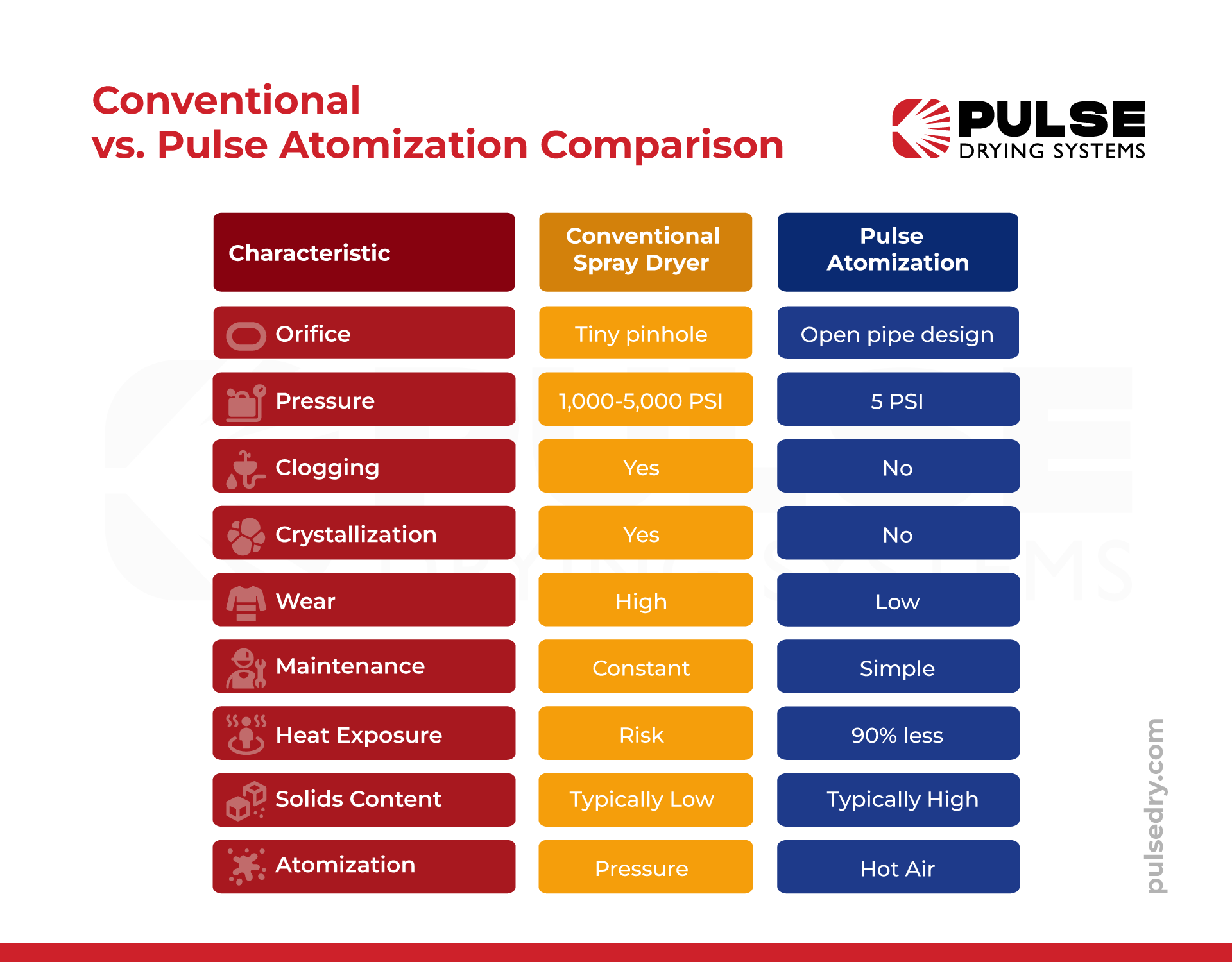
Pressure nozzles operate at extremely high pressures—typically between 1,000 and 5,000 psi. The feed material is forced through a single, incredibly small orifice (opening) at high velocity. This creates a fine mist of droplets that enters the drying chamber.
The problem? That orifice is so small—often just a pinhole—that you need bright light to see it. This precision is essential for atomization, but it’s also the source of the nozzle clogging problem.
Critical Role of Nozzle Orifice Size
The orifice diameter directly determines:
- The atomization quality and final droplet size
• The required operating pressure
• The vulnerability to blockage
• The durability and lifespan of the nozzle
Even a particle slightly larger than the orifice diameter can block the flow, preventing atomization and causing material to spray as a thick stream instead of a fine mist. When this happens, material sticks to the drying chamber walls instead of drying properly.
This is why understanding the causes of nozzle clogging is so critical. Prevention is far more cost-effective than constant cleaning, replacement, and dealing with lost production time.
Primary Causes of Nozzle Clogging
Nozzle clogging doesn’t happen randomly. It’s the result of specific conditions in your feed material or operating parameters. Understanding these causes of nozzle clogging is the first step toward prevention.
Particulate Contamination in Feed Material
This is one of the most common causes. If your feed contains solid particles that aren’t completely dispersed or dissolved, they can lodge in the nozzle orifice and block the flow entirely.
Common sources of contamination include dust and particles from raw materials, inadequate filtering or preparation, and material degradation during storage. Even clean materials can contain particles invisible to the naked eye but large enough to clog a pinhole orifice.
High Solids Content and Viscosity Issues
As your feed material evaporates or concentrates during heating before entering the nozzle, its viscosity (thickness) increases. Thicker material has greater difficulty flowing through the small orifice, especially if it’s already near its maximum viscosity limit.
Additionally, if your solids content is too high to begin with, the material becomes increasingly difficult to atomize. Conventional spray dryers typically struggle with increases in solids content beyond standard design limits. At that point, viscosity becomes unmanageable, and spray dryer nozzle clogging becomes nearly inevitable.
Crystallization and Precipitation at Nozzle Tip
Some materials—particularly those with high sugar or salt content—can crystallize or precipitate as they reach the nozzle tip. This is especially problematic if the feed temperature is high or if the material is held at an elevated temperature for extended periods prior to atomization.
Once crystallization begins, it creates a buildup that progressively narrows the orifice opening, eventually cutting off flow entirely. This is particularly common in dairy, food, and nutraceutical applications.
Product Buildup from Improper Drying
If the material doesn’t atomize properly or isn’t completely dry when it hits the chamber walls, it will stick to the walls. It can also stick to the nozzle itself, gradually restricting the orifice and eventually causing a complete blockage.
Sticky or syrupy materials are particularly prone to this effect. As the material gets cooked on the walls of the hot drying chamber, it becomes increasingly sticky and difficult to remove
Abrasive Materials Causing Nozzle Erosion
Abrasive feed materials contain particles hard enough to erode the nozzle orifice itself. Over time, this erosion causes the precisely sized pinhole opening to enlarge, changing the droplet size and reducing atomization quality. Eventually the nozzle must be replaced
Abrasive materials also increase wear on high-pressure pumps used in conventional spray drying systems. Pump failure is not only costly but also brings operations to a halt until replacement or repair is complete. Companies often have two pumps, one being rebuilt while the other one is feeding the dryer and wearing out.
Temperature Fluctuations Affecting Feed Properties
Unexpected temperature changes in your feed can dramatically alter its properties. Cooling can cause crystallization or precipitation, while heating can increase viscosity or cause material to partially dry at the nozzle tip. Even small temperature fluctuations can tip the balance from stable operation to nozzle blockage.
Operational Impacts of Nozzle Clogging
Nozzle clogging isn’t just an inconvenience. It has far-reaching consequences that affect product quality, operational consistency, and the bottom line. Understanding these impacts makes the case for prevention strategies (or switching to alternative technologies) compelling.
Production Downtime and Lost Output
When a nozzle clogs, the dryer cannot function without immediate operator intervention. The feed to that nozzle must be stopped, the nozzle cleaned or replaced—a process that can result in reduced or complete dryer stoppage..
For operations running continuous or multi-batch schedules, each clogging event represents lost production time and missed throughput targets. Product Quality Inconsistency
A partially clogged nozzle creates inconsistent atomization. The droplet size varies, which causes some material to dry very quickly while other material remains wet longer.
This leads to batches with:
- Inconsistent particle size
• Variable moisture content
• Potential thermal degradation
• Off-specification batches that cannot be sold
Increased Maintenance Labor and Costs
Nozzle clogging requires specialized personnel on-site. The constant manual replacement, cleaning and adjustment demands skilled operators who understand spray drying. These staff members are expensive, and when they’re tied up with clogging issues, they’re not focused on other important maintenance or operational tasks.
Additionally, many operations report that if key personnel aren’t available, production quality and efficiency are negatively impacted.
Frequent Nozzle Replacement Expenses
Nozzles are precision instruments, and replacement nozzles are expensive. Titanium and other erosion-resistant materials drive costs up. Depending on your system and the number of nozzles you operate, frequent replacements can cost thousands of dollars per year.
Beyond the direct cost of the nozzle itself, there’s the labor cost of installation, testing, and adjustment—not to mention the inevitable production delay each time a nozzle is replaced.
How to Prevent Nozzle Clogging: Best Practices
While nozzle clogging is a persistent challenge in conventional spray drying, there are proven strategies to reduce its frequency and severity. However, it’s important to note that in conventional systems, clogging can never be eliminated—it can only be managed.
Feed Filtration and Preparation Techniques
The first line of defense against clogging is rigorous feed preparation:
- Use fine mesh filtration to remove particles before material reaches the pump
• Ensure complete dispersion of all solids in the liquid carrier
• Monitor and document filtration effectiveness regularly
• Replace filter elements on a strict schedule
Proper Solids Content Management
Keep your solids content within design specifications. Most conventional spray dryers perform optimally within moderate solids content ranges.
Temperature and Viscosity Control
Maintain stable feed temperature throughout the system:
- Insulate feed lines to minimize temperature fluctuation
• Use heat tracing to maintain optimal temperature
• Monitor viscosity continuously
• Keep viscosity within design parameters
Regular Nozzle Inspection and Maintenance
Prevention also means regular maintenance:
- Inspect nozzles visually during operation for spray pattern changes
• Schedule preventive nozzle cleaning
• Replace nozzles before erosion damage occurs
• Maintain detailed maintenance records
Alternative Atomization Methods: The Real Solution
Despite best efforts, nozzle clogging in conventional systems is an ongoing operational reality. However, alternative atomization technologies have emerged that fundamentally eliminate this problem. One breakthrough technology is gaining significant traction in the industry: Pulse Atomization.
Pulse Atomization: The Pressure Nozzle-Free Alternative
Pulse Atomization represents a fundamental departure from conventional pressure nozzle design. Instead of forcing material through a precision orifice, Pulse technology uses a proprietary three-fluid nozzle that combines:
- Liquid feed in the center
• Compressed air surrounding the liquid
• Hot drying air surrounding the entire assembly at high velocity.
The critical innovation? The hot air itself does most of the atomization work—not the pressure or orifice size. This eliminates the pinhole bottleneck entirely.
Key advantages of Pulse Atomization technology:
✓ No nozzle clogging—no precision orifices required
✓ Handles higher solids content than conventional spray drying systems.
✓ Reduced exposure time to drying heat.
✓ Dramatically lower thermal degradation risk
✓ Wide range of particle sizes in certain feed materials
✓ Minimal operator training required
Why Pulse Atomization Addresses Nozzle Clogging
Pulse systems operate at significantly lower liquid feed pressures compared to pressure nozzle systems.
This low-pressure design means:
- No tiny orifice to clog
• Material flows through an open tube
• Even fibrous and abrasive materials can be processed
• High-pressure pump wear is eliminated because a low pressure pump, such as a tube pump, can be used. This is particularly important for abrasive or corrosive feeds.
The open-pipe design means your system is more robust, more forgiving of feed variability, and less dependent on specialized maintenance expertise. Particles that would clog a pressure system flow harmlessly through an open pipe.
Stop Losing Money to Nozzle Clogging
Pulse Drying Systems eliminates nozzle clogging with Pulse Atomization technology – resulting in reduced downtime, improved product recovery, and nozzle replacement frequency at or near zero.
Unlike conventional spray dryers that rely on high-pressure nozzles with precision orifices, the Pulse system uses an open-pipe feed delivery at less than 5 psi. This breakthrough design allows you to confidently process high-solids, viscous, and abrasive materials.
The Bottom Line
Nozzle clogging is a costly, persistent challenge in conventional spray drying operations. While prevention strategies can reduce its frequency, they can never eliminate it entirely. The pinhole orifice design that conventional systems depend on will always be vulnerable to blockage from particles, viscosity changes, crystallization, or material buildup.
For operations processing heat-sensitive materials, corrosive or abrasive materials, high-viscosity feeds, or seeking improvements in efficiency and consistency, Pulse Atomization technology offers a proven alternative that eliminates nozzle clogging while simultaneously improving product quality and reducing thermal degradation.
The choice is clear: continue struggling with conventional spray dryers and accepting nozzle clogging as an operational cost, or invest in Pulse Atomization technology and reclaim the time, money, and quality you’re currently sacrificing.
Ready to Eliminate Nozzle Clogging?
Contact Pulse Drying Systems today for a free consultation:
Phone: (415) 726-3536
Email: jrehkopf@pulsedry.com
Website: www.pulsedry.com
Our team will assess your specific drying challenges and show you exactly how much downtime and cost you could save by switching to Pulse Atomization.
The information in this article is provided for general educational purposes and to promote overall awareness. It is not intended as engineering, legal, or other professional advice, and should not be used in place of consultation with qualified professionals familiar with your specific application and conditions. This content should not be considered exhaustive.