When manufacturers need to stabilize sensitive biologicals or food products, they often choose between two primary methods of dehydration. Understanding the nuances of spray drying vs lyophilization is essential for optimizing product quality and controlling production costs.
These technologies represent the backbone of mid-to-large scale powder production, particularly for Spray Dryers used in high-value sectors. While both aim to remove moisture, their physical mechanisms and economic impacts vary meaningfully.
What is lyophilization (freeze drying) and how does it compare to spray drying?
Lyophilization is a cold dehydration process that removes moisture through freezing and sublimation, whereas spray drying uses atomization and hot air to evaporate water, leaving behind powder. This fundamental distinction between a cold vacuum process and a hot air process dictates how each interacts with sensitive materials.
When one compares spray drying vs freeze drying, the state changes are opposites. One relies on a high-temperature gas stream to flash-dry droplets in seconds, while the other slowly pulls water from a frozen matrix. This makes the application of lyophilization vs spray drying processes a common debate when handling proteins or vaccines.
Freeze drying is often the default choice for materials that cannot withstand any sustained heat. However, it requires the product to remain in a vacuum for extended periods, which limits production rate. This method is key for preserving the exact biological structure of the most delicate APIs.
What are the key differences between spray drying and freeze drying?
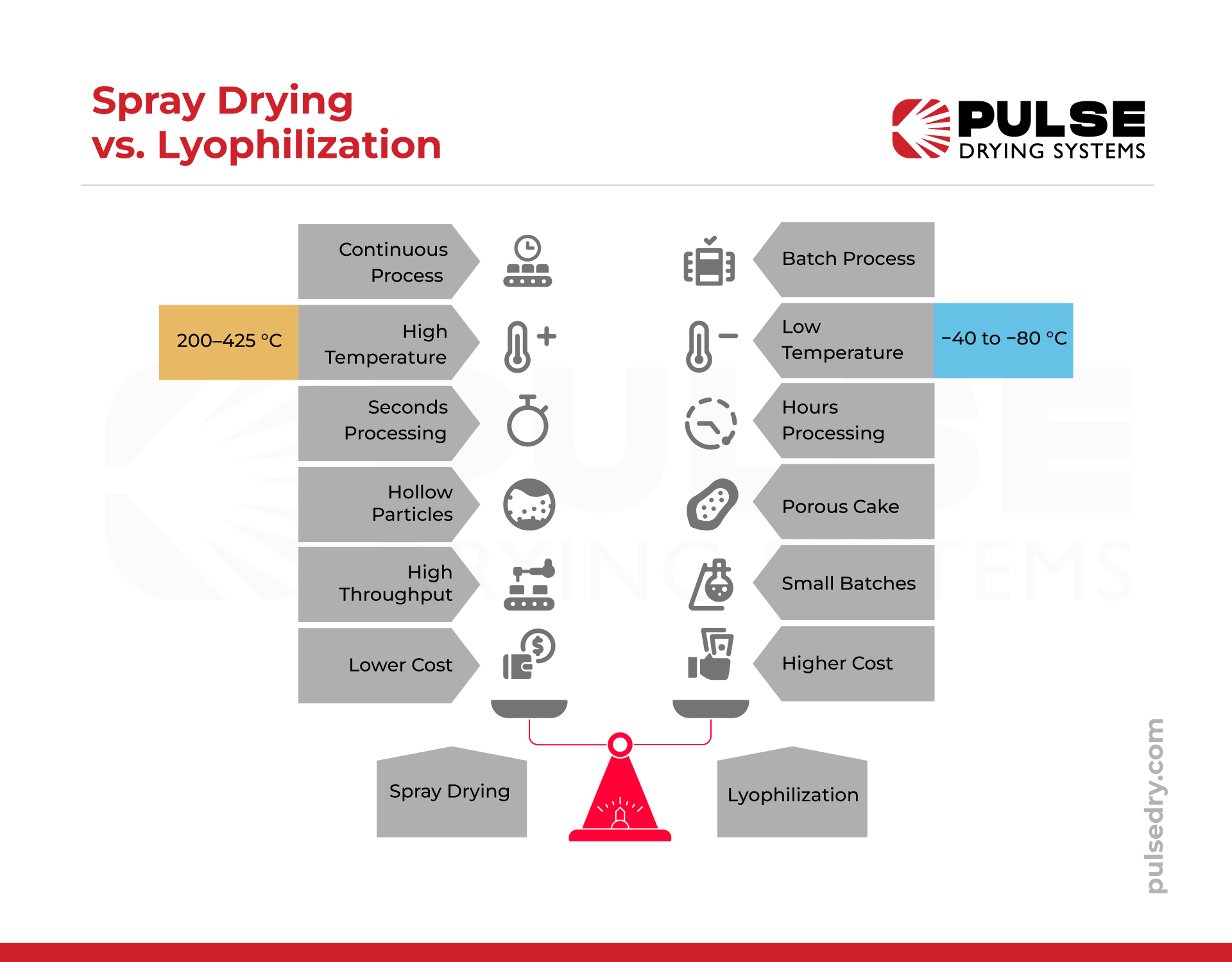
The primary differences between these methods lie in the processing speed, the temperature environment, and the resulting particle morphology. Spray drying is a continuous process that turns liquid into powder in mere seconds, while freeze drying is a batch process.
A typical freeze-drying cycle is an intensive operation that requires 12 to 48 hours to complete. This long duration contrasts sharply with the nearly instantaneous transit of a droplet through a drying chamber.
- Temperature: Spray drying uses inlet temperatures of 200–425 °C, while freeze drying operates between -40 and -80 °C.
- Morphology: Spray-dried particles are often hollow or buckled, whereas freeze-dried products form a porous “cake” or matrix.
- Scalability: Spray drying is designed for high-throughput continuous production, while freeze drying is generally restricted to smaller, high-value batches.
Is spray drying less expensive than freeze drying?
Yes, spray drying is meaningfully more cost-effective due to lower capital investment requirements and vastly superior energy efficiency. By comparison, freeze dryer operational costs are high because the equipment must maintain a vacuum and extreme cold for days at a time.
One must also consider the cost per kilogram of the finished product. Spray drying offers much lower labor and energy costs because it is automated and rapid. The higher labor cost of lyophilization is typically justified only for extremely high-value biologics that are heat-labile.
Advanced solutions from Pulse Drying Systems can provide a freeze-dry quality, powder in a spray drying process, making the economics very compelling. Also, Pulse Dryers can deliver thermal efficiencies of between 45% and 67%, makingthem an even more attractive alternative to expensive batch processes.
Which is better, freeze drying or spray drying?
The choice depends entirely on the specific application, but advanced technology is making spray drying a potential choice for a wider range of heat-sensitive materials. For decades, freeze drying was the only way to make good instant coffee and preserve vaccines and probiotics, but that is changing, albeit slowly.
When evaluating which is better, freeze drying or spray drying, manufacturers must weigh the cost against powder quality. Pulse atomization spray drying is extremely rapid, and ensures a consistent drying environment that prevents localized overheating, allowing it to handle formulations previously reserved entirely for the freezer.
- Food & Nutraceuticals: Spray drying is better for flavors, and probiotics, where volume and cost are critical factors.
Thermal Sensitivity: Pulse Dryers utilize lower-than-usual outlet temperatures of 70–105 °C to protect sensitive compounds.
Conclusion
Choosing between spray drying and lyophilization depends on your specific product requirements and budget. Pulse Drying Systems offers advanced spray drying solutions that deliver many of the quality benefits of freeze drying at a fraction of the cost and time. Our Pulse Atomization technology provides gentle drying conditions suitable for heat-sensitive materials while maintaining the efficiency and scalability advantages of spray drying. Contact our team to evaluate whether spray drying or freeze drying is the optimal choice for your application.
The information in this article is provided for general educational purposes and to promote overall awareness. It is not intended as engineering, legal, or other professional advice, and should not be used in place of consultation with qualified professionals familiar with your specific application and conditions. This content should not be considered exhaustive.