The spray drying method for nanoparticles is a specialized technique that converts a liquid feed into solid, nano-sized particles through rapid atomization and evaporation. For researchers and engineers exploring spray-drying nanoparticles, this one-step process is an essential tool for creating advanced materials and efficient drug delivery systems. Utilizing high-performance Spray Dryers allows control over particle size and morphology during powder production.
How does spray drying produce nanoparticles?
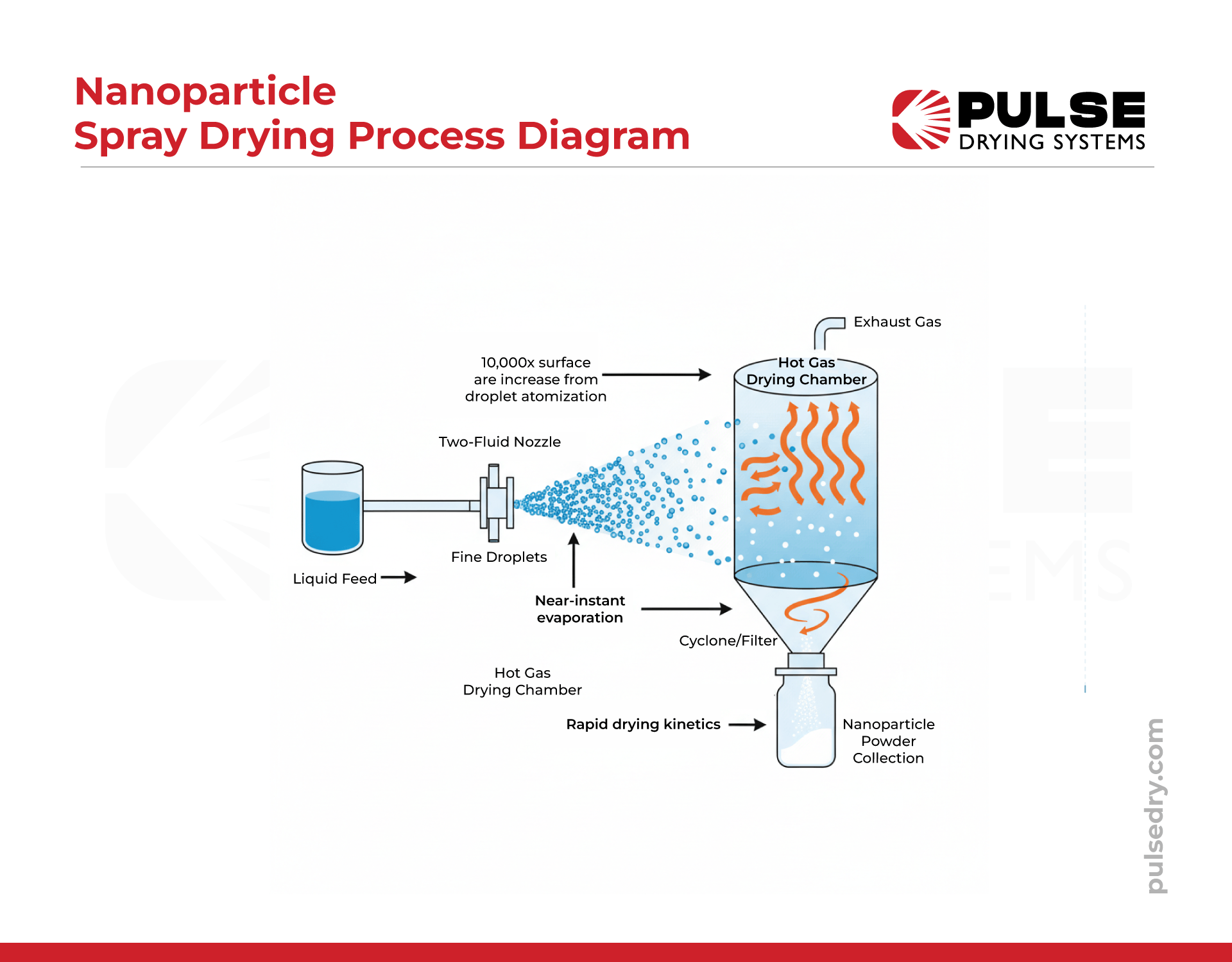
Spray drying produces nanoparticles by breaking a liquid feed into ultra-fine droplets that are introduced into a high-temperature gas stream for near-instantaneous drying. This rapid transition from liquid to solid preserves the small size of the initial droplets and prevents the particles from growing into larger, non-uniform masses.
The process of spray drying nanoparticles typically relies on high-energy atomization, such as two-fluid nozzles, to generate the smallest possible initial surface area. Nanoparticle spray drying is driven by extreme drying kinetics; for example, breaking larger droplets into extremely small droplets significantly increases the available surface area for evaporation. This massive surface area enables the rapid evaporation needed to maintain the integrity of the nanoparticle.
Achieving high collection efficiency is a primary challenge in this method, as smaller particles are more difficult to retrieve from the drying chamber. To overcome this, engineers must carefully manage feed concentration and inlet temperatures to ensure the particles do not agglomerate. Using a consistent drying environment is critical to maintaining a narrow size distribution and preventing product degradation.
What is the spray drying method for microspheres?
The spray drying method for microspheres involves a controlled atomization process designed to create spherical particles that typically fall within the micrometer size range. Unlike nanoparticles, microspheres are often engineered for specific volume-based applications where spherical symmetry and internal porosity are required for performance.
This method is highly favored for producing diagnostic agents, catalyst carriers, and controlled-release pharmaceutical formulations. It relies on optimized drying conditions that allow the particle “skin” to form evenly, resulting in a perfectly spherical morphology. This shape is essential for ensuring consistent flowability and predictable release characteristics in drug delivery systems.
- Drug Delivery: Microspheres allow for the sustained release of active ingredients.
- Catalyst Carriers: High sphericity provides better surface interaction in chemical reactions.
- Diagnostic Agents: Uniform sizes are required for precision imaging and testing.
What is spray drying in microencapsulation?
Spray drying microencapsulation is a process where an active “core” ingredient is enclosed within a protective wall material or matrix, such as proteins, carbohydrates, or polymers, during the drying stage. This technique creates a physical barrier that protects sensitive substances from environmental factors like oxygen, light, and moisture.
The solidification of the wall material occurs almost immediately after atomization, trapping the core material inside. This is widely used for probiotic encapsulation, vitamin stabilization, and essential oil preservation. In the pharmaceutical industry, this method is also utilized for taste-masking bitter compounds and improving the shelf-life of heat-sensitive active ingredients.
Common applications of this technique include:
- Flavor Protection: Preventing the oxidation of volatile aromatic oils.
- Nutraceuticals: Stabilizing vitamins and probiotics for consumer health products.
- Pharmaceuticals: Creating protective matrices for therapeutic proteins and enzymes.
What are the advantages of spray drying for nanoparticle and microsphere production?
The primary advantage of spray drying for nanoparticle and microsphere production is that it is a continuous, scalable, and one-step process that provides superior control over particle size and morphology. It enables rapid production of dry powders from liquid feeds without complex, multi-stage processing.
When compared to alternative methods, spray drying is meaningfully more efficient. Freeze drying is an expensive and slow batch process, while solvent evaporation is time-consuming and difficult to scale. Pulse Drying Systems offer even greater benefits through pulse atomization spray drying, which provides a more efficient, consistent drying environment. Some advanced spray drying configurations may achieve higher thermal efficiency compared to conventional systems.
These systems operate within defined inlet and outlet temperature ranges depending on formulation and equipment configuration. The intense mixing and turbulence within the chamber prevent localized overheating, ensuring that even heat-sensitive formulations are processed safely. This results in superior product quality for advanced applications.
Conclusion
The ability to engineer advanced particles in a single, scalable step makes spray drying the gold standard for high-value powders. Whether your focus is on nanoparticle spray drying for increased surface area, or the spray drying method for controlled release microspheres, the technology provides unmatched flexibility. By leveraging pulse atomization spray drying, manufacturers can maintain uniform conditions even when processing heat-sensitive biopharmaceuticals or complex matrices.
Some advanced systems report higher thermal efficiency when compared to conventional drying units. With inlet temperatures between 200–425 °C and outlet temperatures as low as 70–105 °C, Pulse Drying Systems ensures the integrity of your most sensitive formulations through rapid evaporative cooling.
Are you looking for precise control over your atomization? Contact the team at Pulse Drying Systems today to learn how our pulse atomization spray drying technology can improve your thermal efficiency and product quality.
The information in this article is provided for general educational purposes and to promote overall awareness. It is not intended as engineering, legal, or other professional advice, and should not be used in place of consultation with qualified professionals familiar with your specific application and conditions. This content should not be considered exhaustive.