Flash drying is a specialized industrial process designed for the near-instantaneous removal of moisture from particulate materials. It relies on high-speed air streams to achieve results that traditional batch drying cannot match. Understanding flash dryer operation is a critical step for engineers evaluating thermal processing options among the broader category of Spray Dryer technology offerings.
What is the working principle of a flash dryer?
The flash dryer working principle is based on the combination of pneumatic conveying and rapid heat transfer for processing of wet solids in a single pass. It involves suspending moist particulate material in a high-velocity stream of hot air, which acts as both the transport medium and the heat source.
As the material travels through the system, heat is transferred from the air to the particles while moisture simultaneously moves from the particles to the air. This rapid exchange defines how flash dryers work in modern industrial settings, ensuring that moisture is removed before the product can be damaged by heat.
The process creates a state of constant turbulence, maximizing the surface area of the product exposed to the drying medium. Because the heat and mass transfer occur simultaneously and with great intensity, the evaporation is almost immediate. This makes it ideal for materials that can be easily dispersed in an air stream.
How does the flash drying mechanism operate?
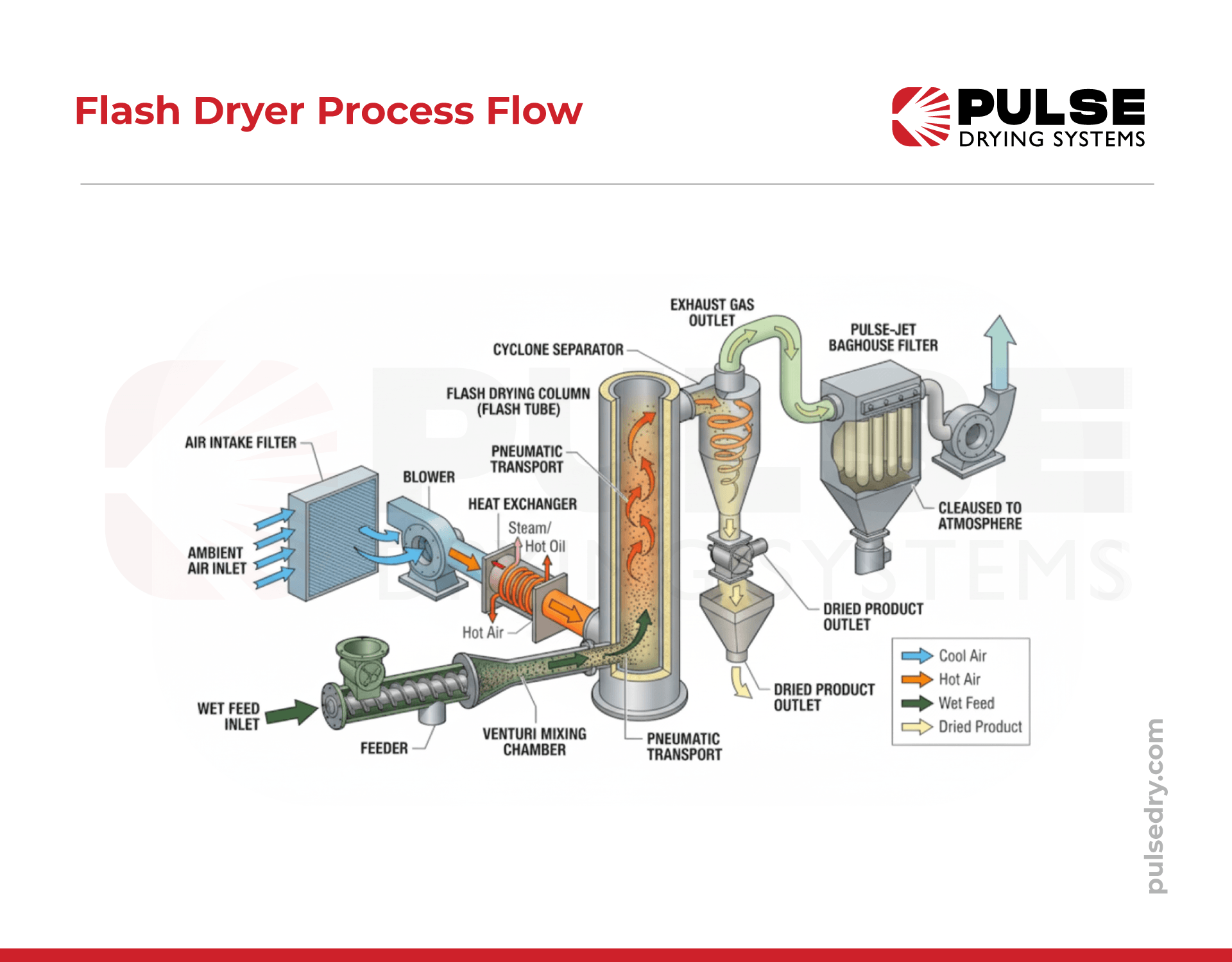
The flash drying mechanism operates through a precise sequence: air heating, material feeding and dispersion, pneumatic transport, rapid moisture evaporation, and particle-air separation. Initially, the ambient air is heated to a specific temperature before it meets the wet feed material at the entry point.
A specialized venturi section is typically utilized at the feeding point to create a high-velocity zone. This zone ensures efficient material dispersion, breaking up any clumps and facilitating intimate contact between the hot air and the individual particles. The turbulence created here is essential for maximizing the rate of evaporation.
The material then enters a drying tube engineered to be of sufficient length to ensure complete moisture removal. Despite the height of these tubes, the residence time for the material is remarkably short. This speed prevents the core temperature of the material from rising excessively.
Finally, a high-efficiency cyclone separator captures the dried product while the exhaust air exits the system. This separation ensures that the final powder is retrieved efficiently as the moist air is vented, completing the drying cycle in a very short time.
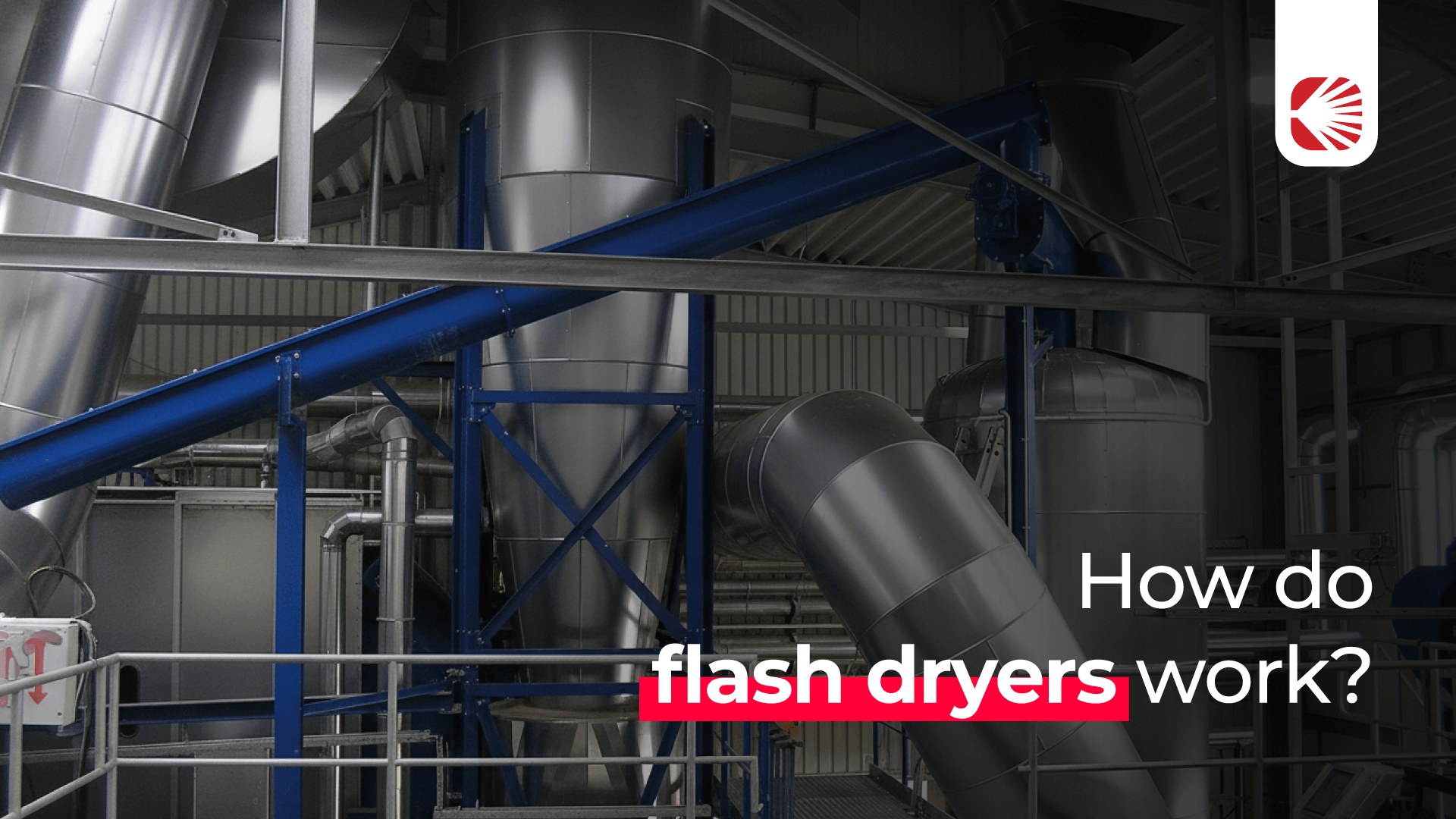
How do flash dryers work
What are the key components in flash dryer operation?
The essential hardware for successful flash dryer operation includes an air heater (direct or indirect), a material feeder (typically a screw conveyor or rotary valve), a mixer, a drying tube, a cyclone separator, and an exhaust fan. Each component must be precisely synchronized to maintain the flow of the pneumatic system.
Control systems are vital for regulating process parameters to ensure a consistent drying environment under uniform conditions. Typical air inlet temperatures span a wide range, often between 150°C and 600°C. High air velocities normally between 20 and 40 meters per second are maintained to keep particles entrained.
The feed rate must be regulated by automated controllers to prevent system overload, which could lead to incomplete drying or blockages. Sensors monitor the temperature at both the inlet and outlet to ensure thermal energy is being used efficiently without overheating the product.
Additionally, air flow balancing is required to maintain the pressure differentials necessary for pneumatic transport. By managing these variables, operators ensure the system provides a consistent output, even when the moisture content of the incoming feed varies slightly.
What are the operational advantages and limitations of flash dryers?
Flash dryers offer meaningful operational advantages, including very fast drying times, a compact vertical footprint, and generally lower capital costs than more complex liquid-processing systems. They are excellent for removing surface moisture and handling heat-sensitive products that cannot withstand long exposure to high temperatures.
However, flash drying has specific limitations. It can only be applied to materials that are already in a particulate state or that can be pre-sized before entry. Because they do not handle liquid feeds, they cannot achieve the precise particle engineering or atomization found in advanced spray drying technologies.
Conclusion
Flash drying provides a high-capacity and cost-efficient method for the rapid removal of surface moisture from particulate materials. By combining pneumatic conveying with intense heat transfer, it maintains uniform conditions that protect product integrity while maximizing throughput. Selecting the right industrial dryer requires a deep understanding of your material’s specific characteristics and your desired particle structure. While flash dryers excel at rapid surface moisture removal from particulate materials, Pulse Drying Systems specializes in advanced spray drying technology that offers superior control for liquid feeds and precise particle engineering.
Our team can help you evaluate whether flash drying, spray drying, or another approach is optimal for your application. Contact us to discuss your drying requirements and find the perfect solution for your production process.
The information in this article is provided for general educational purposes and to promote overall awareness. It is not intended as engineering, legal, or other professional advice, and should not be used in place of consultation with qualified professionals familiar with your specific application and conditions. This content should not be considered exhaustive.