Spray drying is a rapid process used to convert liquid feeds into solid particles by atomizing them into a hot gas stream. Understanding the factors affecting spray drying is essential for any manufacturer looking to optimize production efficiency and product consistency.
Several variables determine the final quality, structure, and morphology of the resulting powder achieved through application of Spray Dryers. This article explores the critical factors affecting spray drying to help you achieve superior results.
What are the factors affecting the drying process?
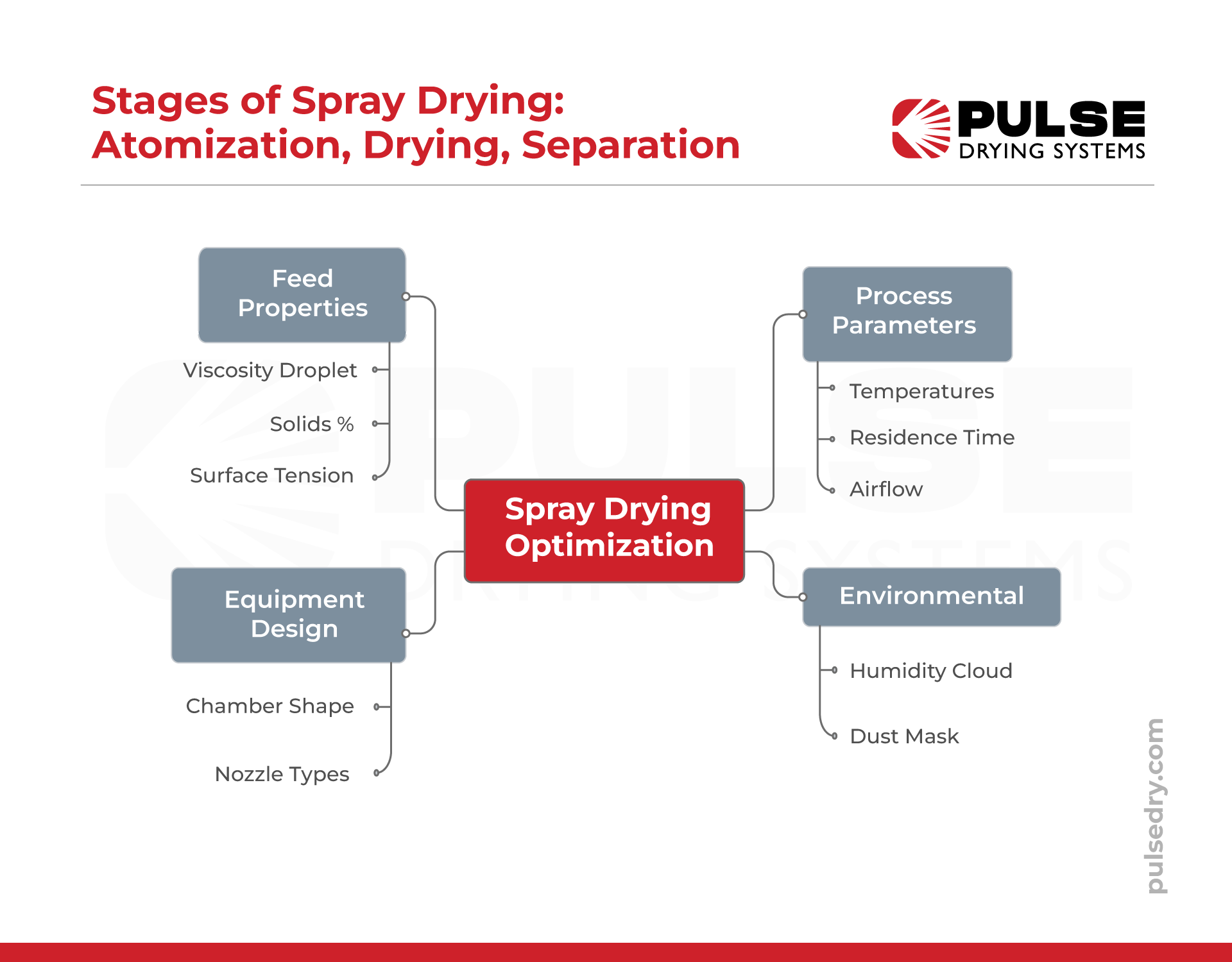
The main categories of factors affecting the drying process include feed properties, process parameters, equipment design, and environmental conditions. These elements are deeply interrelated, meaning a change in one often requires precise adjustment in another to maintain product stability and quality.
Interaction of the factors affecting spray drying is critical for process optimization. Feed properties influence atomization behavior, which in turn affects how process parameters must be set. Equipment design determines the thermal and momentum transfer capabilities, while environmental conditions impact overall system performance.
Mastering these interconnected variables allows manufacturers to achieve consistent particle sizes, maximize throughput, and reduce time and resources spent on trial and error. Process optimization relies on identifying how these factors work together within the drying chamber to deliver the desired product characteristics.
What feed properties affect spray drying performance?
Viscosity, solid content, surface tension, and thermal sensitivity are the primary feed properties that determine atomization quality and drying speed. These characteristics directly influence droplet formation and the subsequent drying behavior of your material.
Viscosity provides resistance to pumping and to the liquid being broken apart into small droplets during atomization. Higher viscosity generally results in larger average droplet sizes, which affects drying time and final particle characteristics. Surface tension acts to stabilize the liquid. Increasing surface tension will also result in larger average droplet sizes with all other factors remaining equal.
Solids content of the feed determines the volume of water that must be evaporated and powder production rate of the dryer. Higher solids content typically reduces energy consumption per pound of powder but may increase feed viscosity. Thermal sensitivity limits the maximum allowable temperatures during processing. This is particularly critical when handling heat-sensitive materials in food, nutraceutical, or pharmaceutical applications.
Feed preparation and pre-treatment are critical considerations for achieving optimal atomization. This may include homogenization, filtration, additives, or temperature adjustment to ensure consistent feed properties throughout the drying campaign.
What factors to consider when drying?
Critical spray drying parameters to consider include inlet temperature, outlet temperature, atomization energy, and air flow rate. These process variables dictate the “drying history” of each droplet as it travels through the chamber, directly impacting final moisture content and particle morphology.
Atomization factors play a crucial role in determining product quality. Nozzle type, atomization pressure, and feed viscosity all influence the surface area available for drying. For instance, atomizing a liquid into finer droplets increases the available evaporation surface area, which accelerates moisture removal.
Inlet temperatures are typically much higher than outlet temperatures, with exact values depending on the material and process configuration. In pulse atomization spray drying, higher inlet temperatures are possible without degrading the powder
“Residence time” – the duration droplets spend in the drying chamber – significantly affects product quality. Insufficient residence time results in high moisture content, while excessive residence time may cause thermal degradation. The configuration of air flow, whether co-current or counter-current, also plays a role in thermal damage protection and particle collection efficiency.
What are the factors affecting spray drying efficiency?
Efficiency is driven by equipment design factors including chamber geometry, atomizer design, heat source type, and collection system efficiency. These spray drying optimization factors are where advanced systems separate themselves from legacy designs by achieving higher performance at lower operating costs.
Chamber geometry affects residence time and heat transfer patterns. Proper design ensures uniform drying conditions throughout the chamber, preventing localized hot spots or under-dried regions. Atomizer design determines droplet size distribution uniformity, which directly impacts product consistency and drying efficiency.
Environmental factors such as ambient humidity, temperature, and dust control can significantly impact system performance. High ambient humidity requires more energy to achieve target outlet conditions, while proper dust control protects both product quality and operator safety.
Maintenance schedules, cleaning procedures, and operator expertise are often overlooked but critically important for sustained efficiency. Regular maintenance prevents equipment degradation that can lead to inconsistent product quality or increased energy consumption.
Conventional spray dryers generally operate at lower thermal efficiency levels compared to certain advanced atomization technologies thatmay produce improvements in thermal efficiency, inlet temperature flexibility, and droplet size distribution uniformity when compared to conventional spray drying configurations.
Pulse Atomization technology addresses multiple critical factors simultaneously by providing uniform conditions throughout the drying chamber. This consistent drying environment ensures materials are protected from localized overheating despite higher than normal inlet temperatures, while achieving superior droplet size uniformity. This translates directly to improvements in product quality and reductions in costs.
Optimizing spray drying requires careful control of multiple interconnected factors. Pulse Drying Systems provides advanced spray dryers with precise control systems that help you optimize critical parameters for consistent, high-quality results. Our Pulse Atomization technology addresses key factors like droplet size uniformity and thermal efficiency that are crucial for product quality. Contact our team to discuss how we can help you optimize your spray drying process for maximum performance and efficiency.
The information in this article is provided for general educational purposes and to promote overall awareness. It is not intended as engineering, legal, or other professional advice, and should not be used in place of consultation with qualified professionals familiar with your specific application and conditions. This content should not be considered exhaustive.