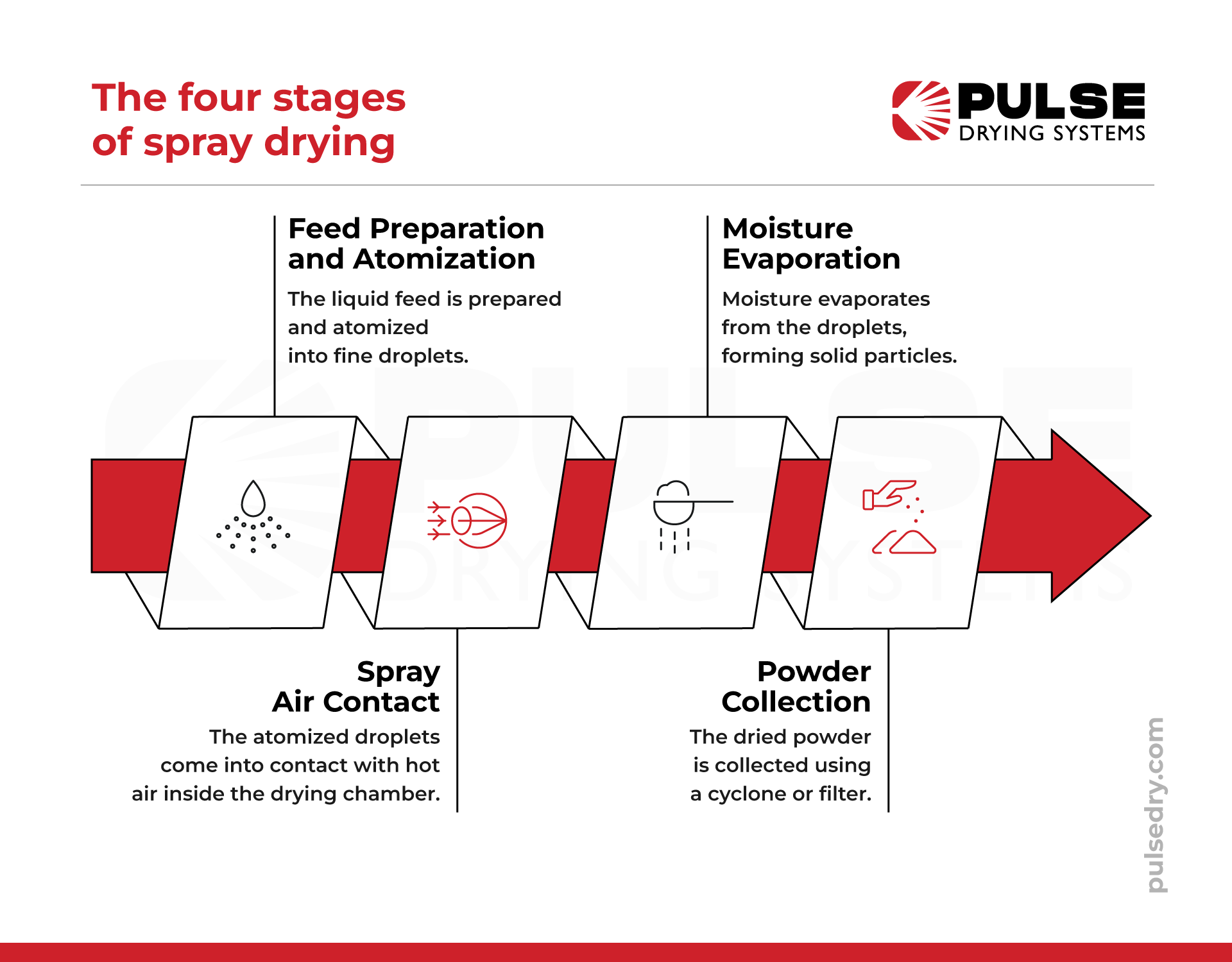
The conversion of a liquid feed into a stable, high-quality powder is a complex operation that relies on four primary spray drying stages. This methodology is essential for the functionality of modern Spray Dryers, allowing manufacturers to transform solutions, suspensions, and emulsions into free-flowing particulates in a single, rapid step encompassing these stages.
What is the spray drying principle and procedure?
The spray drying principle involves the transformation of a liquid feed into dried particulate form by exposing atomized droplets to a hot drying medium. This spray drying process is considered a one-step approach to powder manufacturing because it solidifies the material while simultaneously removing moisture.
The standard procedure begins with feed preparation in a tank, where the liquid is often concentrated or heated to optimize its viscosity. The liquid is then pumped to an atomizer at the top of a drying chamber, where it meets a stream of heated gas. As moisture evaporates, the solids precipitate to form a dry shell around each droplet. The dry powder is conveyed out of the drying chamber and is separated from the drying air and water vapor in a cyclone and/or a baghouse
What are the steps in the spray drying process?
The steps in the spray-drying process work together to ensure efficient dehydration while protecting the product’s structural and chemical integrity. Each step plays a specific role in determining the “drying history” and final morphology of the resulting particles.
- Atomization: The bulk liquid is broken into small droplets using pressure nozzles or advanced pulse-atomization spray-drying technology. This stage is critical because it creates a massive surface area for evaporation.
- Spray-Air Contact: Once atomized, the droplets interact with the hot drying air. In advanced systems, the use of pulse atomization techniques can increase heat and mass transfer rates by a factor of 2–3 compared to conventional atomization methods.
- Moisture Evaporation: Moisture removal happens quickly as the droplets reach their wet-bulb temperature. During this stage, a solid “skin” or crust forms on the surface of the droplet, eventually leading to a fully solidified particle as it moves through the chamber.
- Powder Collection: In the final step, the dried powder is separated from the moist exhaust air. This is typically achieved using a cyclone separator or a baghouse, which recovers the finished product for packaging.
What is the spray drying process flow?
The spray drying process flow diagram traces the material’s path from initial feed preparation through to final product recovery and classification. The flow integrates several critical components, including feed tanks, high-pressure pumps, air handling units with heaters, the main drying chamber, and recovery systems such as cyclones.
The configuration of the airflow is a major variable in this flow. In co-current designs, the spray and hot air travel in the same direction, maintaining a low product temperature as the air cools during the evaporation stage. Counter-current configurations move the air and droplets in opposite directions, potentially improving energy efficiency by maximizing the temperature difference, but require careful control to prevent thermal degradation of sensitive materials.
What are the critical parameters in each spray drying stage?
Establishing a consistent drying environment requires careful management of parameters like droplet size, feed concentration, and gas flow rates. These variables directly dictate particle morphology, residual moisture, and bulk density of the final powder.
Temperature control is perhaps the most vital parameter for maintaining uniform conditions. While conventional spray dryers typically operate at inlet temperatures between 150 and 230 °C, Pulse Drying Systems can operate within aninlet temperature range of 200–425 °C. The rapid drying provided by these systems creates strong evaporative cooling, protecting heat-sensitive proteins and bioactives from thermal damage even at these elevated temperatures.
System efficiency also scales with technology; conventional dryers generally achieve thermal efficiencies up to 40%, whereas Pulse systems reach superior efficiencies between 45% and 67%. By utilizing lower-than-usual outlet temperatures in the range of 70–105 °C, these systems ensure rapid, uniform drying that creates superior powders for foods, minerals, specialty chemicals, and nutraceuticals.
Conclusion
Understanding the stages of spray drying is essential for process optimization. Pulse Drying Systems offers spray dryers engineered for excellence at every stage, featuring our innovative Pulse Atomization system that ensures optimum powder characteristics.. Contact our team to learn how Pulse spray dryers can optimize each stage of your drying process for superior results.
The information in this article is provided for general educational purposes and to promote overall awareness. It is not intended as engineering, legal, or other professional advice, and should not be used in place of consultation with qualified professionals familiar with your specific application and conditions. This content should not be considered exhaustive.