Industrial manufacturers frequently turn to Spray Dryers to transform liquid feeds into stable, high-quality powders in a single step. However, achieving consistent results requires navigating a complex set of operational challenges.
Identifying potential spray drying problems is essential for organizations seeking to optimize their drying cycles and protect the integrity of sensitive formulations. While the process itself is an industry benchmark, traditional spray drying systems often face hurdles ranging from mechanical wear to significant product degradation, making troubleshooting a core component of production management.
What kinds of problems may occur during spray drying?
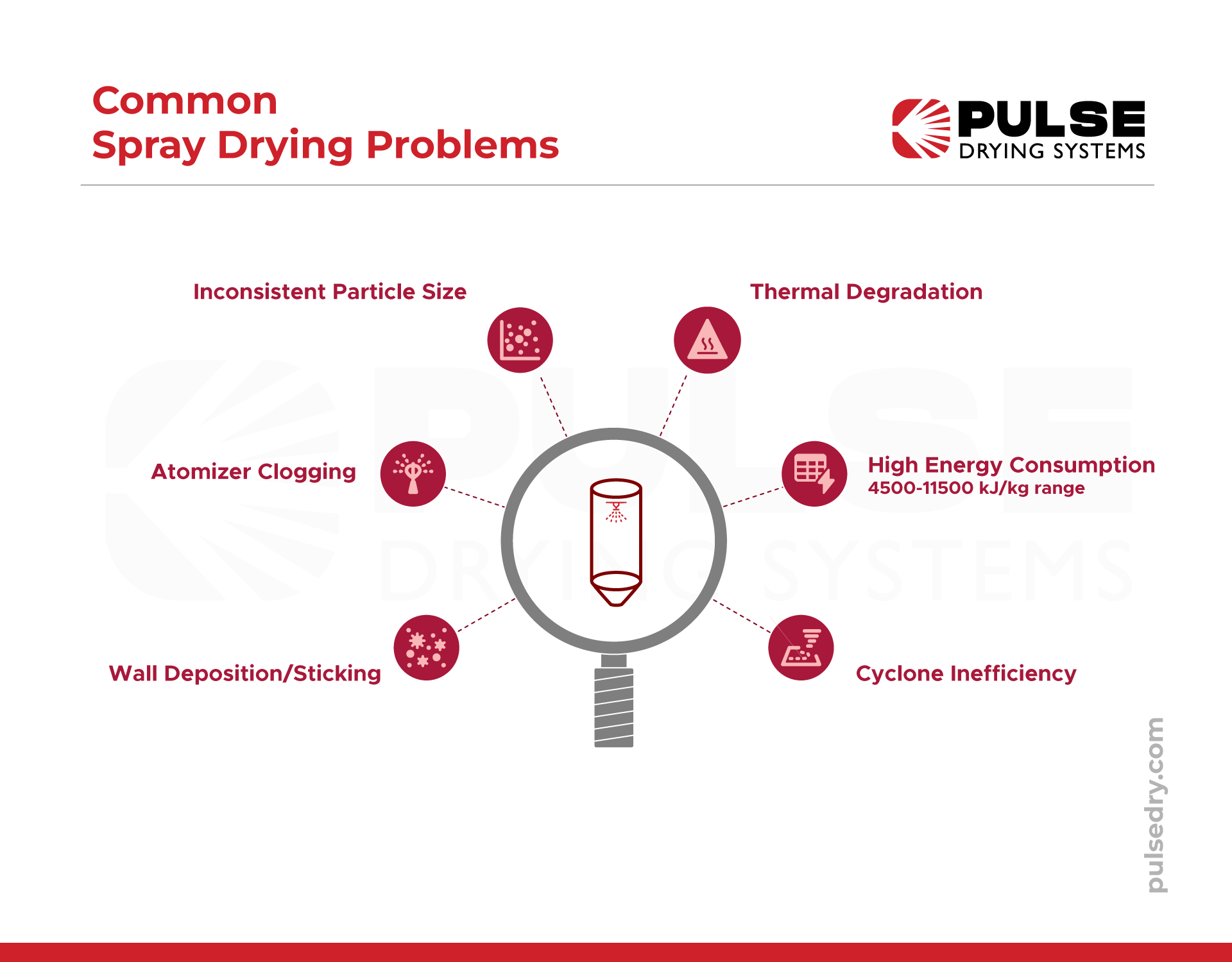
When operators evaluate the reliability of a system, they must consider what kinds of problems may occur during spray drying to prevent costly batch failures. One of the most pervasive operational issues is wall deposition and sticking, which leads to chamber fouling and reduced product yield. This occurs when particles fail to dry sufficiently before contacting the chamber surface, or when the material exceeds its “sticky point” during the falling rate period.
Beyond wall deposition, atomizer clogging and inconsistent particle size remain major concerns. In traditional nozzle or rotary disk systems, the dynamics of atomization change as parts wear over time, leading to non-uniform trajectories and varying drying histories for individual particles. Quality-related issues such as high residual moisture and thermal degradation are also common, particularly with heat-sensitive materials. For example, if residence time is too long or temperature is not precisely controlled, manufacturers risk denaturation of proteins or loss of bioactivity in vaccines.
What are the disadvantages of spray drying?
Thorough analysis reveals several inherent disadvantages of spray drying, starting with high initial capital investment and substantial energy consumption. Traditional industrial dryers often operate with low thermal efficiency, which can represent a major portion of total operating costs. Furthermore, high-viscosity feeds and extremely sticky products are difficult to process in standard dryers, often requiring excessive dilution that further increases energy requirements. Additionally, the massive surface area generated during atomization, while necessary for rapid drying, increases the risk of oxidation and the potential loss of volatile flavor compounds.
What are the most frequent problems with spray drying operations?
In daily use, spray drying operations are subject to frequent equipment-related problems, particularly regarding nozzle wear and cyclone separator inefficiency. Nozzles and rotary disks are subject to mechanical stress and abrasion. This wear necessitates regular unit downtime for component replacement and intensive chamber cleaning to remove built-up wall deposits.
Scale-up difficulties also exist. Moving from a pilot-scale dryer to a full production unit is rarely linear, as airflow patterns and heat transfer kinetics change at larger volumes. Managing the residence time of particles to ensure they reach the target moisture content without overheating requires precise engineering that traditional systems sometimes struggle to maintain. Given their cyclone or downstream filtration limitations, inefficiency in powder collection systems can reduce total yield, especially when dealing with smaller particle diameters.
 How to overcome spray drying limitations and problems?
To overcome traditional spray drying limitations, manufacturers are increasingly turning to advanced troubleshooting and preventive measures. Optimizing feed properties through homogenization and adjusting process parameters—such as the inlet and outlet temperature differential—can mitigate some issues. However, the most effective strategy involves adopting advanced technologies designed to address these fundamental flaws.
Advanced pulse atomization technology specifically addresses traditional spray drying limitations by using “gas dynamic” atomization rather than mechanical nozzles. Because there are no mechanical parts to wear out, the system provides more consistent atomization energy and a tighter particle size distribution.
Furthermore, pulse systems can handle higher-solids feeds, which “obviates the need to dilute the feed material to atomize it, yielding higher powder production rates and much lower processing costs per finished pound“. By utilizing high-velocity airstreams to intensify heat and mass transfer, these systems achieve superior particle control and provide a consistent drying environment that significantly reduces wall deposition and chamber fouling.
Tired of dealing with common spray drying problems? Pulse Drying Systems has engineered solutions to address the most challenging operational issues in spray drying. Our Pulse Atomization technology significantly reduces wall deposition, improves particle consistency, and enhances overall process efficiency. Contact our team today to discover how Pulse technology can solve your spray drying challenges and improve your production outcomes.
The information in this article is provided for general educational purposes and to promote overall awareness. It is not intended as engineering, legal, or other professional advice, and should not be used in place of consultation with qualified professionals familiar with your specific application and conditions. This content should not be considered exhaustive.