The pharmaceutical sector relies on precise moisture removal to ensure the safety and efficacy of therapeutic products. Choosing the most effective drying methods in the pharmaceutical industry is a vital function that directly influences the final form of active pharmaceutical ingredients (APIs) and excipients.
Spray dryers have become a key technology cornerstone for manufacturers seeking to produce uniform, high-quality powders with specific particle characteristics.
What is the importance of drying in the pharmaceutical industry?
The importance of drying in the pharmaceutical industry lies in its ability to extend product shelf life and preserve the chemical stability of volatile compounds. By removing excess moisture, manufacturers inhibit microbial growth and prevent enzymatic degradation that would otherwise compromise drug safety.
Successful control of the drying process in the pharmaceutical industry is also essential for maintaining bioavailability. Improper moisture levels in solid dosage forms, such as tablets or capsules, can lead to poor dissolution rates or physical instability during storage.
Precise moisture control ensures that powders remain flowable, vital for accurate dosing and downstream manufacturing.
What are the main drying methods?
Freeze drying, spray drying, and convective (thermal) drying are the primary techniques used to stabilize sensitive pharmaceutical ingredients.
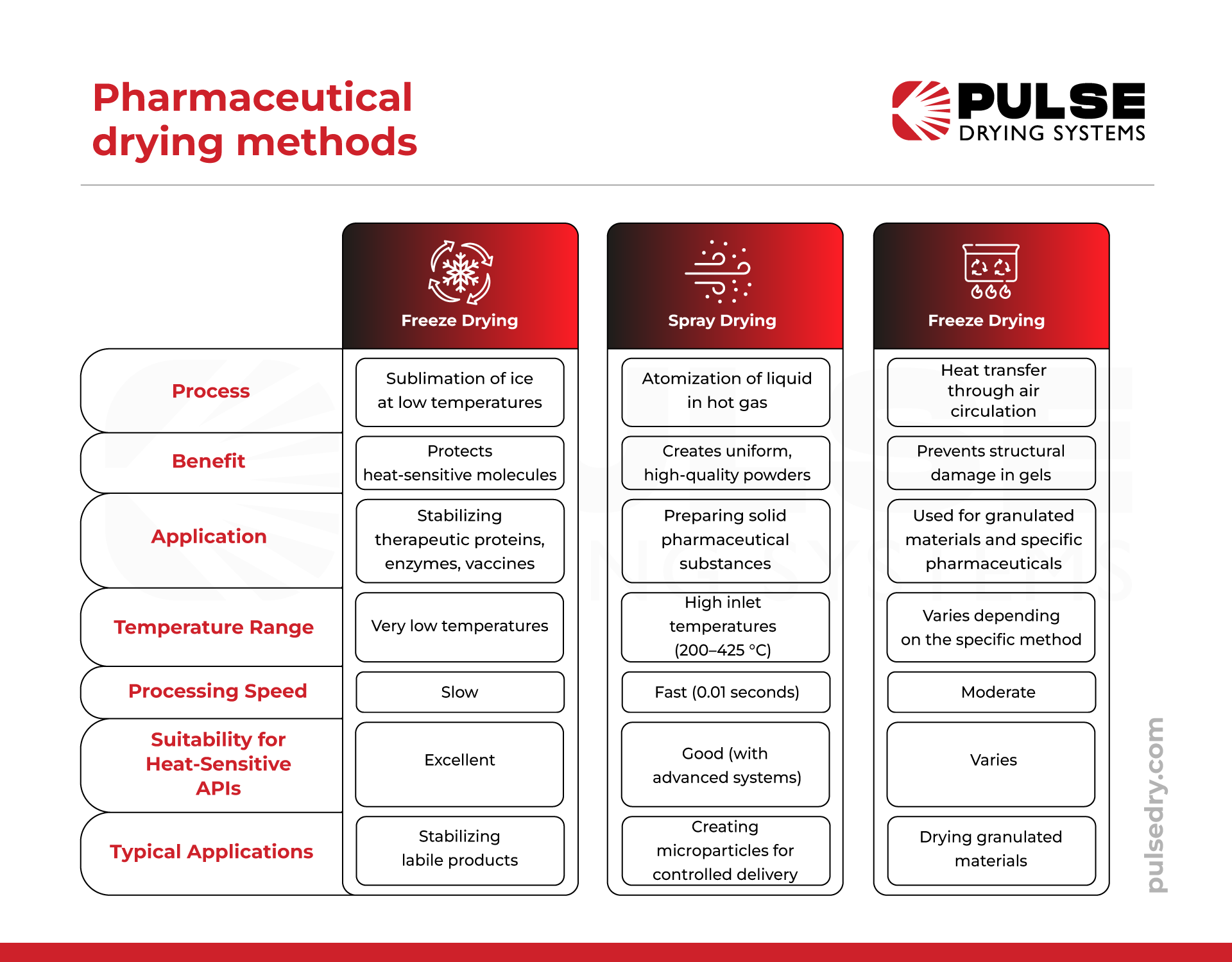
Freeze-Drying (Lyophilization) is often described as the standard methodology for stabilizing highly sensitive or “labile” products, such as therapeutic proteins, enzymes, and vaccines.
- Process: Involves freezing a solution and then creating a vacuum to sublimate the ice into vapor.
- Benefit: Because it operates at very low temperatures, it protects the complex molecular structure of drugs from thermal degradation.
Spray Drying is an attractive alternative to freeze-drying for preparing solid pharmaceutical substances.
- Process: Transforms a liquid feed into a dry powder in a single step by atomizing the liquid into droplets within a hot gas stream.
- Application: Increasingly used to create microparticles that encapsulate bio-active substances for controlled delivery.
Advanced Thermal and Convective Methods Thermal drying is a broad category, specifically referring to several “advanced” or “intensified” thermal processes used for pharmaceuticals:
- Convective Drying: Used when applied in an “educated way” to prevent structural damage in materials like gels.
- Fluidized Bed Drying: Used for granulated materials and specific pharmaceuticals like L-lysine.
- Pulse Atomization Spray Drying (PASD): An advanced thermal technology tested for pharmaceuticals and high-value bio-materials to achieve high efficiency with low protein denaturation.
What are the types of drying methods in the pharmaceutical industry?
The most common types of drying in the pharmaceutical industry include spray drying, freeze drying, and fluidized bed drying,. Each technique offers specific technical advantages depending on the required throughput and physical properties of the drug formulation.
Spray drying is widely recognized for its high volume and relatively low cost.. It is used to make fine, spherical particles ideal for inhalation therapies or direct compression tableting. A newer entry to the spray drying category is pulse atomization spray drying.
Fluidized bed dryers are frequently used for granulations and small particles, providing excellent heat transfer and a uniform moisture profile.
Freeze drying is preferred for materials that are extremely sensitive to oxygen or require a low-temperature environment to prevent degradation.
How to select the right drying method for pharmaceutical applications?
Selecting the right drying method requires a detailed evaluation of the product’s heat sensitivity, the desired particle size distribution, and overall throughput requirements. Regulatory compliance is also paramount, as the equipment must be easily cleanable and capable of maintaining a consistent drying environment.
For many modern drug applications, spray drying is preferred as a one-step approach to making powders. This technology is highly efficient for continuous manufacturing and offers precise particle engineering capabilities.
While conventional spray dryers typically operate with inlet temperatures between 150 and 230 °C, advanced systems from Pulse Drying Systems can utilize higher inlet temperatures ranging from 200–425 °C. These systems offer a turbulent atomization zone that creates robust evaporative cooling, which protects heat-sensitive formulations.
This process ensures that the active ingredients stay within a safe outlet temperature range of 70–105 °C. Consequently, these systems achieve thermal efficiency levels of 45% to 67%, which is meaningfully higher than the 29% to 40% efficiency seen in traditional spray drying designs.
In the table below, the third heading should be Fluid Bed Drying. In the processing speed box under Spray Drying it shoud say Fast (5-30 seconds)
 Conclusion
The importance of drying in pharmaceutical industry operations directly determines shelf life and bioavailability of therapeutic compounds. Selecting efficient methods of drying requires striking a balance between production efficiency and the molecular protection of heat-sensitive APIs.
Pulse Drying Systems specializes in advanced spray drying solutions that offer superior control, consistency, and compliance with pharmaceutical standards. Our Pulse Atomization technology provides precise particle engineering capabilities ideal for APIs, excipients, and specialized drug formulations. Contact our spray drying experts to evaluate which drying method best suits your specific pharmaceutical manufacturing needs.
The information in this article is provided for general educational purposes and to promote overall awareness. It is not intended as engineering, legal, or other professional advice, and should not be used in place of consultation with qualified professionals familiar with your specific application and conditions. This content should not be considered exhaustive.