Jim is the founder and owner of Pulse Combustion Systems. He established company headquarters in Payson, Arizona, and managed the development of the company’s pulse combustor and its intellectual property while growing the company organically. His current project is augmenting the company’s combustor technology with two new heat/atomization sources – a low-NOx duct burner, or an indirect gas-fired heater, which ensures zero nitrates in the pulse-dried powder. These new heat sources also give the company the capability to handle pharmaceutical products.
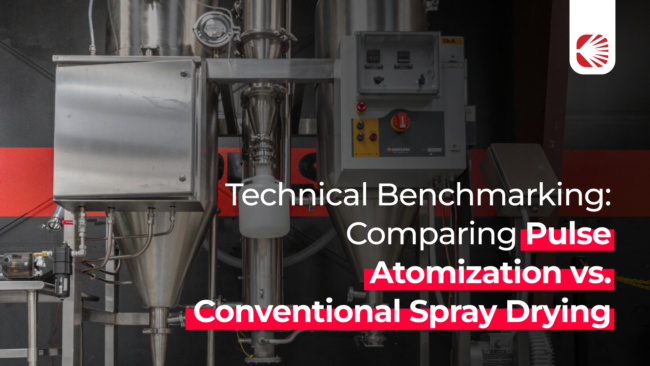
In industrial spray drying, the thermodynamic history of a particle—specifically the relationship between heat intensity and exposure duration—is a primary determinant of final product quality and bioactivity. While both Pulse Atomization Spray Drying (PASD) and most conventional spray dryers operate using co-current flow, their mechanical designs result in divergent residence times and thermal protection capabilities.
In industrial spray drying, achieving a tight and consistent particle size distribution (PSD) is often considered more of an art than a science. Traditional atomization methods, such as pressure nozzles and rotary disks, frequently struggle with “distribution drift” because their mechanical components are subject to constant wear and tear. As an orifice enlarges or a disk erodes, the energy delivered to the liquid feed fluctuates, leading to a wider range of particle sizes and, in some cases, undesirable bimodal distributions. Pulse Atomization Spray Drying (PASD) addresses this fundamental mechanical limitation by utilizing gas-dynamic force rather than restrictive mechanical orifices.
The selection of a drying technology requires a rigorous evaluation of how different atomization and heat transfer mechanisms affect the final powder and operational ROI. While conventional spray drying remains a standard for many commodity applications, Pulse Atomization Spray Drying (PASD) offers a distinct thermodynamic and mechanical profile.
When evaluating industrial drying options for high-value or heat-sensitive materials, three primary conventional technologies serve as the benchmarks for comparison against Pulse Atomization Spray Drying (PASD): pressure nozzle spray dryers, rotary atomizer spray dryers, and freeze dryers. Selecting the appropriate technology requires a technical assessment of atomization mechanics, residence time, and thermal efficiency.
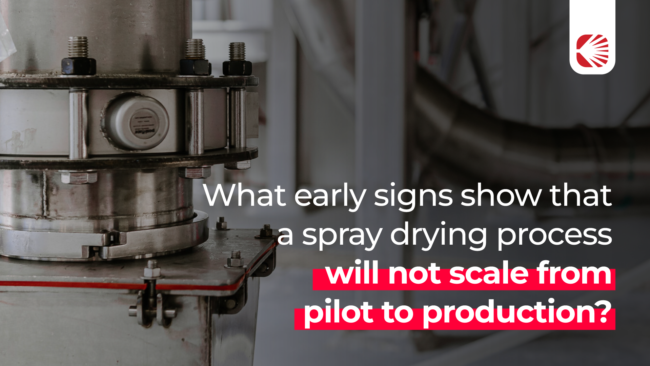
It is a story told in laboratories and R&D centers across the globe: a team spends months perfecting a formulation on a benchtop spray dryer. The powder is perfect, the yield is acceptable, and the stakeholders are ready to greenlight full production. But the moment that same material is fed into a commercial-scale tower, the process collapses. The powder comes out too wet, the particles are the wrong size, or the material simply sticks to the walls and scorches.
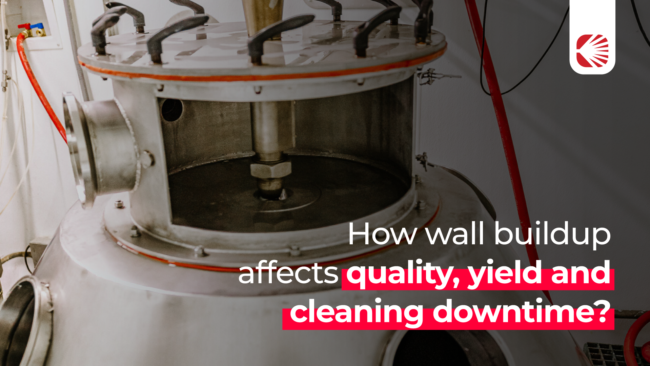
If you have ever opened your spray drying chamber at the end of a production run only to find a thick, scorched layer of material clinging to the stainless steel, you have witnessed one of the more expensive failures in process engineering.
One of the most persistent frustrations in spray drying is the “mystery” of the inconsistent batch. The quality control team confirms the liquid feed meets the specification, yet Batch A produces a perfect, free-flowing powder while Batch B is scorched, sticky, or off-color.
One of the most persistent frustrations in spray drying is the “mystery” of the inconsistent batch. The quality control team confirms the liquid feed meets the specification, yet Batch A produces a perfect, free-flowing powder while Batch B is scorched, sticky, or off-color.
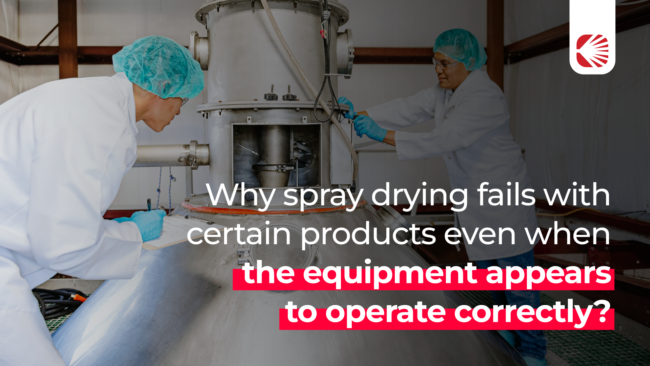
Even the most advanced technologies, like pulse atomization spray dryers, have “bad fit” scenarios. This article explores the three primary reasons spray drying fails even when the equipment is operating correctly, and how to determine whether the product is simply a bad fit for the technology.
Your name Your email Subject Your message (optional) We are pleased to announce that we have moved our offices and production facility from Payson, AZ to Mesa, AZ. We chose the new location to improve the customer experience and convenience. Mesa is only 15 miles from Phoenix Sky Harbor Airport (PHX) instead of the previous trek of 90…